Hermann von Helmholtz
Hermann Ludwig Ferdinand von Helmholtz (1821–1894) was a German physicist and physician known for his groundbreaking contributions across multiple scientific disciplines, particularly in hydrodynamic stability.
In physics, he formulated the conservation of energy and contributed to electrodynamics and thermodynamics.
Helmholtz also had a significant impact on philosophy, influencing neo-Kantianism with his ideas on perception, aesthetics, and the relationship between scientific laws and natural laws.
Early Life and Education
Hermann Ludwig Ferdinand von Helmholtz was born on August 31, 1821, in Potsdam, Prussia (now Germany).
His father, Ferdinand Helmholtz, was a respected headmaster at the local gymnasium and had studied classical philology and philosophy. Ferdinand was a close friend of the philosopher Immanuel Hermann Fichte, son of the renowned German philosopher Johann Gottlieb Fichte, a key figure in German idealism.
The intellectual environment of Helmholtz’s upbringing had a lasting impact on his intellectual development, shaping his future work in natural science, physiology, and philosophy.
From an early age, Helmholtz was immersed in discussions of philosophy and science, primarily influenced by the ideas of Johann Gottlieb Fichte and Immanuel Kant. His father’s philosophical leanings and the family’s connections fostered Helmholtz’s interest in the natural sciences.
Despite his early passion for scientific inquiry, Helmholtz’s father urged him to study medicine, which was a more practical and financially stable career at the time. Helmholtz heeded this advice and began studying medicine at the Friedrich-Wilhelm Institute in Berlin in 1838.
In 1842, Helmholtz earned his medical doctorate, after which he completed a one-year internship at the prestigious Charité hospital in Berlin. His medical education allowed him to gain financial stability, while also giving him the freedom to pursue his scientific passions. Throughout his career, Helmholtz would remain deeply committed to combining his medical knowledge with the principles of natural science and physics.

Image: Hermann von Helmholtz
Early Career and Academic Positions
Helmholtz’s academic journey began in 1848 when he was appointed a teacher of anatomy at the Academy of Arts in Berlin. Just a year later, in 1849, he became an associate professor of physiology at the University of Königsberg, marking the start of his distinguished academic career. During this time, Helmholtz demonstrated a remarkable ability to apply empirical methods to diverse fields of science, particularly in physiology.
By 1855, Helmholtz had accepted a full professorship in anatomy and physiology at the University of Bonn. However, he found the atmosphere at Bonn unsatisfactory and moved three years later to the University of Heidelberg, where he continued his work as a professor of physiology.
It was at Heidelberg where he conducted some of his most groundbreaking research on sensory perception, especially in the areas of vision and hearing. His academic and research career culminated in 1871 when he accepted the prestigious position of professor of physics at the Friedrich Wilhelm University in Berlin, where he would work until his death in 1894. This marked a significant shift in his focus from physiology to theoretical physics.
The Conservation of Energy and the First Law of Thermodynamics
One of Helmholtz’s most influential contributions to science came early in his career. In 1847, while still studying medicine, he published Über die Erhaltung der Kraft (On the Conservation of Force), which laid the groundwork for the principle of energy conservation, a fundamental concept in modern physics. In this seminal work, Helmholtz proposed that energy is conserved within a closed system, meaning that energy cannot be created or destroyed, only transformed from one form to another. This work was pivotal in establishing what would become known as the first law of thermodynamics.
Helmholtz’s interest in energy conservation was driven by his research on muscle metabolism. He sought to demonstrate that muscle movement does not result in the loss of energy, challenging the dominant views of Naturphilosophie and vitalism, which held that “vital forces” were required for biological functions. Helmholtz rejected this speculative tradition by showing that biological systems obeyed the same physical laws as non-living systems.
His work was informed by earlier studies in thermodynamics and mechanics by scientists such as Sadi Carnot, James Prescott Joule, and Benoît Paul Émile Clapeyron. By unifying concepts from mechanics, heat, light, electricity, and magnetism, Helmholtz proposed that these phenomena were all manifestations of a single entity: energy. This theory would later become the principle of energy conservation, which remains fundamental to physics and biology today.
Contributions to Physiology: Vision and Hearing
Beyond his contributions to physics, Helmholtz was a pioneering figure in sensory physiology, making significant advances in the understanding of human vision and hearing. His work in these areas was largely inspired by psychophysics, a field that explores the relationships between physical stimuli and human perceptions. Helmholtz’s experimental approach laid the foundation for modern sensory physiology and experimental psychology, influencing future scientists like Wilhelm Wundt.
Vision and the Ophthalmoscope
In 1851, Helmholtz revolutionized ophthalmology with his invention of the ophthalmoscope, an instrument that allowed physicians to examine the inside of the human eye. This breakthrough earned Helmholtz international recognition and was widely hailed as a medical and scientific marvel. The ophthalmoscope not only transformed the field of ophthalmology but also inspired Helmholtz’s deeper exploration of vision physiology.
Helmholtz’s most comprehensive work in this area was the Handbuch der Physiologischen Optik (Handbook of Physiological Optics), published in three volumes between 1856 and 1867. In this seminal text, Helmholtz addressed several key topics in vision science, including depth perception, color vision, and motion perception. His work on accommodation—the eye’s ability to change focus—remained unchallenged until the late 20th century.
One of Helmholtz’s most enduring contributions to the study of vision was his theory of “unconscious inference.” He proposed that perception is an automatic, unconscious process in which the brain interprets sensory input based on past experiences. This concept foreshadowed modern understandings of the brain’s role in perception and became a foundational idea in psychology.
Hearing and Sensations of Tone
In addition to his work on vision, Helmholtz made groundbreaking contributions to the study of human hearing. In 1863, he published Die Lehre von den Tonempfindungen (Sensations of Tone), a book that explored the physics of sound and its relationship to auditory perception. This text had a profound influence on both acoustics and music theory, becoming a reference for future researchers in speech and hearing sciences.
To analyze sound perception, Helmholtz invented the “Helmholtz resonator,” a device that could identify the various frequencies or pitches present in complex sounds. His research demonstrated how specific combinations of sound frequencies could mimic vowel sounds, laying the foundation for modern speech science.
Helmholtz’s work in acoustics also had an indirect impact on telecommunications. His studies on sound perception inspired Alexander Graham Bell, who, although misunderstanding Helmholtz’s research, believed that sound could be transmitted electrically. This mistaken belief spurred Bell’s development of the telephone, although Helmholtz himself had not proposed electrical transmission of sound.
Measuring Nerve Transmission Speed
Another of Helmholtz’s groundbreaking experiments took place while he was at the University of Königsberg in 1849. Using a dissected frog’s sciatic nerve and calf muscle, Helmholtz measured the speed at which nerve signals traveled. At the time, it was widely believed that nerve impulses moved instantaneously. However, Helmholtz’s experiments demonstrated that nerve transmission occurs at a measurable speed, which he calculated to be between 24.6 and 38.4 meters per second. This discovery fundamentally transformed the understanding of how the nervous system communicates with the body and provided new insights into the mechanisms of biological function.
Later Work: Electromagnetism and Philosophy of Science
In the late 1860s, Helmholtz turned his attention to electromagnetism, studying electrical oscillations and conducting experiments on electrical circuits. While his contributions to electromagnetism were not as significant as his earlier work, his student Heinrich Rudolf Hertz would later become famous for demonstrating the existence of electromagnetic waves, advancing the field that Helmholtz helped cultivate.
Helmholtz also made important contributions to the philosophy of science. He explored the relationship between the laws of perception and the laws of nature, proposing that sensory perception was not always a direct reflection of physical reality but rather a product of the brain’s interpretative processes. He challenged the notion that Euclidean geometry was the only valid framework for understanding space, introducing ideas about non-Euclidean geometry that would influence later developments in mathematics and physics.
Helmholtz’s philosophical work drew from Kantian ideas, particularly regarding the nature of perception and the role of the mind in shaping our experience of the world. These ideas were further developed within the neo-Kantianism movement of the late 19th century, which Helmholtz helped to inspire through his rejection of Naturphilosophie and his embrace of empirical science.
Honors and Legacy
Throughout his career, Hermann von Helmholtz received numerous honors and accolades in recognition of his extraordinary contributions to science. In 1873, he was elected as a member of the American Philosophical Society, and in 1881, he was awarded the Légion d’honneur at the rank of Commandeur. In 1883, Helmholtz was raised to the nobility by the German Emperor, earning the title “von Helmholtz.”
In 1871, Helmholtz moved to Berlin, where he continued his work in physics and electromagnetism. As a professor of physics at the Friedrich Wilhelm University in Berlin, he mentored several notable students, including Heinrich Hertz, who would go on to discover electromagnetic waves, and Wilhelm Wundt, a pioneer in experimental psychology.
Helmholtz’s legacy extends far beyond his immediate scientific contributions. His interdisciplinary approach to science helped bridge the gap between the physical sciences and the study of human perception, shaping modern research in fields as diverse as physiology, psychology, acoustics, and physics. The Helmholtz Association, Germany’s largest research organization, was named in his honor. In addition, several lunar and Martian craters, as well as an asteroid, bear his name, commemorating his contributions to science.
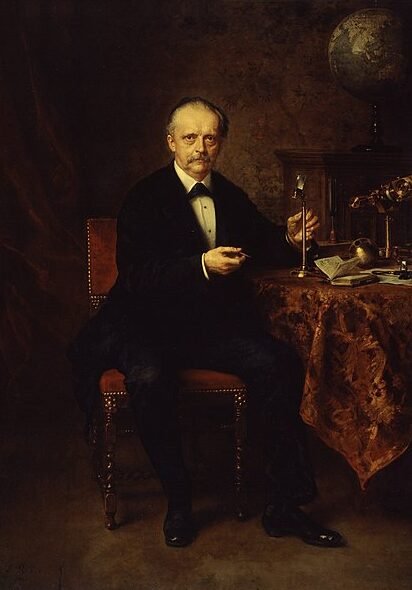
Helmholtz was elected to the American Philosophical Society in 1873, awarded the Légion d’honneur in 1881, and raised to the nobility by the German Emperor in 1883. Image: Helmholtz in 1881.
Major Works
Throughout his career, Helmholtz published a number of influential works that had a lasting impact on multiple scientific fields. Some of his most notable publications include:
- Über die Erhaltung der Kraft (On the Conservation of Force, 1847), which established the principle of energy conservation.
- Handbuch der Physiologischen Optik (Handbook of Physiological Optics, 1856–1867), a comprehensive study of vision, depth perception, and color theory.
- Die Lehre von den Tonempfindungen (Sensations of Tone, 1863), which explored the physics of sound and its relationship to auditory perception.
- Vorlesungen über die elektromagnetische Theorie des Lichts (Lectures on the Electromagnetic Theory of Light, 1897), which contributed to the study of electromagnetism.
Death and Legacy
Hermann von Helmholtz passed away on September 8, 1894, in Berlin, leaving behind a profound legacy in the scientific world. His work continues to influence contemporary research in physics, physiology, and psychology, and his contributions to the understanding of energy conservation, sensory perception, and electromagnetism remain foundational to modern science.
Frequently Asked Questions

When and where was Hermann von Helmholtz born?
Hermann von Helmholtz was born on August 31, 1821, in Potsdam, Germany.
What subjects influenced Helmholtz’s early intellectual development?
Helmholtz grew up in an intellectually stimulating environment, influenced by the philosophies of Johann Gottlieb Fichte and Immanuel Kant, as well as classical philology and philosophy, which his father had studied.
Helmholtz earned a medical doctorate from the Friedrich-Wilhelm Institute in 1842.
What was Helmholtz’s first academic appointment?
His first academic position was as an anatomy teacher at the Academy of Arts in Berlin in 1848.
What was Helmholtz’s major scientific achievement in 1847?
In 1847, Helmholtz published his treatise Über die Erhaltung der Kraft (On the Conservation of Force), which laid the groundwork for the principle of conservation of energy.
What was Helmholtz’s stance on Naturphilosophie and vitalism?
Helmholtz rejected Naturphilosophie and vitalism, which posited that “vital forces” were responsible for biological functions, and demonstrated that the same physical laws applied to both living and non-living systems.
What contributions did Helmholtz make to the study of human vision and hearing?
Helmholtz made pioneering contributions to the physiology of vision and hearing, studying how physical properties like light intensity and sound amplitude correspond to human perceptions of brightness and loudness.
What major publication did Helmholtz release on the physiology of vision?
Helmholtz published Handbuch der Physiologischen Optik (Handbook of Physiological Optics) in three volumes between 1856 and 1867, exploring depth perception, color vision, and motion perception.
What was the concept of “unconscious inference” introduced by Helmholtz?
“Unconscious inference” refers to the automatic and unconscious process by which the brain interprets sensory input, shaped by past experiences.
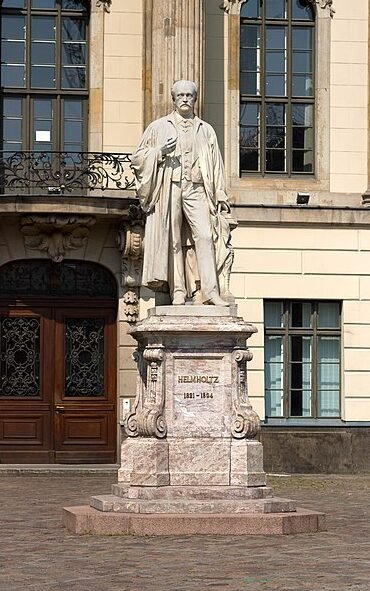
In 1849, Helmholtz measured the speed of nerve transmission at approximately 24.6 to 38.4 meters per second, transforming the understanding of how the nervous system communicates with the body. Image: Statue of Helmholtz.
What was Helmholtz’s contribution to the study of sound?
In 1863, Helmholtz published Sensations of Tone, which explored the physics of sound and its relationship to hearing, and invented the “Helmholtz resonator” to identify frequencies in complex sounds.
How did Helmholtz’s work influence Alexander Graham Bell?
Helmholtz’s research into sound perception indirectly inspired Alexander Graham Bell’s invention of the telephone, as Bell initially believed Helmholtz had transmitted sound electrically.
What area of study did Helmholtz pursue in the late 1860s?
In the late 1860s, Helmholtz focused on electromagnetism, studying electrical oscillations and circuits.
Who were some of Helmholtz’s notable students?
Heinrich Rudolf Hertz, who demonstrated electromagnetic waves, and Wilhelm Wundt, a founding figure in experimental psychology, were among Helmholtz’s notable students.
When did Hermann von Helmholtz pass away?
Helmholtz passed away on September 8, 1894.