History of Ferdinand Magellan and Major Facts about His Circumnavigation of the Globe
Ferdinand Magellan is a towering figure in the history of exploration, not so much for his scientific contributions but for the transformative voyages he undertook. For example, historian Laurence Bergreen hailed his journey as “the greatest sea voyage ever undertaken, and the most significant.”
Without a shred of doubt, Magellan’s expeditions paved the way for future explorations, and he was the first European to navigate the Strait of Magellan and reach the Philippine archipelago. This exploration greatly expanded the European geographical horizon and understanding of the world.
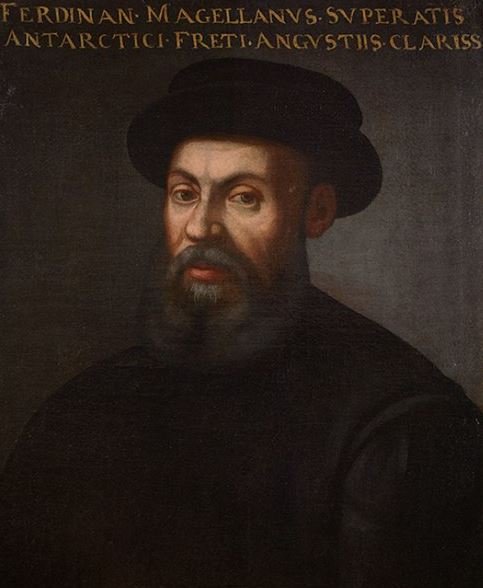
While Magellan’s life was fraught with danger and ended tragically, Magellan’s legacy as a pioneer explorer who expanded the geographical knowledge of his time continues to inspire adventurers and scholars alike.
In the article below, World History Edu delves into the life of the famed Portuguese explorer as well as some of the major details of his circumnavigation of the globe.
Family and Early Life
Born in Sabrosa, Portugal, to Rui de Magalhães and Alda de Masquita, Ferdinand Magellan came from a family of Portuguese nobility. His early years at the court of Queen Eleanor of Portugal exposed him to the intense rivalry between Portugal and Spain over maritime exploration. These formative years at court ignited his passion for adventure and exploration, setting the stage for his future endeavors on the high seas.
First Expedition: The Beginning of a Mariner’s Tale
Magellan’s maritime career began in earnest when he joined the Portuguese military fleet under Francisco de Almeida in 1505. His eight years of voyages across India and Africa were marked by fierce battles and significant Portuguese conquests in the Indian Ocean. These experiences not only toughened Magellan but also deepened his understanding of naval strategy and logistics, crucial for his later expeditions.
The Strait of Magellan: A Perilous Discovery
The peak of the spice trade in the 15th century saw Europe’s mariners desperate for faster routes to Asia’s riches. Magellan, now a seasoned navigator, proposed a bold plan to reach Asia by sailing west through the Atlantic.
After repeated rejections from the Portuguese crown, a frustrated Magellan renounced his Portuguese citizenship and moved to Spain. Supported by Charles V, Holy Roman Emperor, Magellan embarked on his most famous voyage in 1519 with five ships and 270 men.
In 1520, after a hazardous journey, he discovered the strait that now bears his name, providing a passage through South America to the Pacific Ocean, which he named for its deceptive calmness.
How Magellan’s journey was rocked by two mutinies
Magellan faced significant resistance from his mostly Spanish crew, who were uneasy about serving under a Portuguese captain. This discontent led to two mutinies before reaching the Pacific. The first mutiny was quickly quelled, but the second, in April 1520, was more serious, with three of the five ships revolting. Magellan, determined and resourceful, managed to suppress this rebellion, punishing conspirators and even marooning two plotters to prevent a third mutiny. Despite these efforts, discontent persisted, culminating in the desertion of the San Antonio, which abandoned the expedition and returned to Spain, further straining the already embattled voyage.
Mar Pacifico
After enduring severe storms and losing a ship near southern South America, Magellan navigated into the waters now known as the Strait of Magellan in November 1520. Upon entering a tranquil ocean, he named it “Mar Pacifico,” meaning “peaceful sea” in Portuguese, reflecting the stark contrast to the rough seas he had just experienced. Optimistic about a swift journey to the Spice Islands, Magellan and his strained fleet unexpectedly faced a grueling 98-day voyage across the Pacific Ocean before finally encountering any habitable land, testing the limits of human endurance and navigation skills.

Magellan named the tranquil waters he encountered “Mar Pacifico,” meaning “peaceful sea” in Portuguese. Image: Magellan’s Passage
How Magellan’s obsession with converting the locals led to his tragic Demise at the Battle of Mactan
While not officially part of his mission, Ferdinand Magellan zealously sought to convert the indigenous peoples he encountered to Christianity. This endeavor was most prominent in April 1521 in the Philippines, where he baptized King Humabon of Cebu and thousands of his followers.
The Portuguese explorer’s intense commitment to spreading Christianity led him to threaten death to local chieftains who resisted conversion, a tactic that ultimately contributed to his demise.
In a significant clash, after a king named Lapu-Lapu refused to convert, Magellan’s forces moved in and burned their village on the island of Mactan.
Persisting in his efforts, Magellan returned to Mactan with 49 men, demanding that Lapu-Lapu submit to his authority. The king’s steadfast refusal led to a fierce battle where Magellan was fatally injured, first struck by a spear, then killed by multiple blows from the islanders’ cutlasses and scimitars.
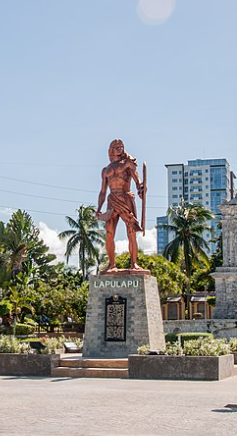
To solidify his relationship with King Humabon of Cebu, Magellan attacked Mactan on April 27, 1521, with a small force. In the ensuing battle, he was initially wounded by a metal-tipped rattan spear and ultimately killed by surrounding warriors using various weapons. Image: Mactan Shrine, the site of the Battle of Mactan, in present-day Lapu-lapu City. the Philipines
Personal Life
Magellan’s personal life saw him marrying Maria Caldera Beatriz Barbosa, through whom he had familial connections that helped him secure support for his voyages. The couple had two children who died young, adding personal tragedies to Magellan’s storied life.
Enrique – Ferdinand Magellan’s personal slave
One of the pivotal yet often overlooked figures in Magellan’s historic circumnavigation was his personal slave, Enrique of Malacca. Acquired by Magellan during a previous expedition to Malacca in 1511, Enrique was originally from the East Indies and proved indispensable as the expedition’s interpreter, especially in the Philippines, due to his fluency in a Malay dialect. This linguistic skill was critical as it facilitated communication with various local populations throughout the voyage.
The narrative of Enrique takes on additional historical significance due to his possible geographical origins. Many historians suggest that if Enrique was indeed from the region around the Philippines or Malacca, he might have completed a full circumnavigation of the globe by the time the expedition reached the Philippine archipelago. This scenario arises from the fact that Magellan’s route from Spain to the Philippines involved traveling westward, potentially returning Enrique to his native region.
If this interpretation holds true, then Enrique would preempt the European mariners as the first person to circumnavigate the globe, a remarkable feat particularly given his status as a slave. This aspect of the voyage highlights the complex interplay of exploration, colonization, and the personal stories of individuals like Enrique, who played crucial roles in these monumental historical events yet whose contributions are often overshadowed by their European counterparts.
Lasting Accomplishments and Legacy
Magellan’s voyages had profound implications. He demonstrated empirically that the world was larger than previously conceived and affirmed its spherical shape against prevalent flat Earth beliefs of earlier times.
His discovery of the western route to Southeast Asia opened new avenues for trade and exploration. Despite not surviving the journey, Magellan is credited with the first circumnavigation of the globe, which fundamentally altered European strategies in global exploration and colonization.
His arrival in the Philippines paved the way for subsequent Spanish influence and the spread of Christianity, intertwining his legacy with the cultural and historical fabric of the region.
Today, Ferdinand Magellan is remembered not only as a pivotal figure in the Age of Exploration but also as a symbol of the relentless pursuit of knowledge and the human spirit’s capacity to overcome daunting challenges.
Who were the 10 Most Influential Explorers of the Age of Discovery?
Major facts about Magellan’s Circumnavigation of the world
- Magellan’s Spanish expedition was culturally diverse, with a majority of Spanish and Portuguese sailors, but also included crew members from England, Greece, Sicily, France, Germany, and even North Africa.
- Ferdinand Magellan, originally Portuguese, received sponsorship from Spain’s King Charles I for his voyage, angering Portugal’s King Manuel I. In response, Manuel I tried to sabotage Magellan’s preparations, vandalized his family properties, and may have attempted assassination. After Magellan’s departure, an infuriated Manuel I dispatched Portuguese ships to capture and forcibly return him to Portugal.
- Magellan’s expedition sought a western route to the spice-rich Moluccas in Indonesia due to the Treaty of Tordesillas, which granted the practical eastern route to the Portuguese. This decree forced Spain to explore a new passage by navigating west around South America.

The Treaty of Tordesillas (1494) was a papal decree dividing newly discovered lands outside Europe between Spain and Portugal along a demarcated line. Image: Original page from the Tratado de Tordesilhas.
Frequently Asked Questions

Ferdinand Magellan’s endeavors not only reshaped the European outlook on the world but also demonstrated the profound impact of exploration on human understanding and global interaction. Image: Effigy of Ferdinand Magellan in the Monument of the Discoveries, in Lisbon, Portugal
Here are some questions and answers about Ferdinand Magellan and his expedition:
Why is Ferdinand Magellan significant in the history of maritime exploration?
Ferdinand Magellan was a Portuguese explorer renowned for orchestrating the first expedition to circumnavigate the globe. Although he did not complete the voyage himself, his journey significantly expanded European geographical knowledge and demonstrated the vastness of the Earth.
What early experiences influenced Magellan’s career in exploration?
Magellan’s early life at the court of Queen Leonora in Portugal exposed him to the exciting world of maritime exploration and the lucrative spice trade. His participation in military and exploration expeditions in India, Southeast Asia, and Africa provided him with essential nautical and combat experience.
Why was the spice trade important in the 15th century, and how did it compare to modern commodities?
In the 15th century, spices like cinnamon, clove, nutmeg, and black pepper were critical for food preservation, medicine, and culinary use, much like how oil is vital in today’s economy. Europe’s inability to cultivate these spices led to the intense competition to find a direct sea route to the Spice Islands.
What led Magellan to renounce his Portuguese nationality and move to Spain?
After King Manuel of Portugal repeatedly rejected his proposals for a westward expedition to the Spice Islands, Magellan renounced his Portuguese nationality and moved to Spain in 1517 to seek support for his venture, which he eventually received from King Charles I.
What were the major challenges faced by Magellan’s fleet during their voyage?
Magellan set sail from Spain on August 10, 1519, with a fleet of five ships: Trinidad, San Antonio, Conception, Victoria, and Santiago. This marked the beginning of a challenging three-year odyssey aimed at finding a westward sea route to the Spice Islands.
The expedition faced numerous challenges, including a mutiny which Magellan suppressed, the treacherous passage through the newly discovered Strait of Magellan, and the arduous crossing of the Pacific Ocean marked by hunger, scurvy, and extreme weather conditions.
How did Magellan’s journey end, and what was the outcome for his fleet?
Magellan was killed during the Battle of Mactan in the Philippines in April 1521. Despite his death, the expedition continued under new leadership, eventually reaching the Spice Islands and returning to Spain with just one ship, the Victoria, and 18 survivors of the original 270 crew members.

When the Victoria docked in Spain in September 1522, only 18 of the original 260 crew members had survived, underlining the monumental challenge of the first global circumnavigation initiated by Magellan. Image: The Victoria, Detail from a map by Ortelius, 1590.
Who were the “giants” Magellan encountered on his journey?
While anchored near what is now Argentina, Magellan’s crew encountered unusually tall individuals on the beaches of Patagonia, whom they described as “giants.”
After becoming friends with these giants, Magellan allegedly lured one aboard his ship and took him captive. This captive was baptized and given the name Paul, but unfortunately, he died during the arduous journey across the Pacific Ocean.
Many historians believe these so-called giants were actually members of the Tehuelche tribe, natives to southern Chile and Argentina, known for their above-average height. While the crew likely exaggerated their stature, the legend of the Patagonian giants persisted in European lore for many years.
What were the broader implications of Magellan’s circumnavigation of the globe?
Ferdinand Magellan’s journey provided concrete proof that the Earth could be circumnavigated by sea, which discredited the medieval view of the world’s geography and expanded European geographical horizons. It paved the way for future maritime exploration and the establishment of global trade routes.
As Magellan died in Mactan, can he actually be credited for circumnavigating the globe?
Ferdinand Magellan is frequently credited as the first person to circumnavigate the globe, but this claim doesn’t hold up to scrutiny. While he was instrumental in organizing and leading the expedition that aimed to find a western route to the Spice Islands, Magellan did not complete the journey. He successfully navigated through the now-named Strait of Magellan and across the vast Pacific Ocean, yet he met his demise in the Philippines, far short of the journey’s conclusion.
The accolade of completing the first circumnavigation rightfully belongs to Juan Sebastian Elcano, a Basque mariner. After Magellan’s death, leadership of the expedition fell to Elcano, who took command of the Victoria, the sole remaining ship of the original fleet. Under his guidance, the Victoria continued from the Spice Islands across the Indian Ocean, around the Cape of Good Hope, and northward along the west coast of Africa, finally returning to Spain in September 1522.
Elcano’s leadership and navigational skill were crucial in completing the circumnavigation, successfully bringing the ship and a diminished crew back to Spain. Thus, while Magellan planned and initiated this monumental voyage, it was Elcano who completed it, and he shares a significant portion of the historical credit for this achievement in maritime exploration.

Magellan was killed by a poison arrow at the Battle of Mactan on April 27, 1521. His death marked a poignant end to his direct leadership of his expedition, but his crew continued, eventually completing the first circumnavigation of the Earth. Image: A depiction of the Battle of Mactan in the Magellan shrine
How has Magellan’s legacy influenced contemporary views of global exploration?
Magellan’s legacy has highlighted the potential of westward sea travel and underscored the transformative power of human curiosity and ambition. His journey demonstrated the relentless human pursuit of knowledge and the desire to explore the unknown, fundamentally changing European strategic interests and approaches to global exploration.
Did you know…?
- During his time in the Philippines, Ferdinand Magellan successfully converted over 2,000 locals, including King Rajah Humabon of Cebu, to Christianity.
- Among the few lucky people to make it back to Seville, Spain with the Victoria was Antonio Pigafetta, an Italian scholar and explorer. Pigafetta kept a detailed journal of the voyage. His accounts provide invaluable insights into the early interactions with the diverse cultures and lands encountered during the expedition, serving as a crucial record for future generations.
- In the Philippines, Magellan is often remembered more as a tyrant than a hero, and the Battle of Mactan is vividly reenacted every April 27, with a prominent Filipino actor portraying the defiant Lapu-Lapu, celebrating his resistance against foreign domination.
- The difficulty in Ferdinand Magellan’s circumnavigation of the globe at the time was further underscored by the fact that it took almost six decades before it was repeated. In 1577, English navigator Sir Francis Drake embarked on the second circumnavigation, following a route similar to Magellan’s. Much like Magellan’s fleet, Drake’s voyage also endured severe hardships, culminating in only his flagship, the Golden Hind, successfully returning to England in 1580.





