History of the Circus Maximus
The Circus Maximus, Latin for “largest circus” (Italian: Circo Massimo), stands as a remarkable symbol of Ancient Rome’s architectural, cultural, and societal achievements. Situated in the valley between the Aventine and Palatine Hills, this chariot-racing stadium and entertainment venue remains an enduring testament to Roman ingenuity and grandeur.
Historical Overview
The Circus Maximus was the first and largest stadium of ancient Rome and its Empire. At its peak, the structure measured around 620 meters in length and 117 meters in width, accommodating over 145,000 spectators. This made it not only a centerpiece of Roman life but also the model for circuses throughout the Roman Empire. Although now a public park, its influence and historical significance endure.
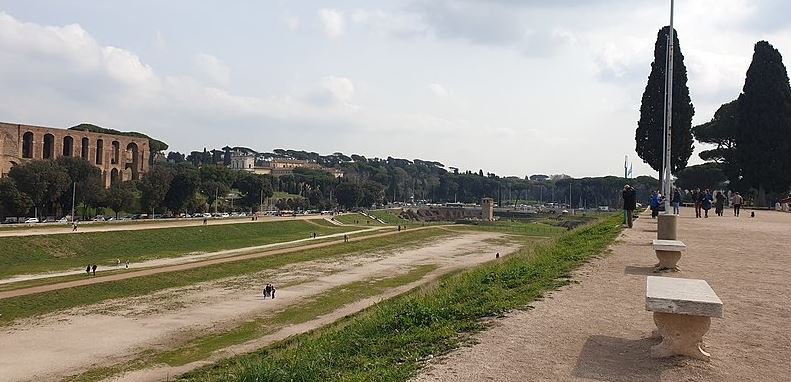
A 2023 photo of the Circus Maximus.
Events and Uses of the Circus Maximus
Ludi: The Public Games
The Circus Maximus served as the grand stage for ludi, public games closely tied to Roman religious festivals. These events were sponsored either by prominent Romans or the Roman state for the enjoyment of the populus Romanus and the appeasement of the gods. The origins of these games trace back to the late Regal era, with Tarquin the Proud’s vow to Jupiter after his victory over Pometia.
Ludi encompassed a wide array of activities, including:
- Chariot and horse racing
- Athletic competitions
- Theatrical performances
- Beast-hunts (venationes)
- Public executions
- Religious ceremonies and processions
The games often began with a pompa circensis, a grand procession akin to a triumphal parade that showcased participants and emphasized the games’ religious importance.
Evolution of the Games
During the Roman Republic, ludi were organized by aediles, whose ability to host grand spectacles often determined their political futures. Over time, the games expanded in duration and splendor. By the late Republic, ludi were held on 57 days annually. Under the Empire, this increased to 135 days per year, reflecting the growing demand for public entertainment.
The Circus Maximus was an ancient Roman chariot-racing stadium and mass entertainment venue located in Rome, Italy, between the Aventine and Palatine Hills.
Even as specialized venues like the Colosseum and Stadium of Domitian emerged, the Circus Maximus remained unrivaled for large-scale events. Notably, it hosted religious processions, long-distance foot races, and grand venationes, such as Emperor Probus’ 3rd-century spectacle involving a forest-like stage.
Topography and Construction
Regal Era Origins
The Circus Maximus occupied the Valley of Murcia, a fertile but flood-prone area between the Palatine and Aventine Hills. Early races likely took place in a rudimentary track surrounded by agricultural land. Initial infrastructure included turning posts (metae) and spectator seating made of wood, introduced by Lucius Tarquinius Priscus.
Over time, wooden stands expanded, accommodating Rome’s social hierarchy:
- Patricians and equites received shaded, elevated seating.
- Plebeians were seated in separate areas, possibly on the Aventine side.
Drainage improvements, including canals, mitigated the valley’s flood risks, but early structures were prone to decay and required frequent rebuilding.

The ruins of the Circus Maximus as seen in 1983.
Republican Era Developments
During the Republic, permanent seating and starting gates (carceres) were introduced. By 328 BC, brightly painted wooden gates were installed, designed to release up to 12 chariots simultaneously. Lap counters in the form of eggs and, later, bronze dolphins added an element of spectacle and precision to the races.
Julius Caesar significantly upgraded the Circus in the 1st century BC, extending seating tiers and introducing a canal to protect spectators. By then, the Circus could hold around 145,000 people, although some ancient estimates claim numbers as high as 250,000.
Imperial Era Enhancements
Augustus’ Contributions
Emperor Augustus added two monumental features:
- A pulvinar, a raised shrine where he and the gods could be venerated during games.
- An obelisk, brought from Heliopolis, symbolizing his victories and Rome’s dominance.
These additions elevated the Circus’ prestige and tied it to Imperial propaganda.

Caesar Augustus was the first emperor of the Roman Empire
Trajan’s Reconstruction
Following fires and structural decay, Emperor Trajan rebuilt the Circus in stone, enhancing its durability and grandeur. Under his reign, seating capacity increased, and a new pulvinar emphasized the emperor’s role as a central figure in Roman society.
Subsequent emperors, including Caracalla and Diocletian, made further modifications, often in response to disasters such as collapses and fires. By this period, the Circus Maximus had reached its definitive form.
READ MORE: 10 Greatest Roman Emperors and Their Achievements
Religious Significance
The Circus Maximus was deeply intertwined with Roman religion. Several deities were honored through temples and rituals at or near the site:
- Murcia, a goddess associated with Venus and fertility, was venerated at the southeastern turn.
- Consus, a god of grain storage, had a shrine incorporated into the track’s turning post.
- Hercules, whose Ara Maxima predated Rome, guarded the starting gates.
The Consualia festival, celebrating Consus, and the Cerealia, honoring Ceres, were among the prominent religious events held at the Circus. The latter featured unique traditions, such as releasing flaming foxes into the arena.
Sun and moon cults also played a significant role. The Sun-god’s obelisk towered over the central barrier, symbolizing cosmic order and victory. These associations reinforced the Circus’ importance as a sacred and social hub.
Decline and Legacy
By the 6th century, the Circus Maximus had fallen out of favor as Christianity gained prominence. The last recorded events include a beast-hunt in 523 AD and chariot races held by Totila in 549 AD. Over subsequent centuries, the site deteriorated:
- Flooding buried the lower levels under silt and debris.
- Structures were dismantled for building materials during the Renaissance.
- By the 16th century, the area was repurposed for agriculture.
Excavations in the 19th and 20th centuries revealed portions of the seating, central barrier, and other features. Today, the site functions as a public park, hosting concerts, celebrations, and cultural events. Notably, it served as the venue for Italy’s 2006 World Cup victory celebrations.
Questions and Answers
What events were held at the Circus Maximus?
The Circus hosted ludi (public games) tied to religious festivals, which included chariot races, processions, athletics, theatrical performances, gladiatorial combat, beast hunts (venationes), and even public executions. It was also a venue for large-scale religious processions and celebrations.
What role did the Circus Maximus play in Roman culture?
The Circus Maximus was a focal point of Roman entertainment and religious life. It showcased the grandeur of Rome, emphasized civic unity, and allowed politicians and emperors to gain favor through the sponsorship of elaborate games.
How was the Circus Maximus constructed?
Initially a simple track with wooden seating, it was later expanded and developed with permanent stone structures under Julius Caesar, Augustus, and Trajan. The track included a central barrier (spina) with decorative obelisks, lap counters, and shrines. The seating tiers accommodated senators, equestrians, commoners, and non-citizens.
What was its religious significance?
The Circus incorporated shrines and altars to gods like Consus, Murcia, Ceres, and the Sun god. Religious festivals such as the Consualia and Cerealia were held there, often featuring rituals tied to Roman mythology and agriculture.
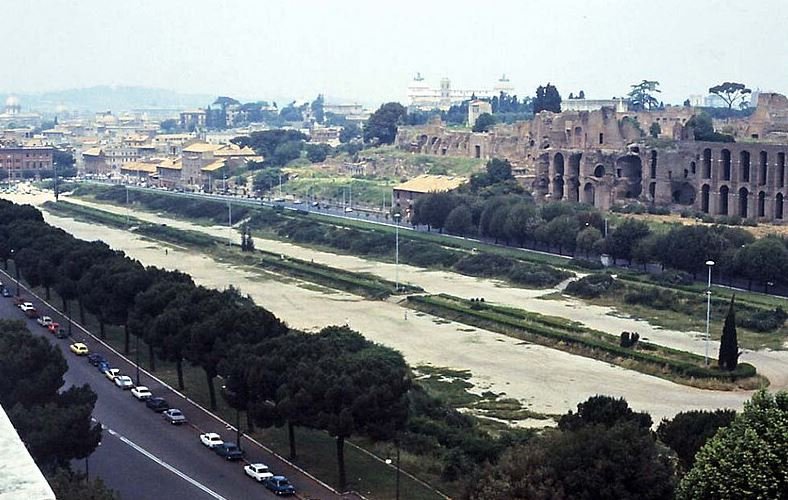
A 1978 photograph of the Circus Maximus.
When and why did the Circus Maximus decline?
With the rise of Christianity as the Roman Empire’s official religion, the pagan games lost favor. The last known games were held in 549 AD by Totila. Over time, the site fell into disuse, flooding, and decay.
What is the status of the Circus Maximus today?
The site is now a public park in Rome, often used for concerts, events, and celebrations. Excavations have uncovered portions of its structure, but much of the original site remains buried.





