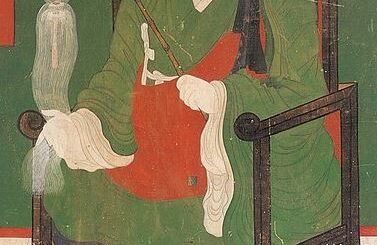
Buddhism in Korea
Buddhism, which entered Korea from China via the Silk Road, has deeply influenced Korean culture, history, and society for over 1,600 years. Although it underwent periods of growth and decline, it remains a major spiritual and cultural force in the country.
In the article below, World History Edu provides an in-depth understanding of the evolution, practices, and contemporary relevance of Buddhism in Korea.
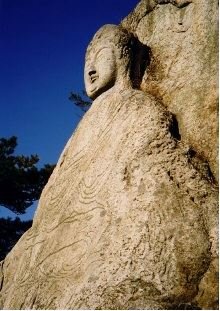
A 7th-century stone Buddha statue near Gyeongju, South Korea.
Introduction of Buddhism to Korea
Buddhism first arrived in Korea during the Three Kingdoms period through interactions with China.
Scholars generally state that Buddhism came to Korea via the northern route, where monks and scholars traveling along the Silk Road brought Buddhist texts and practices from India and Central Asia to China and subsequently to Korea.
According to historical records, Buddhism was officially introduced to Goguryeo in 372 CE when King Sosurim invited the monk Sundo from the Former Qin dynasty in China. Baekje, another of the Three Kingdoms, adopted Buddhism around 384 CE through the efforts of the Indian monk Marananta.
In Silla, Buddhism was introduced in 527 CE but faced strong resistance initially. However, during the reign of King Jinheung (540–576 CE), Silla fully embraced Buddhism, leading to the establishment of numerous temples and monastic communities.
It must also be noted that the adoption of Buddhism was not merely a religious choice but a political and cultural decision.
Flourishing of Buddhism During the Unified Silla Period
The Unified Silla period (668–935 CE) witnessed the golden age of Korean Buddhism. Venerable Jiho highlights that during this period, Buddhist thought, art, and architecture reached their zenith. Temples such as Bulguksa and Seokguram Grotto were constructed, reflecting advanced engineering and artistic skill. Bulguksa, in particular, embodies the idea of a spiritual utopia on earth, with its layout symbolizing the Buddhist cosmology.
Buddhism also played a pivotal role in the development of education and scholarship. The Hwaeom (Huayan) school of Buddhism, represented by the great monk Uisang (625–702 CE), gained prominence during this period. Uisang’s interpretation of Huayan philosophy emphasized the interpenetration of all phenomena, a concept that resonated deeply with Korean thinkers.
The Yogacara school (Beopsang in Korean), introduced by the monk Wonhyo (617–686 CE), gained wide acceptance due to its emphasis on the mind as the source of all phenomena.
Wonhyo’s contribution extended beyond philosophy. He was a prolific writer who authored numerous commentaries and texts, including the Awakening of Faith in the Mahayana. His efforts helped propagate Buddhism not just as a religion of the elite but as a belief system that touched the lives of ordinary people.
Decline During the Goryeo Dynasty and Suppression Under Joseon
The Goryeo dynasty (918–1392 CE) initially continued the promotion of Buddhism, but the relationship between the state and Buddhism became more complex over time.
The early Goryeo rulers, who were devout Buddhists, promoted the construction of grand temples and the printing of Buddhist texts, such as the Tripitaka Koreana, a remarkable collection of over 80,000 wooden printing blocks preserved to this day at Haeinsa Temple.
However, as Buddhism gained wealth and political influence, it attracted criticism from Confucian scholars who viewed it as corrupt and detrimental to governance. By the late Goryeo period, Buddhist institutions were seen as centers of power and privilege, leading to widespread calls for reform.
The Joseon dynasty (1392–1897 CE) ushered in an era of Neo-Confucianism, during which Buddhism was marginalized and suppressed. The founders of the Joseon dynasty sought to establish a Confucian social order and regarded Buddhism as a threat to their vision.
Despite these challenges, Buddhism survived in the mountainous regions of Korea, where monks preserved and transmitted the teachings. The Seon (Zen) tradition, emphasizing meditation and direct realization, became the dominant school during this period. Leading figures such as Seosan (1520–1604 CE) played a crucial role in keeping Buddhist teachings alive.
The Revival of Buddhism in Modern Korea
The decline of Buddhism persisted until the end of the Joseon dynasty, but the 20th century saw a resurgence of interest in Buddhism, coinciding with Korea’s struggle for independence from Japanese colonial rule (1910–1945). During this period, many Korean Buddhists viewed their faith as a means of preserving national identity and resisting cultural assimilation.
With the establishment of the Republic of Korea in 1948, efforts to restore Buddhist institutions gained momentum. The Jogye Order, the largest Buddhist order in Korea today, was reestablished as the guardian of Korean Seon Buddhism. The Jogye Order played a significant role in revitalizing Buddhism and promoting its relevance in contemporary Korean society.
The history and evolution of Buddhism in Korea illustrate a remarkable journey of resilience, adaptation, and cultural enrichment.
Practices and Rituals in Korean Buddhism
Korean Buddhism encompasses a wide range of practices, from meditation and chanting to rituals that honor ancestors and protect the living. Some scholars see meditation (Seon) as the core of Korean Buddhist practice.
In addition to meditation, heavy importance is also placed on chanting sutras, offering prayers, and performing rituals. These rituals serve as a bridge between the living and the deceased. This in turn fosters a sense of continuity and respect for ancestors.
Buddhist monks and lay practitioners also engage in intensive retreats, known as “Gyeolje,” where they practice meditation for extended periods, often lasting 90 days. Such retreats reflect the deep-rooted monastic discipline that characterizes Korean Buddhism.
Influence on Korean Art, Culture, and Ethics
Buddhism has left an indelible mark on Korean art, architecture, and cultural values. Buddhist art flourished during the Silla and Goryeo periods, resulting in masterpieces such as gilt-bronze statues, celadon ceramics, and elaborate pagodas.
Temples such as Bulguksa and Haeinsa not only serve as places of worship but also as repositories of Korea’s cultural heritage. The Seokguram Grotto, with its serene image of the Buddha, reflects the synthesis of Buddhist philosophy and artistic mastery.
Buddhism’s ethical teachings, particularly the emphasis on compassion, mindfulness, and respect for all living beings, continue to shape Korean society. Venerable Jiho points out that the concept of Gongyang (almsgiving) and the practice of Jangseung (wooden totems believed to protect villages) illustrate the integration of Buddhist values into everyday life.
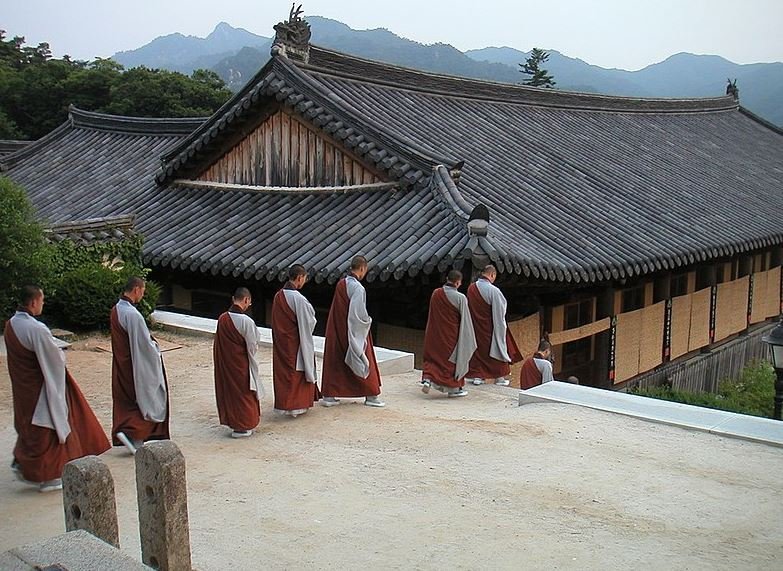
Buddhist Monks at Haeinsa in South Korea
Challenges and Adaptations in the Modern Era
Despite its rich heritage, Korean Buddhism faces significant challenges in the modern era. Declining monastic enrollment, secularization, and the influence of Western ideologies are some of the factors that contributed to the diminishing role of Buddhism in contemporary Korean society.
To address these challenges, Korean Buddhist leaders have embraced new approaches, including digital outreach, educational programs, and social engagement.
The Role of Buddhism in Promoting Social Harmony
In recent years, Korean Buddhism has also played a significant role in promoting social harmony, environmental sustainability, and humanitarian efforts. Buddhist organizations have been active in addressing social issues, including poverty, education, and disaster relief.
Also, the principle of interdependence, central to Buddhist philosophy, underpins many of these efforts.
Korean Buddhism is not monolithic; it encompasses a variety of movements and schools that reflect diverse interpretations and approaches. The Jogye Order remains the most influential, but other traditions, such as the Taego Order and the Won Buddhism movement, have also gained followers.
Frequently asked questions
How did Buddhism first spread to Korea, and what role did Chinese culture play in its introduction?
Buddhism arrived in Korea during the 4th century CE, entering through the Three Kingdoms — Goguryeo, Baekje, and Silla. At that time, Korea consisted of various kingdoms and states that had developed advanced political and economic systems. The collapse of the Han dynasty in China led to the spread of Chinese culture, including governance, philosophy, writing, and religion, to neighboring regions such as Korea.
Buddhism was part of this cultural package and played a role in modernizing Korean states by aligning them with the sophisticated culture of the time. Diplomatic ties facilitated this transmission, with Buddhist missionaries arriving in Goguryeo from northern China and in Baekje from southern China. Silla adopted Buddhism later, likely introduced by monks from Goguryeo.
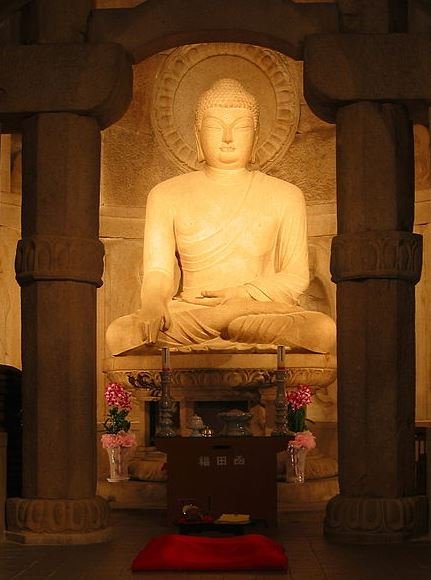
A statue of Gautama Buddha in Gyeongju, South Korea.
How did Korean monks contribute to the growth and spread of Buddhism in East Asia?
From the mid-6th century CE, Korean monks traveled to China and India to gain deeper knowledge of Buddhism, bringing back sacred texts, artistic styles, and new branches of the religion.
Korean monks played a critical role in this cultural exchange, with many visiting key monasteries in China and making pilgrimages to sacred sites in India. By the 6th century CE, Korean monks had begun traveling to India, with records indicating that over 15% of East Asian monks in India at the time came from Silla. These monks contributed to the spread of Buddhism to Japan, with Goguryeo and Baekje sending monks, artisans, and scholars to the Japanese court.
When and how did Seon (Zen) Buddhism emerge in Korea?
Seon Buddhism, known as Zen in Japan, has its origins in the Chan tradition of China. Bodhidharma, an Indian monk, introduced the Chan tradition to China in the 6th century. The first Korean monk to study the Chan tradition in Tang China was Beomnang in the mid-7th century.
Over the following centuries, numerous Korean monks traveled to study under renowned Chan masters, bringing these teachings back to Korea.
By the end of the Silla period in the 10th century CE, nine schools of Seon had been established, collectively known as the “Nine Mountains” (Gu-san). These schools followed the meditative traditions of Chan Buddhism and became the predominant form of monastic practice in Korea.
During the Goryeo period (918–1392 CE), Seon Buddhism incorporated both study and meditation, a practice that continues in contemporary Korean Buddhism.

What impact did Buddhism have on Korean art, culture, and ethics?
Buddhism significantly influenced Korea’s art, architecture, and societal values. Temples such as Bulguksa and Seokguram Grotto showcase a blend of Buddhist philosophy and artistic mastery.
The ethical teachings of Buddhism, which emphasize compassion, respect for life, and mindfulness, permeated Korean society. This blending of Confucian and Buddhist values created a unique cultural milieu where governance and ethics coexisted with spiritual concerns. The artistic and cultural legacy of Buddhism in Korea remains evident in the preservation of temples and monasteries, which serve as repositories of Korea’s artistic heritage.
Why did Buddhism decline during the Joseon dynasty, and what factors led to its suppression?
The Joseon dynasty (1392–1910 CE) witnessed the marginalization of Buddhism in favor of Neo-Confucianism. The rulers of the Joseon dynasty sought to establish a Confucian model of governance and viewed Buddhism as a threat to this vision. As a result, Buddhist monasteries were dissolved, monks were relegated to remote mountain temples, and Buddhist clerics were classified alongside marginalized groups such as butchers and slaves.
What factors contributed to the revival of Buddhism in Korea during the modern era?
Buddhism experienced a revival in the late 19th and early 20th centuries as the power of the Joseon state declined. Young Confucian scholars began questioning the intellectual and moral foundations of the state, leading to a reform movement aimed at purifying Buddhist monastic practice.
Protestant Christianity also entered Korea during this period, providing a competitive stimulus for Buddhism to modernize and engage more actively with the laity. Protestant influence encouraged the formation of Buddhist lay groups, publications, and outreach efforts.
Additionally, Japan’s annexation of Korea in 1910 led the colonial government to support Buddhism as a counterbalance to Protestant Christianity. This period of renewed support and reform led to vibrant monastic communities and the preservation of cultural treasures such as the Tripitaka Koreana at Haeinsa Temple.

Buddha statues in a Buddhist temple in South Korea.
What is the legacy of Buddhism in modern Korea?
The legacy of Buddhism in Korea extends beyond religious practice, with its influence reflected in Korea’s artistic, cultural, and ethical traditions.
While pre-modern Buddhist influence on contemporary Korean society is minimal, its artistic contributions remain profound.
Temples and monasteries continue to serve as repositories of Korea’s artistic heritage, and national museums display a wealth of Buddhist religious art. The Tripitaka Koreana at Haeinsa Temple is a testament to Korea’s dedication to preserving Buddhist knowledge.
In the 20th and 21st centuries, Korean Buddhism has adapted to modern challenges by engaging with contemporary society, promoting digital outreach, and addressing environmental concerns.