History of the U.S. Capitol Rotunda
The U.S. Capitol Rotunda, located below the Capitol dome, is considered the “symbolic and physical heart” of the Capitol, connecting the House of Representatives, Senate chambers, and historical spaces like the National Statuary Hall.
Summary
The United States Capitol Rotunda, located beneath the Capitol dome, serves as the “symbolic and physical heart” of the U.S. Capitol. Constructed between 1818 and 1824, the rotunda is a grand architectural space that connects the House of Representatives to the south and the Senate chambers to the north. Nearby, the semi-circular National Statuary Hall and the Old Senate Chamber provide additional historical context. Thousands of visitors daily experience the rotunda, which measures 96 feet (29 m) in diameter and rises 180 feet (54.94 m) to the dome’s canopy. Its use extends beyond a historical showcase, serving ceremonial purposes such as state funerals and special events authorized by Congress.

“Frieze of American History”, artwork by Italian painter Constantino Brumidi at the Capitol rotunda.
Design and Construction
Dr. William Thornton first proposed a central rotunda in his 1793 design for the Capitol. However, construction delays, limited funds, and the British burning of the Capitol during the War of 1812 postponed its development until 1818. Architect of the Capitol Charles Bulfinch completed the rotunda in 1824, ahead of Marquis de Lafayette’s visit. Designed in the neoclassical style, the rotunda emulates the Pantheon in Rome.
The Capitol rotunda stands as a central element of American democracy, combining architectural grandeur, historical art, and ceremonial significance.
The original sandstone walls rise 48 feet (15 m). The dome, designed by Thomas U. Walter in 1854, includes an inner and outer structure with a suspended canopy visible through an oculus. Construction began in 1856 and was completed in 1866 during the Civil War, using cast iron for fireproofing. During the war, the rotunda served as a military hospital for Union soldiers.
Renovations and Preservation
The Capitol rotunda underwent major renovations in 2013, a $10 million project addressing structural concerns, lead paint removal, and the restoration of artwork. Safety concerns prompted the installation of protective netting, temporarily obstructing views of its iconic art. The dome and rotunda had last been conserved in 1960. Restoration included updating lighting and repairing weather-damaged ironwork.
Art and Iconography
The rotunda is a national art gallery featuring eight large historical paintings, each 12 by 18 feet (3.7 by 5.5 m). Four, commissioned from John Trumbull in 1817, depict pivotal Revolutionary War events:
- Declaration of Independence: The Committee of Five presents the Declaration in 1776.
- Surrender of General Burgoyne: British surrender following the Battle of Saratoga in 1777.
- Surrender of Lord Cornwallis: Depicts the 1781 Yorktown surrender.
- General George Washington Resigning His Commission: Washington’s 1783 resignation reinforces civilian control of the military.
Between 1840 and 1855, four additional works illustrated exploration and colonization:
- Landing of Columbus by John Vanderlyn
- Discovery of the Mississippi by William Henry Powell
- Baptism of Pocahontas by John Gadsby Chapman
- Embarkation of the Pilgrims by Robert Walter Weir
Frieze of American History
Encircling the upper rotunda, the “Frieze of American History” is a trompe-l’œil fresco spanning 19 scenes of U.S. history. Designed by Constantino Brumidi in 1859, work began in 1878 but was interrupted by his death. Filippo Costaggini completed additional scenes by 1889, leaving a 31-foot gap filled in 1951 by Allyn Cox. The frieze features events such as the landing of Columbus, the Declaration of Independence, and the Wright brothers’ first flight.
Most influential intellectuals of the American Revolution Era
The Apotheosis of Washington
Suspended 180 feet above the rotunda floor, The Apotheosis of Washington is a fresco by Constantino Brumidi. Covering 4,664 square feet, it depicts George Washington ascending into the heavens, surrounded by allegorical figures representing American ideals like liberty and victory.
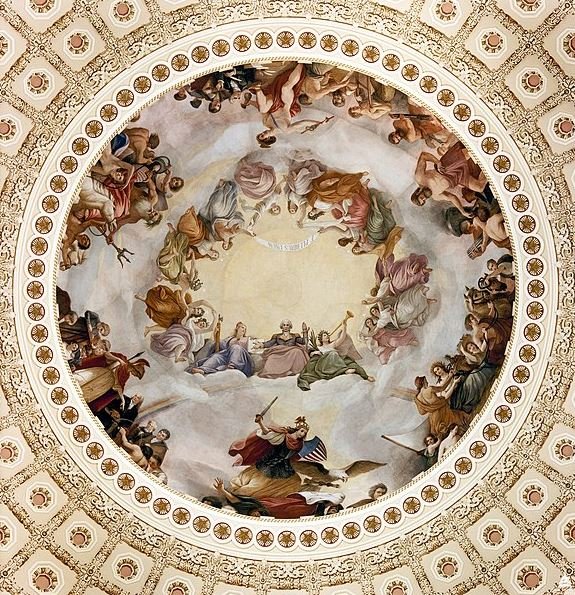
The Apotheosis of Washington, painted by Constantino Brumidi, is a stunning fresco on the ceiling of the Capitol rotunda in the United States Capitol building.
Statuary and Sculptures
The rotunda houses significant sculptures, including:
- George Washington: A bronze cast of Jean-Antoine Houdon’s marble statue.
- Thomas Jefferson: A bronze statue donated by Uriah Levy.
- Abraham Lincoln and Ulysses S. Grant: Statues by Vinnie Ream and Franklin Simmons, respectively.
- Bust of Martin Luther King, Jr.: Created by John Woodrow Wilson and unveiled in 1986.
- Portrait Monument: A tribute to women’s suffrage leaders, sculpted by Adelaide Johnson and moved to the rotunda in 1997.
Lying in State and Honor
The rotunda hosts ceremonies to honor prominent figures. Lying in state is reserved for government officials and military officers, guarded by U.S. Armed Forces. Private citizens lie in honor, with Capitol Police providing the guard. Notable figures who have lain in state include Abraham Lincoln, John F. Kennedy, George H. W. Bush, and Jimmy Carter. Rosa Parks and Billy Graham are among the few private citizens to lie in honor.
READ MORE: 1980 U.S. Presidential Election and Why Jimmy Carter Lost

Frequently Asked Questions about the U.S. Capitol Rotunda
When was the Rotunda built?
Construction began in 1818 and was completed in 1824 under Architect of the Capitol Charles Bulfinch. The dome, designed by Thomas U. Walter, was completed in 1866.
What is the architectural style of the Rotunda?
The Rotunda is designed in the Neoclassical style, inspired by the Pantheon in Rome, with sandstone walls and a cast-iron dome.
What is displayed in the Rotunda?
The Rotunda showcases significant historical paintings, sculptures, and frescos, including The Apotheosis of Washington by Constantino Brumidi and Trumbull’s Declaration of Independence.

The rotunda, as seen from behind the statue of George Washington.
What events are held in the Rotunda?
It hosts ceremonial events such as lying in state or honor for prominent individuals, as well as public gatherings authorized by Congress.
What historical role did the Rotunda play during the Civil War?
It served as a military hospital for Union soldiers.
What major renovations have been made to the Rotunda?
A $10 million renovation from 2013 to 2016 addressed lead paint removal, structural repairs, and artwork preservation.
What is the significance of the Frieze of American History?
The frieze, a trompe-l’œil fresco encircling the dome’s base, depicts key moments in American history, painted by Constantino Brumidi and completed by others.





