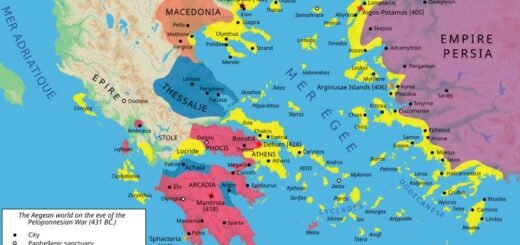
The Delian League: Origins and Evolution
The Delian League emerged in the aftermath of the Persian Wars (490–479 BCE), a defining period in Greek history. The Greek victory in battles like Marathon (490 BCE), Salamis (480 BCE), and Plataea (479 BCE) halted Persian expansion into mainland Greece. However, the Persian Empire still held influence over the Aegean islands, Ionia, and parts of the eastern Mediterranean.
The Greek poleis (city-states) recognized that Persian ambitions remained a threat. This vulnerability created the need for a more permanent defensive alliance, especially to protect the Greek cities of Ionia and the islands in the Aegean from Persian reprisals.
Formation of the Delian League (478/7 BCE)
The Delian League was founded in 478/7 BCE as a coalition of Greek states under Athenian leadership. Its primary goals were:
- Defense Against Persia: Prevent further Persian incursions into Greek territory.
- Liberation of Ionian Greeks: Free the Greek cities under Persian control.
- Economic Stability and Security: Secure vital trade routes and resources in the Aegean.
The League’s headquarters were established on the sacred island of Delos, chosen for its neutral and religious significance. The treasury was housed there, and members swore oaths to uphold the alliance.
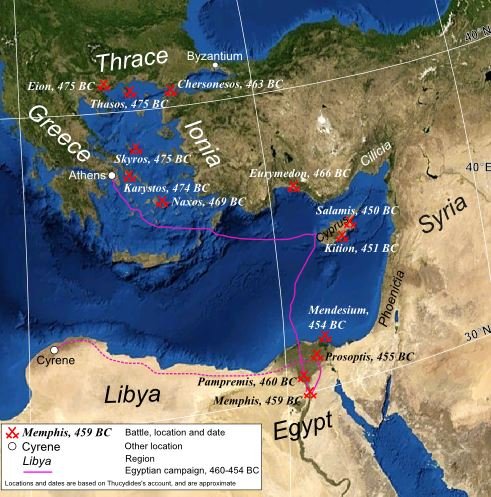
A map highlighting the various battles fought by the Delian League.
Structure and Contributions
Athens assumed the leadership role due to its naval supremacy and decisive role in the Persian Wars. Aristides, an Athenian statesman, played a key role in organizing the League.
Also, member states contributed either ships or monetary payments (phoros). Wealthier and more strategically important poleis often provided ships, while smaller states paid tribute.
Member states theoretically had a voice in League decisions, but Athens increasingly dominated the decision-making process.
Initial Campaigns and Consolidation (478–470 BCE)
Under Athenian leadership, the League conducted successful campaigns against the remnants of Persian control in the Aegean and Ionia. Key events included:
- Capture of Eion (476 BCE): A strategic Persian stronghold near the Strymon River was captured, cutting off Persian supply lines.
- Conquest of Scyros (474 BCE): Athens expelled the pirates from Scyros and settled Athenians there, securing the Aegean trade routes.
- Siege of Carystus (473 BCE): Carystus, a city in Euboea, was compelled to join the League, showing Athens’ willingness to enforce membership through military means.
- Revolt of Naxos (ca. 470 BCE): The first major rebellion within the League occurred when Naxos attempted to secede. Athens responded with force, demonstrating its determination to maintain the League as a cohesive unit.
These actions solidified the League’s control over the Aegean and established Athens as the dominant power.
The Delian League’s Shift Toward Empire
Initially, the League was a voluntary alliance, but Athens’ increasing assertion of control over its allies marked a shift toward imperialism. This transformation occurred for several reasons:
The tribute collected by Athens bolstered its economy and funded monumental projects like the Parthenon.
To maintain a strong naval force, Athens required a steady stream of resources and secure bases.
Athenian leaders, particularly Themistocles and later Cimon, viewed the League as a means to expand Athenian influence.
By suppressing rebellions like Naxos and centralizing decision-making, Athens effectively turned the League into an extension of its power.

The Battle of Eurymedon (469/466 BCE)
The Battle of Eurymedon was a decisive conflict in the League’s early history, marking the culmination of its campaigns against Persia. Led by Cimon, the Athenian fleet achieved a stunning victory over Persian forces near the Eurymedon River in southern Asia Minor.
Key Outcomes:
- Destruction of Persian Forces: The League’s fleet defeated a Persian navy and army in a single campaign, significantly reducing Persian influence in the eastern Mediterranean.
- Consolidation of Aegean Control: The victory demonstrated the League’s dominance and secured its hegemony over the Aegean region.
- Increased Athenian Prestige: Cimon’s triumph elevated Athens’ reputation as the leader of the Greek world, further solidifying its control over the League.
The League’s Challenges and Transformations (465/4 BCE)
Despite its successes, the League faced internal challenges. Many member states began to resent Athens’ heavy-handed leadership and the compulsory nature of their contributions. Additionally, Athens’ use of League resources for its own purposes caused tensions.
By 465/4 BCE, the Delian League had evolved from a defensive alliance into a vehicle for Athenian imperial ambitions.
Thasos, a wealthy island member of the League, revolted in 465 BCE, protesting Athens’ interference in its economic affairs, particularly its control over gold mines and trade routes. Athens besieged Thasos, eventually subduing it after a two-year struggle. The revolt underscored growing discontent among League members and highlighted Athens’ willingness to use force to maintain its dominance.
Questions and Answers about the Delian League
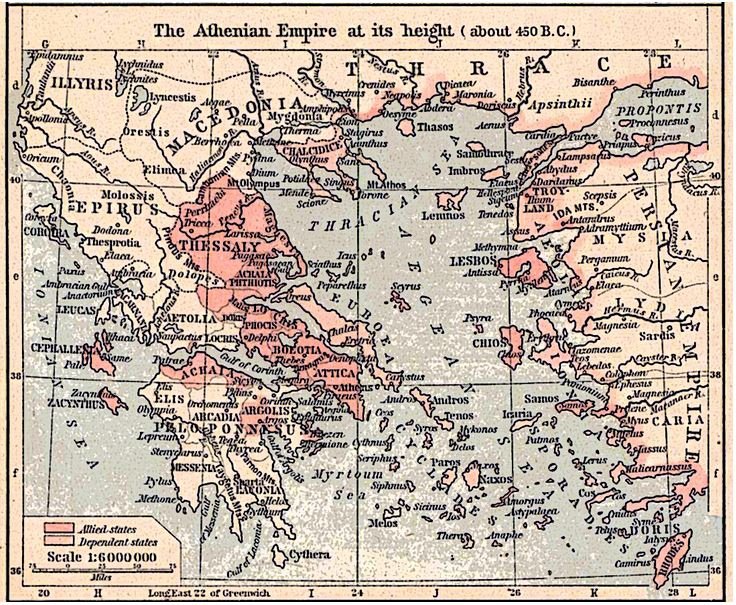
Map of the Athenian Empire circa 450 BC.
What was the Delian League, and why was it formed?
The Delian League was a maritime alliance of Greek city-states formed after the second Persian invasion of Greece (480–479 BCE). It aimed to secure Greek freedom, exact reparations from Persia, and maintain collective defense against future threats.
Why is it called the Delian League?
The League was named after its treasury, which was initially housed on the sacred island of Delos, symbolizing its religious and neutral foundation.
What were the three main objectives of the Delian League?
The League aimed to defend against Persian aggression, liberate Ionian Greeks under Persian control, and maintain Greek autonomy and maritime stability.
Why did Athens assume leadership of the Delian League?
Athens took leadership due to its naval supremacy, its prominent role in victories at Marathon and Salamis, and its reliance on maritime trade for economic stability.
READ MORE: Strategy used by the Greeks at the Battle of Salamis in 480 BCE
What was the significance of the oaths taken by League members?
Members pledged to “have the same enemies and friends” and symbolized their commitment by sinking iron lumps into the sea, representing the League’s intended permanence.
How was the Delian League structured?
The League’s headquarters and treasury were on Delos. Members contributed either warships or monetary tribute (phoros) based on their capacity. Athens oversaw military and financial operations, quickly emerging as the dominant force.
What were some key early campaigns of the Delian League?
Early campaigns included the capture of Eion (476 BCE), the expulsion of pirates from Skyros (474 BCE), and the coerced inclusion of Carystus (ca. 472 BCE). These victories secured Aegean trade routes and expanded the League’s influence.
What was the significance of the Revolt of Naxos?
Naxos attempted to secede from the League around 467 BCE, protesting Athens’ dominance and financial demands. Athens besieged and subjugated Naxos, marking a shift toward compulsory membership and setting a precedent for using force to maintain the alliance.

What happened at the Battle of Eurymedon?
Led by Cimon, the League won a decisive victory against Persian forces at the Eurymedon River (469/466 BCE), destroying or capturing nearly 200 Persian ships and securing Athenian dominance in the eastern Mediterranean.
What was the impact of the victory at Eurymedon?
The victory crippled Persian naval power, liberated Greek cities in Asia Minor, and demonstrated the League’s military potential. However, it also solidified Athens’ role as hegemon, increasing tensions over its imperial ambitions.
What were the long-term consequences of the Delian League’s transformation?
Athens’ dominance and heavy-handed control sowed discontent among its allies, setting the stage for internal tensions and the broader conflicts of the Peloponnesian War.