Indrani: The Queen of the Devas
Indrani, also known as Shachi, is a prominent goddess in Hindu mythology. She is revered as the queen of the devas (gods) and the consort of Indra, the king of the gods. Renowned for her beauty, pride, and kindness, she is also one of the Sapta Matrika, the seven divine mothers. Her multifaceted character and significant roles in myths reflect her importance in the Hindu pantheon.
Origins and Name
Indrani is the daughter of the asura Puloman, making her lineage both divine and demonic. Her name derives from her association with Indra, where “Indrani” translates to “wife of Indra.” She is also referred to by other epithets, including Shachi, Poulomi, and Aindri. The name Shachi signifies strength, eloquence, and power, linking her with the later concept of Shakti, the feminine embodiment of energy.
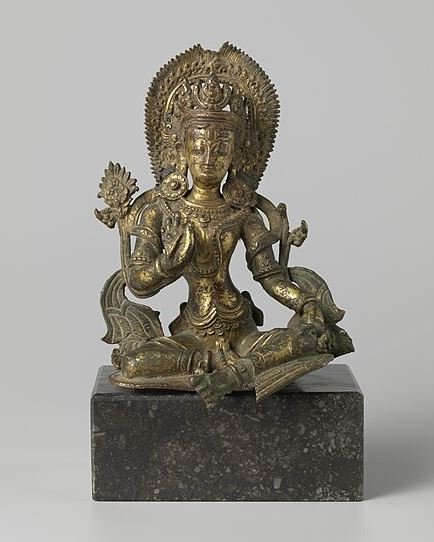
Image: Indrani of Nepal, portrayed as the consort of Indra.
Role in Hindu Mythology
Indrani’s beauty and grace made her a central figure in many myths, often coveted by other gods and demons. Despite these challenges, her loyalty and resourcefulness set her apart. One of the most famous stories highlights her cleverness in thwarting Nahusha, a mortal king who became the ruler of heaven during Indra’s absence. Nahusha desired Indrani, but she devised a plan that led to his downfall and restored Indra to his rightful position.
In the Ramayana, another tale narrates how Indrani was abducted by the demon Anuhlada with her father Puloman’s support. Indra intervened, defeating both Anuhlada and Puloman to rescue his wife, further underscoring her role as a loyal and protected figure.
Depiction in Vedic and Puranic Texts
Indrani is prominently mentioned in the Rigveda, where she is portrayed as a figure of beauty and pride. She is described as jealous of rivals and, in one hymn, even asserts dominance over Indra, showing a complex relationship with her husband. Despite this, her character often takes a secondary role to Indra in early Vedic literature.
In Puranic texts, Indrani’s character evolves, presenting her as a devoted wife and mother. She is the mother of Indra’s children, including Jayanta, Rishabha, and Midhusha. Her association with the divine Parijata tree also highlights her role in stories of conflict and reconciliation, particularly in her interactions with Krishna and his wife Satyabhama.

Image: Indra and Indrani depicted in an Indian temple.
Association with the Matrikas
Indrani is identified as one of the Sapta Matrika, the seven divine mothers who embody different aspects of feminine energy. As a Matrika, she personifies the power of Indra and plays a critical role in the Devi Mahatmyam. Alongside the other Matrikas, she aids in defeating demons like Shumbha, Nishumbha, and Raktabija. Her martial prowess and strength are emphasized in these texts, where she is depicted wielding a thunderbolt and spear.
Iconography and Symbols
Indrani is commonly depicted seated with Indra on the celestial elephant Airavata. She is shown as a youthful, ornamented goddess, often carrying a lotus or thunderbolt, symbolizing her beauty and power. In her form as a Matrika, she has a red complexion, three eyes, and four arms holding weapons like a thunderbolt and spear. Her association with Airavata and the kalpaka tree further signifies her divine status and connection to prosperity and power.

Image: Indra and Indrani riding on Airavata, the celestial elephant.
Worship and Rituals
Indrani is typically worshipped alongside Indra rather than as an independent deity. Temples often depict her with her husband, and she is venerated during specific rituals like Ashada Navratri. In some regions, she is equated with the Matrika of the same name and worshipped as part of this divine group. While her worship is less widespread compared to other Hindu goddesses, she remains significant in certain rituals and family traditions, especially in royal lineages.
Indrani in Other Religions
Indrani’s influence extends to Jainism and Buddhism, though her roles differ. In Jain traditions, she is the consort of Indra, representing an ideal divine couple. They descend to celebrate the birth of a Tirthankara, symbolizing purity and divinity.
Indrani’s presence in Hinduism, Jainism, and Buddhism underscores her significance across Indian religious traditions.
In Buddhist texts, Indrani is known as Sujā, the wife of Śakra, Indra’s Buddhist counterpart. Her story emphasizes purification and spiritual growth, highlighting her journey across multiple lifetimes to become Śakra’s queen.
Themes and Symbolism
Indrani symbolizes loyalty, strength, and feminine power. Her stories often emphasize her quick wit, independence, and resourcefulness, making her a protector of divine order. As one of the Sapta Matrika, she embodies jealousy, a characteristic tied to her role as a guardian of her husband’s devotion. Her association with beauty and power connects her to the broader concept of Shakti, the feminine cosmic energy.
Modern Interpretations
In contemporary Hinduism, Indrani is often viewed as a symbol of feminine strength and resilience. While not as widely worshipped as other goddesses, her role as a devoted consort and her inclusion in the Sapta Matrika underscore her importance in mythology and ritual practice. Her narratives continue to inspire interpretations of loyalty, resourcefulness, and divine grace.
Frequently Asked Questions
What role does Indrani play in Hindu mythology?
Indrani is central to many myths, often depicted as a clever and loyal figure. She thwarts Nahusha’s advances by orchestrating his downfall, ensuring Indra’s return to power. Her stories emphasize her independence and devotion to her husband.
How is Indrani depicted in the Rigveda?
In the Rigveda, Indrani is portrayed as a figure of beauty and pride. She is described as jealous of rivals and asserts dominance over Indra. However, like other Vedic goddess-consorts, her character is often overshadowed by her husband’s prominence.
What is the story of Indrani and the Parijata tree?
The Parijata tree emerged during the churning of the ocean. Indrani, its owner, was challenged by Krishna’s wife Satyabhama, who took the tree to Dvaraka after Krishna defeated Indra in battle.
What is Indrani’s role in Shaktism?
Indrani is identified as one of the Sapta Matrika in Shaktism, embodying Indra’s power. She is depicted with red complexion, three eyes, and four arms holding a thunderbolt and spear, symbolizing her martial prowess.
How is Indrani worshipped and depicted in temples?
Indrani is typically worshipped alongside Indra, seated on the celestial elephant Airavata. Texts describe her as a youthful goddess adorned with ornaments, holding symbols like a lotus or thunderbolt. Her worship is rare but occurs during rituals like Ashada Navratri.
What are Indrani’s roles in Jainism and Buddhism?
In Jainism, Indrani represents the ideal divine couple with Indra and celebrates the birth of Tirthankaras. In Buddhism, she is Sujā, Śakra’s wife, embodying purification and spiritual growth through multiple lifetimes.
How does Indrani symbolize feminine power in Hinduism?
Indrani’s stories highlight her strength, intelligence, and independence. As one of the Sapta Matrika, she represents feminine energy, protecting the divine order and combating evil forces alongside other goddesses.





