Pergamon Museum
The Pergamon Museum, located on Berlin’s Museum Island, is a masterpiece of Stripped Classicism architecture. Construction began in 1910 under Alfred Messel’s design and continued by Ludwig Hoffmann after Messel’s death. The museum was commissioned by Emperor Wilhelm II to house Germany’s growing collection of archaeological finds. Despite delays caused by World War I and economic instability during the 1920s, the museum opened in 1930.
During World War II, the museum suffered significant damage from air raids. To protect its collection, many artifacts were stored in secure locations or walled in. After the war, the Red Army took numerous items as war booty, some of which were later returned in 1958, though others remain in Russian museums. The Pergamon Museum was partially restored and reopened in 1959 in East Berlin.
Collections of the Pergamon Museum

The architectural grandeur of the Pergamon Museum, combined with its unparalleled collections of ancient and Islamic art, make it one of the world’s most significant cultural institutions. Image: Side view of the Pergamon museum.
Antiquity Collection (Antikensammlung)
The Antiquity Collection houses Greek and Roman artifacts, including monumental architectural reconstructions, sculptures, mosaics, pottery, and bronzes. Its roots trace back to the Brandenburg electors’ acquisitions in the 17th century, expanding through German excavations in sites like Pergamon, Olympia, and Miletus. The highlight of this collection is the Pergamon Altar, a Hellenistic marvel featuring a 113-meter frieze depicting the battle between gods and giants.
READ MORE: Greatest Masterpieces of Hellenistic Art
Museum of the Ancient Near East (Vorderasiatisches Museum)
This collection features artifacts from ancient Mesopotamian cultures, including Assyrian, Babylonian, and Sumerian civilizations. Major exhibits include the Ishtar Gate and Processional Way of Babylon, the throne room facade of Nebuchadnezzar II, and the Meissner fragment from the Epic of Gilgamesh. These items reflect the architectural and cultural achievements of the ancient Near East.
READ MORE: Epic of Gilgamesh: When was the story first recorded, and by whom?
Museum of Islamic Art (Museum für Islamische Kunst)
The Islamic Art collection, moved to the Pergamon Museum in 1932, showcases Islamic artifacts from the 8th to the 19th centuries. Highlights include the Mshatta Facade, originally from an Umayyad palace, and intricate examples of Islamic textiles, ceramics, and calligraphy. This collection emphasizes the richness and diversity of Islamic artistic traditions.

Image: The main entrance to the Pergamon Museum.
Significance of the Pergamon Museum
The Pergamon Museum is a UNESCO World Heritage Site, recognized for its historical and architectural importance. Its monumental reconstructions, such as the Pergamon Altar and Ishtar Gate, offer visitors a unique insight into ancient civilizations by preserving large-scale architectural works. These exhibits go beyond art to represent the cultural, political, and technological advancements of their times.
The museum also exemplifies Germany’s legacy in archaeology and curation. The collections stem from extensive excavations led by German archaeologists, reflecting the country’s active role in studying ancient cultures. Additionally, the museum’s role in preserving and presenting Islamic art underscores its commitment to showcasing diverse global traditions.
Renovation and Future Plans
The museum entered a major renovation phase in 2014 as part of the Museum Island Master Plan. These renovations aim to modernize facilities, add a fourth wing, and connect the museum to others on the island via an underground promenade. However, the project has faced delays and budget overruns, pushing the reopening of the fully renovated museum to 2037–2043. The North Wing is expected to reopen in 2027.
During the closure, select artifacts are displayed at a temporary exhibition nearby. A panoramic reconstruction of ancient Pergamon, created by artist Yadegar Asisi, offers visitors an engaging alternative during the renovation.
Frequently Asked Questions about the Pergamon Museum
Why is the museum significant?
It is a UNESCO World Heritage Site for its role in showcasing the evolution of museums as architectural and social institutions.
What are its main collections?
The museum houses the Antiquity Collection, the Museum of the Ancient Near East, and the Museum of Islamic Art.
What are its most famous exhibits?
Key exhibits include the Pergamon Altar, the Market Gate of Miletus, and the Ishtar Gate with the Processional Way of Babylon.
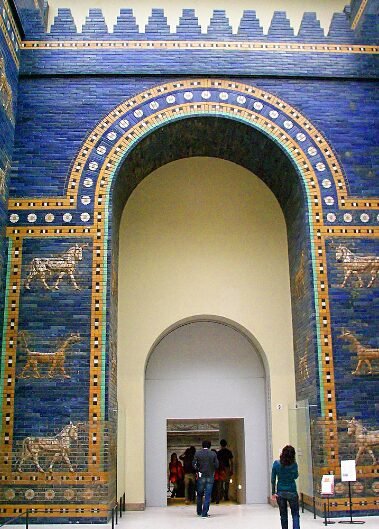
Image: Ishtar Gate.
What challenges did its construction face?
Construction, initiated by Alfred Messel and continued by Ludwig Hoffmann, endured delays due to World War I and economic struggles during the 1920s.
How was the museum affected by World War II?
The building suffered damage, but many artifacts were safeguarded. Some were taken by the Red Army, with partial returns in 1958, though many remain in Russian museums.
Why is the museum currently closed?
It closed in October 2023 for extensive renovations, expected to last until 2037–2043, with partial reopening of the North Wing planned for 2027.
What are the renovation plans?
Renovations include adding a fourth wing, constructing an underground promenade, and modernizing the space while maintaining its historical integrity.





