Ishtar Gate: History and Major Facts
The Ishtar Gate was constructed during the reign of King Nebuchadnezzar II around 569 BCE, at the height of the Neo-Babylonian Empire. Babylon, located in modern-day Hillah, Iraq, was the center of one of the ancient world’s greatest civilizations. Nebuchadnezzar II, known for his ambitious architectural projects, aimed to enhance Babylon’s grandeur to reflect its divine importance and his power.
The Ishtar Gate was named after Ishtar, the goddess of war, love, and fertility, revered as one of the most powerful deities in the Babylonian pantheon. It served as the eighth and main gate into Babylon’s inner city, symbolizing both protection and divine favor. Beyond its practical function as a fortified entrance, the gate was a key component of religious rituals, linking it to Babylon’s spiritual identity.

Image: Ishtar Gate, located at the Berlin Museum.
Construction of the Ishtar Gate
The Ishtar Gate was a feat of ancient engineering and artistry. It was constructed using glazed bricks, predominantly blue, made to resemble lapis lazuli, a highly prized semi-precious stone. The bricks were created by molding fine clay into forms, firing them to harden, and then coating them with colored glazes. This gave the façade a vibrant, jewel-like appearance.
To achieve the elaborate depictions of animals and gods, relief molds were used to press intricate images into the bricks. These included lions, bulls, and dragons, symbolizing the deities Ishtar, Adad, and Marduk. After glazing, the bricks were fired again at high temperatures to ensure durability and color brilliance.
The gate’s height was approximately 15 meters, with its foundations extending 14 meters underground. It consisted of a double-gate structure, with a smaller frontal gate and a grander, more intricate posterior gate. Its doors were made of cedar wood, adorned with bronze fittings, signifying the use of luxurious materials.
READ MORE: Marduk’s conflict with Tiamat
Symbolic Design
The Ishtar Gate’s surface was adorned with rows of bas-relief animals. Each symbol had a specific divine connection:
- Lions represented Ishtar, the goddess of fertility, war, and protection.
- Mušḫuššu dragons symbolized Marduk, Babylon’s chief deity and the god of order and justice.
- Aurochs (bulls) represented Adad, the storm god associated with rain and fertility.
These depictions not only showcased Babylonian artistry but also communicated a message of divine protection. The animals reflected the gods’ roles in guarding the city and ensuring its prosperity.
The Processional Way
The Ishtar Gate was intricately linked to the Processional Way, a long ceremonial avenue leading into the city. This roadway was used during Babylon’s most significant religious festival, the New Year Festival. The Processional Way was paved with massive stones set in bitumen and stretched over 800 meters into Babylon’s sacred temple district.
Lining the walls of the Processional Way were over 120 relief lions, alternating on both sides. These lions, symbols of Ishtar, reflected her protective role over the city and created an atmosphere of divine majesty. The attention to detail was astounding—each lion was crafted from 46 molded bricks, and slight variations were made in their posture, emphasizing naturalism.
The New Year Festival was a grand celebration lasting 12 days at the time of the spring equinox. During this event, statues of deities, including Marduk, were carried through the Ishtar Gate and down the Processional Way. This ceremony symbolized the renewal of life and reaffirmed the king’s divine legitimacy as Marduk’s earthly representative.

Image: A 2006 image of the Ishtar gate.
Religious and Cultural Significance
The Ishtar Gate was more than just an architectural wonder; it held profound religious and cultural meaning for the Babylonians. Dedicated to Ishtar, the gate highlighted her significance as the city’s protector. By prominently featuring Ishtar, Adad, and Marduk, the gate reinforced the spiritual hierarchy of Babylon’s deities.
The gate also served as a reminder of Nebuchadnezzar II’s power and piety. By constructing such a magnificent structure, he aligned himself with the gods and showcased his dedication to maintaining Babylon’s divine favor. The visual splendor of the gate would have inspired awe in both residents and visitors, emphasizing Babylon’s status as the center of the known world.
Symbolically, the gate reflected the cosmic order that the Babylonians believed Marduk upheld. Its blue-glazed bricks imitated the heavens, linking the gate to the divine realm and reinforcing the connection between earth and the gods.
READ MORE: Babylonian Mythology: How the world was created
Excavation and Reconstruction
The Ishtar Gate remained buried under centuries of earth and debris until its rediscovery in the early 20th century. From 1904 to 1914, German archaeologist Robert Koldewey led the excavation of Babylon, uncovering the Ishtar Gate and the Processional Way. Recognizing its historical importance, Koldewey meticulously documented and dismantled the gate’s remains.
The fragments of the gate, including thousands of glazed bricks, were transported to Germany. At Berlin’s Pergamon Museum, a partial reconstruction of the gate took place. The smaller frontal gate was restored and now stands 14 meters high and 30 meters wide, serving as a central exhibit and a testament to Babylonian ingenuity.
The excavation, however, was not without controversy. Much of the gate’s material was removed from its original location, sparking debates about the ethics of artifact removal. Today, parts of the gate, including its animal reliefs, are displayed in museums across the world, such as the Metropolitan Museum of Art, the Istanbul Archaeology Museum, and the Louvre.
Symbolism in Modern Times
The Ishtar Gate remains an enduring symbol of Iraq’s cultural heritage. Replicas of the gate’s façade have been constructed at Iraqi embassies in countries like China, Jordan, and Pakistan, celebrating Babylon’s legacy. In 1987, under Saddam Hussein, a smaller reproduction of the gate was built as part of a campaign to reconnect Iraq to its ancient past.
Unfortunately, the original gate and its reproductions have faced damage due to war and neglect. In recent years, conflicts like the Iraq War have raised concerns about the preservation of such significant monuments.
Controversy and Repatriation Debates
The Ishtar Gate’s removal to Berlin has been a subject of ongoing controversy. The Iraqi government has made multiple requests for the gate’s return, arguing that it is a critical piece of their cultural identity. Advocates for repatriation emphasize that the gate belongs in its original context, where it can contribute to Iraq’s historical narrative.
Conversely, proponents of its current location in Berlin argue that the gate is better preserved and accessible at the Pergamon Museum. They cite historical events, such as the damage caused by World War II and the instability in Iraq, as reasons to keep the gate in a secure environment. This debate reflects broader issues surrounding the repatriation of artifacts taken during colonial-era excavations.
The Legacy of the Ishtar Gate
The Ishtar Gate stands as a testament to the ingenuity, artistry, and cultural richness of ancient Babylon. Its vibrant blue-glazed façade, adorned with mythological animals, captured the divine essence of the gods it represented and showcased Babylon’s power to the world.
Through its connection to the Processional Way and the New Year Festival, the gate became a critical part of Babylon’s spiritual and ceremonial life. It symbolized the city’s role as a center of civilization, where the gods’ favor ensured prosperity and protection.
Despite being partially reconstructed in Berlin, the Ishtar Gate continues to inspire awe and wonder. It bridges the gap between the past and the present, serving as a powerful reminder of humanity’s shared cultural heritage. Whether as a piece of ancient history or a symbol of modern identity, the Ishtar Gate remains an enduring icon of art, religion, and architectural achievement.
Frequently Asked Questions

Where was the Ishtar Gate located?
It was built on the northern side of Babylon, in present-day Hillah, Iraq, serving as a grand entrance to the city.
What materials and techniques were used in the gate’s construction?
The gate was made of blue-glazed bricks, designed to resemble lapis lazuli. The bricks were molded, fired, and coated with colored glazes, with depictions of animals symbolizing Babylonian gods.
What deities were symbolized in the gate’s design?
The gate featured lions for Ishtar (goddess of war and fertility), dragons (mušḫuššu) for Marduk (chief deity), and bulls for Adad (storm god), showcasing divine protection.
What was the Processional Way, and how did it relate to the gate?
The Processional Way was a grand avenue leading through the gate, lined with over 120 lions, bulls, and dragons, and used for New Year Festival ceremonies honoring Marduk.
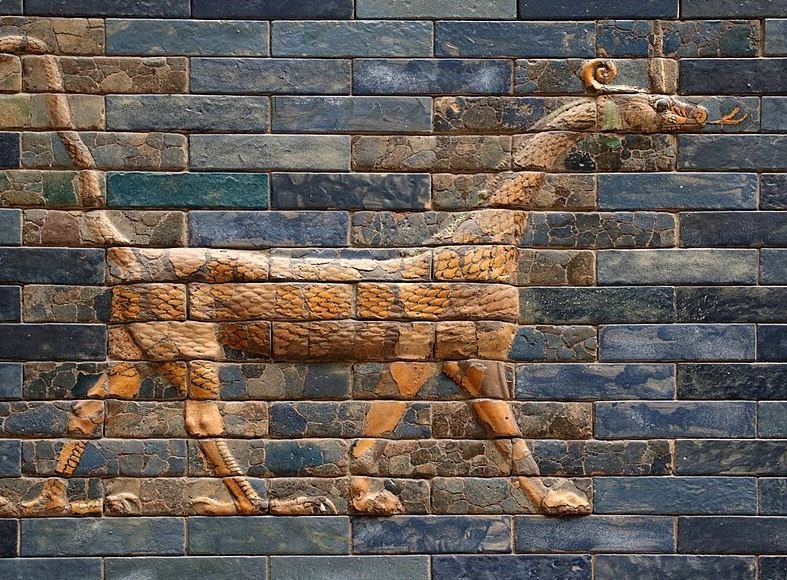
Image: One of the legendary mušḫuššu dragons on the gate.
Who excavated the Ishtar Gate, and where is it now?
German archaeologist Robert Koldewey excavated the gate between 1904 and 1914. The smaller frontal section was reconstructed and is displayed at the Pergamon Museum in Berlin.
Why is the Ishtar Gate significant in modern times?
The gate represents Iraq’s cultural heritage, with replicas adorning Iraqi embassies worldwide. However, its removal and display in Berlin have sparked repatriation debates.
What controversies surround the Ishtar Gate?
The gate’s removal to Berlin during colonial-era excavations has led to ongoing disputes over cultural ownership, with Iraq requesting its return for decades.





