Journals of the Continental Congress
The Journals of the Continental Congress represent a key collection of documents that provide invaluable insight into the formative years of the United States. These records stem from the first three representative bodies of the original United Colonies, ultimately forming the foundation of the United States of America. The journals document not only the decisions made during these early assemblies but also the underlying political struggles, philosophical debates, and pivotal moments that defined the American Revolution and the creation of our nation.
Through these documents, one can trace the path from the early resistance to British rule through to the establishment of the U.S. Constitution and the transition from a loose confederation to a unified republic.

First Continental Congress
The First Continental Congress: Formation and Purpose
The First Continental Congress convened in response to the growing dissatisfaction in the colonies with British rule. From September 5 to October 26, 1774, representatives from twelve of the thirteen colonies gathered at Carpenters’ Hall in Philadelphia. This was a critical moment in colonial history, as tensions between the colonies and Great Britain were reaching a boiling point due to the imposition of what the colonists termed the “Intolerable Acts.” These acts, which included punitive measures such as the closing of Boston’s port and the dissolution of local governments, were seen as direct attempts to curtail the colonies’ self-governance and economic independence.
The purpose of the First Continental Congress was to address these injustices and unite the colonies in their opposition to British policies. While the Congress did not immediately call for independence, its members sought a peaceful resolution through diplomatic means. They agreed on a set of resolutions aimed at boycotting British goods, petitioning the king for redress of grievances, and asserting their right to self-governance. A key outcome of the First Continental Congress was the passage of the Continental Association on October 20, 1774. This was a coordinated boycott of British goods, with a view to economically pressuring Britain into reversing its policies.
Despite the emphasis on diplomacy, the Congress also recognized the need for military preparedness. A series of resolutions were passed that recommended the colonies begin forming militias in case of further military action by the British. The First Continental Congress, although short-lived, laid the groundwork for what would become a broader colonial movement for independence, creating the necessary infrastructure for the Second Continental Congress to meet just months later.
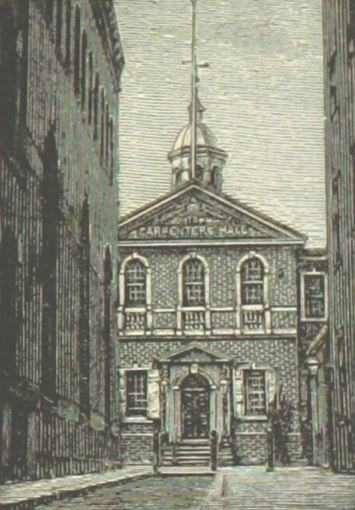
An 1891 illustration depicting the Carpenters’ Hall
The Second Continental Congress: Declaration and War
The Second Continental Congress met from May 10, 1775, to March 1, 1781. This Congress was far more significant than its predecessor in terms of its scope and its impact on the future of the colonies. The events that led to the convening of the Second Continental Congress were marked by the outbreak of armed conflict between colonial militias and British forces, most notably the Battles of Lexington and Concord in April 1775. The shots fired at these engagements marked the start of the American Revolutionary War, prompting the colonies to adopt more drastic measures in their response to British aggression.
The Second Continental Congress found itself in a precarious position, balancing the need for military action with the desire to seek peaceful reconciliation. In the early months of the Congress, representatives debated the prospects of negotiation with Great Britain, but as military hostilities escalated, the Congress began to act as the de facto government of the colonies. It assumed responsibility for the Continental Army, appointing George Washington as its commander-in-chief, and it also worked to coordinate the war effort among the colonies.
One of the defining moments of the Second Continental Congress was the drafting and adoption of the Declaration of Independence on July 4, 1776. This document, authored primarily by Thomas Jefferson, formally severed ties with Britain and declared the colonies to be independent states. The Journals of the Continental Congress document the process by which this momentous decision was made, including debates over the wording of the declaration, the nature of the colonies’ relationship with Britain, and the philosophical justification for independence.
In addition to the Declaration of Independence, the Second Continental Congress also passed a number of important measures that would shape the future of the United States. These included the adoption of the Articles of Confederation in 1781, which created a loose confederation of states with a weak central government, and the negotiation of crucial foreign alliances, particularly with France, which played a significant role in ensuring American victory in the war.
Throughout its tenure, the Second Continental Congress was deeply involved in the practical matters of war, diplomacy, and governance, establishing the framework for the fledgling United States government. The decisions made during this period, including the drafting of foundational documents like the Declaration of Independence and the Articles of Confederation, would continue to influence the political landscape of the nation long after the war had ended.

The Congress of the Confederation: Post-War Transition
With the conclusion of the American Revolutionary War and the signing of the Treaty of Paris in 1783, the need for a more stable and effective government became clear. The Articles of Confederation, which had been adopted during the Second Continental Congress, provided a framework for governance, but its weaknesses soon became apparent. The central government created by the Articles was too weak to effectively manage national issues, particularly in areas like taxation and interstate commerce. This led to the creation of the Congress of the Confederation, which convened from 1781 to 1789.
The Congress of the Confederation operated under the Articles of Confederation, and its role was to oversee the implementation of the treaty that ended the Revolutionary War, manage the national finances, and handle other national matters. However, the lack of a strong central government proved problematic, as the Congress struggled to address issues such as trade disputes, economic instability, and the growing calls for a stronger federal system.
In 1787, recognizing the limitations of the Articles, a Constitutional Convention was convened to draft a new governing document, leading to the creation of the United States Constitution in 1789. The Congress of the Confederation played a critical role in this process, as it was during this period that many of the key issues—such as the need for a standing army, the power to tax, and the establishment of a more robust federal government—were discussed.
The journals of the Congress of the Confederation provide essential records of this transition period, documenting debates, legislation, and correspondence that influenced the drafting of the Constitution. The records also provide a snapshot of the challenges the fledgling nation faced in its efforts to build a stable government and move beyond the weak structure of the Articles of Confederation.
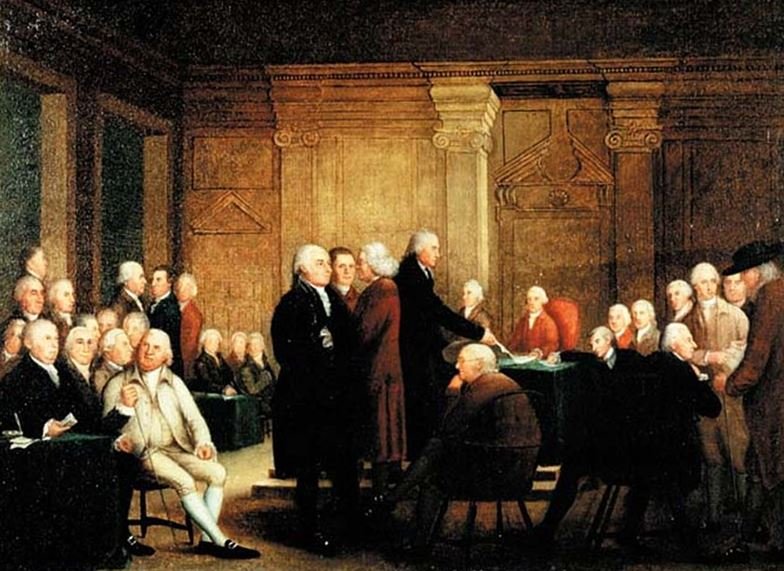
“Congress Voting Independence”, artwork by English artist Robert Edge Pine.
The Journals of the Continental Congress encapsulate the work of the First Continental Congress, the Second Continental Congress, and the Congress of the Confederation.
The Journals’ Legacy and Influence
The Journals of the Continental Congress are more than just a collection of documents. They are a window into the political and philosophical struggles that shaped the early years of the United States. These records capture the debates, compromises, and decisions that led to the birth of the nation and the establishment of its foundational principles. From the resistance to British oppression to the drafting of key documents like the Declaration of Independence and the Articles of Confederation, the Journals illustrate the complexities of governance and the vision of the leaders who steered the country through its formative years.
The publication of these journals, particularly the 34-volume edition edited by Worthington C. Ford and released between 1904 and 1937 by the Library of Congress, made these vital documents accessible to historians, scholars, and the general public. By preserving these records, Ford ensured that future generations could examine the decision-making processes that guided the early nation. The Journals continue to serve as a primary source for understanding the evolution of American political thought and the early development of the United States government.
FREQUENTLY ASKED QUESTIONS
What were the Journals of the Continental Congress?
The Journals of the Continental Congress are official records of the meetings and decisions made by the Continental Congress, which governed the colonies during the American Revolution and the early years of the United States.
What was the purpose of the First Continental Congress?
The First Continental Congress, meeting from September 5 to October 26, 1774, aimed to address the “Intolerable Acts” and other British infringements on colonial rights, ultimately leading to coordinated resistance against Britain.
What significant action did the First Continental Congress take?
On October 20, 1774, the First Continental Congress passed the Continental Association, establishing a boycott of British goods and a commitment to colonial unity in opposition to British policies.
What was the outcome of the Second Continental Congress?
The Second Continental Congress, which met from 1775 to 1781, oversaw the Continental Army’s creation, appointed George Washington as commander-in-chief, and issued the Declaration of Independence in 1776.

George Washington (1732 – 1799)
How did the Declaration of Independence come about?
The Declaration of Independence, adopted on July 4, 1776, was a product of debates within the Second Continental Congress, asserting the colonies’ right to independence from Britain.
What was the role of the Congress of the Confederation?
The Congress of the Confederation, operating from 1781 to 1789, served as the national governing body following the Revolutionary War, functioning under the Articles of Confederation until the U.S. Constitution was established.
How did the Journals of the Continental Congress influence American history?
The Journals provide critical insights into the decisions and debates that shaped American independence, governance, and the creation of foundational documents like the Declaration of Independence and the Articles of Confederation.
Why are the Journals important for historical study?
The Journals offer a detailed record of the political, philosophical, and strategic discussions that shaped the early United States, making them an essential primary source for understanding the nation’s formation and early governance.





