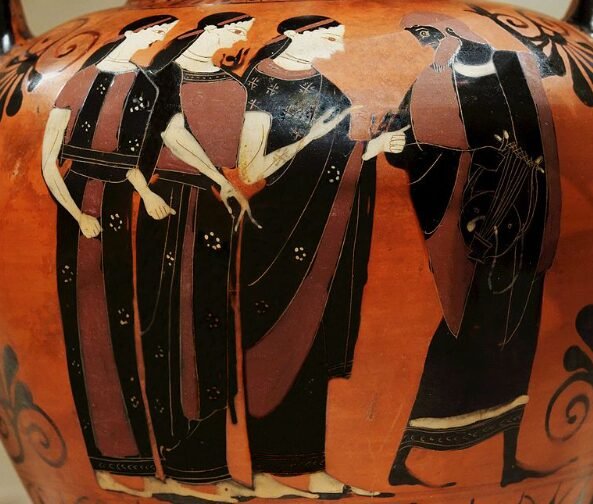
The Judgement of Paris is a Greek myth that sparked the Trojan War and, in later retellings, contributed to Rome’s foundation. Image: Attic black-figure neck amphora by Swing Painter (c. 540–530 BC), now in the Metropolitan Museum of Art
The Judgement of Paris stands as one of the most pivotal and enduring tales in Greek mythology, intricately weaving themes of beauty, power, desire, and consequence. This myth not only serves as a foundational narrative for the legendary Trojan War but also permeates various aspects of art, literature, and cultural discourse across millennia.
Below, World History Edu delves into the origins, narrative intricacies, variations across sources, symbolic interpretations, artistic representations, and enduring legacy of the Judgement of Paris.
Mythic Origins and Narrative

The Judgement of Paris originates from the rich tapestry of Greek mythology, serving as a catalyst for one of its most famous conflicts: the Trojan War. Image: Prince Paris with apple by Danish sculptor H.W. Bissen, Ny Carlsberg Glyptotek, Copenhagen
The story unfolds during the wedding celebration of Peleus, a mortal king, and Thetis, a sea goddess. Invited to this divine union were many gods and goddesses, but Eris, the goddess of discord, was deliberately excluded. This exclusion was no mere oversight; it was a calculated decision, as Eris was known for her propensity to incite strife and chaos, qualities deemed undesirable for a harmonious celebration.

Eris’ Apple of Discord, or her exclusion, became the ultimate trigger of the Trojan War. Image: Golden Apple of Discord by Flemish painter Jacob Jordaens
Offended by her exclusion, Eris sought retribution. She brought forth a golden apple, a symbol of beauty and desire, and inscribed it with the phrase “To the fairest one” (καλλίστῃ, kallistēi). Tossing this apple into the midst of the wedding guests, Eris set the stage for divine competition and ensuing turmoil.
The apple did not land randomly but was destined to ignite a rivalry among three of the most prominent goddesses: Hera, the queen of the gods and goddess of marriage and power; Athena, the goddess of wisdom and war; and Aphrodite, the goddess of love and beauty.

Eris, goddess of discord, was excluded from Peleus and Thetis’ wedding and retaliated by throwing a golden apple inscribed “To the fairest.” Hera, Athena, and Aphrodite quarreled over it, asking Paris of Troy to decide. Image: Eris on an Attic plate, ca. 575–525 BC
Each goddess laid claim to the apple, asserting their own superiority in beauty and virtue. Unable to resolve the dispute themselves, the goddesses turned to Zeus, the king of the gods, for judgment. However, Zeus, wary of the potential for favoritism and further conflict, deferred the decision to a mortal—a choice that would have far-reaching consequences. He selected Paris, a prince of Troy, known for his fairness and impartiality, to serve as the judge of this divine contest.

“The Judgment of Paris” by Peter Paul Reubens (ca. 1638).
Paris’s selection was not arbitrary. Prior to the Judgement of Paris, Paris had demonstrated his equanimity and fairness in a contest involving Ares, the god of war, disguised as a bull. In that instance, Paris had awarded victory to Ares over his own prized bull without hesitation, earning Zeus’s trust in his judgment.
Guided by Hermes, the messenger god, the three goddesses prepared to present their cases. They bathed in the sacred springs of Mount Ida, each seeking to present their best self to Paris. When Paris arrived to judge their beauty, each goddess offered him a bribe to secure his favor. Hera promised him dominion over Europe and Asia, Athena offered unparalleled wisdom and prowess in warfare, and Aphrodite pledged the love of the most beautiful mortal woman—Helen of Sparta, who was married to King Menelaus.
Tempted by the promise of Helen’s love, Paris awarded the golden apple to Aphrodite. This decision was pivotal, as it led to Helen’s departure (whether by abduction or mutual elopement, depending on the version of the story) to Troy with Paris. Helen’s departure incited the wrath of Menelaus and the united Greek forces, culminating in the decade-long Trojan War, a central event in Greek mythology and literature, most notably depicted in Homer’s Iliad.

Aphrodite bribed Paris with Helen of Sparta, the world’s most beautiful woman, though she was married to Menelaus. Paris chose Aphrodite and abducted Helen, leading to the Greek invasion of Troy to retrieve her. Image; The Love of Helen and Paris by Jacques-Louis David (oil on canvas, 1788, Louvre, Paris)
Variations Across Sources
While the core narrative of the Judgement of Paris remains consistent, details vary across different sources and retellings. The earliest mention of the Judgement of Paris appears in Homer’s Iliad (Book 24.25–30), where it is referenced briefly, suggesting that the audience was already familiar with the story. The Cypria, a lost epic from the Epic Cycle, provided a more detailed account, but only fragments and summaries of this work survive today.
Later ancient writers expanded and reinterpreted the myth to suit their narratives and philosophical agendas:
- Ovid, in his Heroides and Fasti, presented the story with a Roman sensibility, often emphasizing the personal and emotional aspects of the characters involved.
- Lucian, in Dialogues of the Gods, infused the tale with irony and satire, reflecting his skeptical and often humorous take on mythology.
- Pseudo-Apollodorus, in his Bibliotheca, offered a systematic compilation of Greek myths, presenting a more standardized version of the Judgement of Paris.
- Hyginus, in Fabulae, provided a concise retelling, making the story accessible to a broader audience through his mythographic approach.
Each of these authors, while maintaining the fundamental elements of the myth, introduced variations that highlight different facets of the story, whether it be the moral implications, the interplay of divine politics, or the human emotions intertwined with divine actions.
Symbolism and Interpretations

Aphrodite taunts Hera and Athena with the Apple, relief in the Achilleion, Corfu.
At its surface, the myth is a divine beauty contest, showcasing the epitome of beauty through the goddesses Hera, Athena, and Aphrodite. The golden apple symbolizes not only beauty but also desire and temptation.
Each goddess represents different aspects of power. Hera embodies political power and the sanctity of marriage, Athena represents intellectual and martial prowess, and Aphrodite personifies sensual allure and romantic influence. Paris’s decision reflects a choice between different types of power and influence.
Also, the myth underscores the theme of bribery and the corrupting influence of power. Paris is swayed not by merit but by personal desire, highlighting human susceptibility to temptation and the moral dilemmas inherent in decision-making.
The Judgement of Paris illustrates how a single decision can have monumental consequences. Paris’s choice of Aphrodite leads directly to the Trojan War, demonstrating the far-reaching impact of individual choices.
In a way, the story intertwines personal responsibility with the whims of the gods. While the gods set the stage and offer their favors, Paris’s agency in making the decision emphasizes themes of fate and accountability.
Some scholars have pointed how the myth reflects the patriarchal dynamics of ancient Greek society, where female figures, even divine ones, wielded influence primarily through beauty and allure rather than direct power or wisdom.
Since the 5th century BC, particularly through the works of playwright Euripides, the focus of the myth has shifted towards its moral and political implications. Euripides, known for his critical approach to traditional myths, used the story to explore themes of justice, human vulnerability, and the ethical dimensions of leadership and decision-making.
History and Major Facts about the Three Most Acclaimed Greek Tragedians
Artistic Representations
The Judgement of Paris has been a favored subject in art for centuries, offering artists a rich tableau to explore themes of beauty, choice, and divine interaction. Its visual appeal lies in the depiction of three divine figures, each embodying different aspects of femininity and power, and the moment of judgment that holds significant narrative weight.
The earliest representations date back to the 6th century BC, where vase painters and sculptors depicted the goddesses and Paris in stylized forms. On the chest of Cypselus at Olympia, described by the ancient traveler Pausanias, Hermes is shown presenting Hera, Athena, and Aphrodite to Paris without accompanying inscriptions, relying on the viewer’s familiarity with the myth.
During the Renaissance, there was a revival of classical themes, and the Judgement of Paris became a popular subject. Artists like Lucas Cranach the Elder painted multiple versions, blending classical narratives with Northern Renaissance aesthetics. The depiction often emphasized the beauty and nudity of the goddesses, aligning with Renaissance interests in humanism and the celebration of the human form.
In the Baroque period, artists like Peter Paul Rubens infused the myth with dynamic movement, sensuality, and dramatic contrasts of light and shadow. Rococo artists such as Antoine Watteau further explored the sensual and decorative aspects, highlighting the elegance and grace of the divine figures.
The Judgement of Paris has continued to inspire modernist and contemporary artists. Post-Impressionists like Paul Cézanne and surrealists like Salvador Dalí reinterpreted the scene, infusing it with abstract forms and dreamlike qualities. These modern interpretations often focus on the psychological and symbolic dimensions of the myth, moving beyond its literal narrative.
Beyond painting and sculpture, the myth has been depicted in various decorative arts, including illuminated manuscripts, inkstands, cassoni (marriage chests), and maiolica ware. These representations often served both aesthetic and narrative functions, bringing the myth into everyday objects and enhancing their decorative appeal.

The visual narrative of the Judgement of Paris naturally lent itself to operatic and theatrical adaptations. The story has been adapted into ballets and operas, where the visual grandeur of the myth complements the musical and dramatic elements of performance. Image: Judgement of Paris, c. 1801, Capodimonte porcelain (Capitoline Museums, Rome)
Broader Cultural Impact
The influence of the Judgement of Paris extends beyond visual arts into various facets of culture, including literature, music, philosophy, and even modern movements.
The myth has inspired numerous literary works and operas. William Congreve’s libretto The Judgement of Paris and Antonio Cesti’s Il pomo d’oro are notable examples where the story is adapted to explore themes of love, politics, and morality. These adaptations often emphasize the dramatic and emotional stakes of Paris’s decision, translating the myth’s narrative into musical and theatrical forms.
Classical authors and philosophers have referenced the Judgement of Paris to discuss ethical dilemmas, the nature of desire, and the complexities of human choice. Euripides, Plato, and Aristotle, among others, have utilized the myth to illustrate points about justice, leadership, and the consequences of personal decisions.
The term “the apple of discord,” derived from the golden apple thrown by Eris, has entered common parlance to describe situations where a seemingly minor issue leads to significant conflict. This idiomatic usage underscores the myth’s relevance in understanding the origins of disputes and the fragile nature of harmony.

English romantic painter J. M. W. Turner, The Goddess of Discord Choosing the Apple of Contention in the Garden of the Hesperides (c. 1806)
In modern religious and philosophical movements, the Judgement of Paris plays a symbolic role. Discordianism, a parody religion founded in the late 1950s, venerates Eris and her apple as central symbols of chaos and creativity. The word “kallisti” (“to the fairest”) inscribed on the apple embodies principles of individualism and subjectivity, challenging traditional notions of order and authority.
Contemporary analyses of the Judgement of Paris often focus on its portrayal of female agency and the objectification of women. Feminist critiques explore how the myth reflects and reinforces patriarchal values, with the goddesses vying for male approval and using beauty as a primary means of influence. These interpretations seek to uncover the underlying gender dynamics and power structures embedded in the myth.
The Judgement of Paris is also examined through psychological lenses, where the characters and their interactions symbolize internal human conflicts. Paris’s decision can be seen as a representation of the human struggle between reason, power, and desire, mirroring the psychological processes involved in making difficult choices.
Modern Interpretations and Legacy

The Judgment of Paris by Joachim Wtewael (1615)
The legacy of the Judgement of Paris is evident in its continual reinterpretation and relevance in contemporary discourse. Its adaptability allows it to resonate with modern audiences, reflecting enduring human concerns and societal dynamics.
The Judgement of Paris has found its way into various forms of popular culture, including literature, film, and television. These adaptations often recontextualize the myth to address contemporary themes such as identity, choice, and the interplay of power dynamics.
In modern narratives, the Judgement of Paris serves as an allegory for pivotal life choices and their consequences. The story exemplifies how decisions driven by desire can lead to unforeseen and far-reaching outcomes, a theme that remains universally relevant.
Contemporary artists continue to draw inspiration from the Judgement of Paris, using it as a motif to explore personal and societal issues. The myth’s rich symbolic layers provide a versatile framework for artistic expression, allowing for diverse and innovative interpretations.

Manuscript illustration of Eris at the wedding of Peleus and Thetis from Jean Miélot’s L’Epître d’Othéa c. 1460
The myth invites ongoing philosophical reflection on themes such as fairness, ethics, and the nature of judgment. It challenges individuals to consider the factors that influence their decisions and the moral implications of their choices.
The golden apple remains a potent symbol in various contexts, representing everything from temptation and discord to reward and desire. Its symbolic versatility ensures that the Judgement of Paris continues to hold cultural significance across different societies and eras.
In the realm of psychology, particularly in Jungian analysis, the characters and motifs of the Judgement of Paris can be seen as archetypes representing different aspects of the human psyche. The goddesses symbolize different facets of human desire and ambition, while Paris represents the individual’s role in mediating conflicting desires.

Storage Jar with the Judgement of Paris (Athens, c. 360 BC)
Conclusion
The Judgement of Paris is more than a mere mythological tale; it is a complex narrative that encapsulates essential aspects of human experience and divine interaction. From its origins in ancient Greek culture to its pervasive influence in modern art, literature, and philosophy, the story continues to captivate and inspire. Its multifaceted themes of beauty, power, desire, and consequence resonate across ages, making it a timeless allegory for the human condition.
By examining the Judgement of Paris through various lenses—mythological, artistic, cultural, and philosophical—we gain a deeper appreciation for its enduring significance. The myth serves as a mirror reflecting the virtues and vices inherent in humanity, the delicate balance of power and desire, and the intricate web of cause and effect that shapes our lives and societies.
Frequently Asked Questions

The Judgement of Paris is a pivotal Greek myth that narrates the selection of the fairest goddess among Hera, Athena, and Aphrodite by Paris, a Trojan prince. Image: Judgement of Paris, fresco from Pompeii
How is the Judgement of Paris referenced in Homer’s Iliad?
In Homer’s Iliad (24.25–30), the Judgement of Paris is briefly alluded to, indicating that the episode was already a familiar narrative to ancient audiences. This allusion serves as the initiating event that sets the stage for the ensuing Trojan War depicted in the epic.
Which ancient work provides a more detailed account of the Judgement of Paris, and what is its current status?
A more detailed account of the Judgement of Paris was provided in the Cypria, a now-lost work of the Epic Cycle. Although the original text does not survive, only fragments and a reliable summary remain, offering insights into the fuller narrative of the myth.
How was the Judgement of Paris depicted in ancient Greek art, specifically on the chest of Cypselus?
The Judgement of Paris appeared wordlessly on the ivory and gold votive chest of the 7th-century BC tyrant Cypselus at Olympia. According to Pausanias, the chest depicted Hermes presenting the goddesses Hera, Athena, and Aphrodite to Paris for judgment, with an inscription indicating their roles in the contest for beauty.

Paris receives Greek god Hermes who leads other deities Athena, Hera and Aphrodite, four women facing to the right. Painting on terracotta panels, 560–550 BC
How does the mythic narrative of the Judgement of Paris go?
The narrative begins at the wedding banquet of Peleus and Thetis, where Eris, the goddess of discord, is excluded. In retaliation, Eris throws a golden apple inscribed “To the fairest” among the gods, sparking a rivalry between Hera, Athena, and Aphrodite. Zeus delegates the judgment to Paris, a Trojan prince known for his fairness.
Guided by Hermes to Mount Ida, each goddess offers Paris a bribe: Hera offers power, Athena promises wisdom and military skill, and Aphrodite pledges the love of Helen of Sparta. Paris awards the apple to Aphrodite, leading to Helen’s departure and the subsequent Trojan War.

Antique fresco from Pompeii, showing Trojan prince Paris with Helen of Troy (1st century CE)
What symbolism and interpretations are associated with the Judgement of Paris?
The myth operates on multiple levels, symbolizing a divine beauty contest that embodies power (Hera), intellect (Athena), and desire (Aphrodite). Deeper interpretations highlight themes of bribery and corruption, reflecting human flaws projected onto the gods. The story underscores the complexities of choice and consequence, with Euripides shifting the focus from physical beauty to the moral and political implications of Paris’s decision, aligning the myth with broader cultural narratives of fate and accountability.

Trojan prince Paris’s decision, influenced by divine bribery, led to the abduction of Helen of Sparta and subsequently ignited the Trojan War. Image: “The Abduction of Helen” by Gavin Hamilton (1784)
How has the Judgement of Paris been represented in artistic works throughout history?
The Judgement of Paris has been a favored subject in art since the 6th century BC with ancient Greek vase painters. In Renaissance art, all three goddesses were often depicted nude, a departure from ancient depictions where only Aphrodite was sometimes unclothed. Artists like Lucas Cranach the Elder, Rubens, Watteau, Cézanne, and Salvador Dalí have rendered the scene, each bringing their stylistic interpretations. The myth has also been popular in decorative arts, appearing on objects like inkstands and cassoni, and has been reimagined in various art movements, including Northern Mannerism, Baroque, Rococo, and modernist abstract and surrealist styles.
What is the broader cultural impact of the Judgement of Paris beyond visual arts?
Beyond visual arts, the Judgement of Paris has inspired operatic works, such as William Congreve’s libretto The Judgement of Paris and Antonio Cesti’s Il pomo d’oro. It has influenced decorative arts, appearing on functional objects like inkstands and marriage chests, and has been referenced in literature and philosophy to explore themes of love, politics, morality, fairness, temptation, and human folly. The myth has also permeated modern expressions and idioms, symbolizing disputes arising from trivial causes.
How is the Judgement of Paris utilized in Discordianism, and what does the golden apple symbolize in this context?
In Discordianism, a modern parody religion, the golden apple inscribed with “kallisti” (“to the fairest”) from the Judgement of Paris becomes a central symbol representing chaos and creativity. The myth’s elements are subverted to challenge traditional narratives of order and harmony. The word “kallisti” symbolizes individualism and subjectivity, while Eris and her apple embody the principles of Discordianism, promoting the idea of embracing chaos and questioning established structures.
What role did Eris’ exclusion from the wedding play in the Judgement of Paris narrative?
Eris’s exclusion from the wedding banquet of Peleus and Thetis was the catalyst for the Judgement of Paris. Feeling slighted, Eris sought revenge by throwing the golden apple inscribed “To the fairest” into the proceedings. This act of discord initiated the rivalry among the goddesses Hera, Athena, and Aphrodite, ultimately leading to Paris’s judgment and the ensuing Trojan War. Eris’s exclusion highlights themes of jealousy and the consequences of divine favoritism.
How have philosophers and classical authors engaged with the Judgement of Paris in their works?
Classical authors and philosophers have frequently referenced the Judgement of Paris to delve into themes such as fairness, temptation, ethical decision-making, and human folly. Euripides used the story in his plays to critique divine justice and human vulnerability. Philosophers like Plato and Aristotle alluded to the myth to discuss ethical dilemmas and the nature of judgment. Roman poets, including Ovid and Horace, utilized the narrative to dramatize the consequences of desire and ambition, integrating the myth into broader philosophical and literary discourses.





