Kingdom of Osroene
Osroene, also known as the Kingdom of Edessa, was an ancient state and region in Upper Mesopotamia. Established in the 2nd century BC, it remained an independent or semi-autonomous entity until the 3rd century AD. The kingdom was primarily ruled by the Abgarid dynasty and maintained close ties with the Parthian Empire before being fully integrated into the Roman Empire.
In the article below, World History Edu explores the origins, political developments, cultural influences, and eventual decline of Osroene.
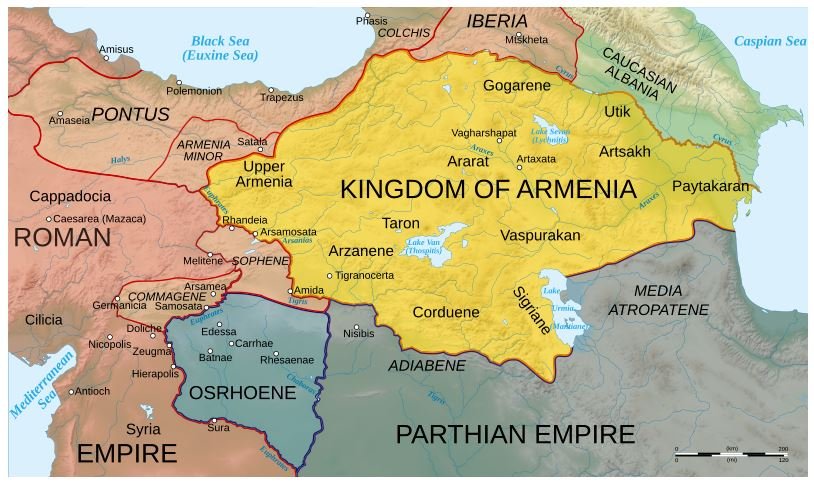
A map showing Osroene (left) and its nearby towns during the 1st century AD.
Origins and Establishment
Osroene emerged in the mid-2nd century BC as the Seleucid Empire weakened, allowing several independent states to form. The ruling Abgarid dynasty was of Nabataean Arab origin, and the kingdom itself was heavily influenced by the Aramaic-speaking culture. The capital city, Edessa (modern-day Şanlıurfa, Turkey), played a crucial role in the region’s trade and governance. The name “Osroene” is thought to derive either from the Osrhoeni tribe or from “Urhay,” the Aramaic name for Edessa.

Political Structure and Rulers
Throughout its history, Osroene was ruled by a succession of twenty-eight kings, most of whom bore the names Abgar or Manu. The kingdom’s status fluctuated between independence and client-state status, primarily under Parthian influence. However, it periodically aligned with Rome, leading to significant political shifts.
During the reign of Emperor Trajan, Osroene briefly became a Roman vassal state in AD 114 before being absorbed into the empire in 214 under Emperor Caracalla. Despite this, the region saw a brief reestablishment of the Abgarid dynasty under Gordian III in the 3rd century. The final monarch, Abgar X, ruled nominally until 242, after which Osroene became a permanent Roman province.
Cultural and Religious Influences
Osroene’s population was a mix of Syriac, Arab, Parthian, and Hellenistic cultures. The predominant language was Syriac, but Greek and Parthian influences were also evident in administration and art.
Religiously, Osroene was home to various belief systems, including Syriac paganism, Parthian traditions, and some Arab cults. Christianity arrived early in the region, and by the 2nd century, it had become a center for Syriac Christian scholarship. The city of Edessa later gained prominence as a hub for Christian literature and theological study, particularly during the 4th and 5th centuries.
As a kingdom, Osroene served as a bridge between East and West, blending Syriac, Arab, Parthian, and Hellenistic traditions.
Osroene in Roman Sources
Roman historians frequently mentioned Osroene due to its strategic location and political significance. The kingdom’s rulers were often characterized as “Arab phylarchs” or allies of Rome, though their loyalties frequently shifted between Rome and Parthia. Osroene played a key role in Roman-Parthian conflicts, and its rulers, such as Abgar II and Abgar V, were central figures in regional power struggles.
Edessa served as a critical military outpost for Rome, given its proximity to the Parthian and later Sasanian frontiers. The city lay along major trade routes connecting the East and the Mediterranean, which made it both economically valuable and strategically vital.
Decline and Integration into the Roman Empire
Osroene’s autonomy ended in AD 214 when Emperor Caracalla abolished the monarchy and incorporated the territory into the Roman Empire. The region continued to serve as a frontier province, frequently changing hands between Rome and Persia.
Under Roman rule, Osroene became part of the Diocese of the East and hosted a Roman garrison, particularly as tensions with the Sasanian Empire grew. The province played an essential role in regional conflicts throughout the late Roman and early Byzantine periods.

A map illustrating the Eastern Roman provinces in the 5th century AD, with Osroene among them.
Later History and Influence
Despite losing its political independence, Osroene remained a significant cultural and religious center. By the 5th century, Edessa had become a leading center for Syriac Christianity, housing scholars such as Bardaisan and later serving as a stronghold against Arianism.
During the early 7th century, Osroene fell to the Sasanian emperor Khosrow II but was briefly reclaimed by the Byzantines before being permanently conquered by Muslim forces in 638. Under Islamic rule, Edessa continued to be a center of learning and trade, though its influence gradually waned.

Frequently Asked Questions
What was the significance of Osroene’s location?
Situated on key trade routes between the East and the Mediterranean, Edessa became a major cultural and commercial hub, blending Syriac, Greek, Parthian, and Arab influences.
Who ruled Osroene?
The kingdom was governed by the Abgarid dynasty, with most rulers named Abgar or Ma’nu. It maintained semi-autonomy under Parthian and later Roman influence.
What was Osroene’s relationship with Rome and Parthia?
Osroene was initially allied with the Parthians but later became a Roman vassal. In AD 214, Emperor Caracalla annexed it as a Roman province.
Was Osroene the first Christian kingdom?
There is a tradition that King Abgar V converted to Christianity and made it the state religion, but historical evidence for this claim is weak.
What role did Osroene play in early Christianity?
Edessa became a major center for Syriac Christianity and literature, producing works like the Diatessaron and fostering scholars such as Tatian and Bardaisan.
How did Osroene fall?
The Romans annexed it in AD 214. It later changed hands between the Byzantines, Sasanians, and Arabs, finally falling to the Muslim conquest in AD 638.
What was the cultural composition of Osroene?
The population was mainly Syriac-speaking but influenced by Arab, Greek, and Parthian cultures. Greek and Aramaic inscriptions, along with Arab names, reflect this diversity.





