King’s Theatre in Edinburgh
The King’s Theatre in Edinburgh is one of Scotland’s most prestigious and historic theatrical venues. Established in the early 20th century, it has played a crucial role in the city’s cultural landscape. Over the decades, the theatre has witnessed significant transformations, from its ambitious construction to its modern-day role in Edinburgh’s thriving arts scene.
Below, WHE delves into the theatre’s history, its architectural significance, and its enduring legacy.
Origins and Early Years
The origins of the King’s Theatre date back to the early 1900s when it was commissioned by the Edinburgh Building Company Ltd, led by Robert C. Buchanan. Buchanan, an experienced theatre manager, aimed to create a rival venue to the well-established Royal Lyceum Theatre. Despite financial hurdles, the project moved forward, and on August 18, 1906, the foundation stone was laid by Andrew Carnegie. Underneath, newspapers and coins of the era were buried, symbolizing a new chapter in Edinburgh’s theatrical history.
When construction neared completion, financial difficulties forced the owners to transfer operating rights to a newly formed King’s Theatre Company, with William Stewart Cruikshank as a major shareholder. Initially, an attempt was made to sell the theatre to Howard & Wyndham Ltd, but it failed, leading the Cruikshank family to assume direct management. This marked the beginning of the King’s Theatre as an independent venue, setting the stage for its future prominence.

Front view of King’s Theatre.
Early Performances and Growing Reputation
The King’s Theatre opened its doors to the public on December 8, 1906, with a festive production of “Cinderella”, featuring Violet Englefield as the Prince and Phyllis Dare as Cinderella. The theatre quickly established itself as a premier venue for touring productions, including performances by Carl Rosa Opera and Richard D’Oyly Carte’s company. The repertoire expanded under A. Stewart Cruikshank, incorporating musicals, opera, drama, and large-scale pantomimes.
In 1928, A. Stewart Cruikshank realized the theatre was at a disadvantage by not being part of a larger circuit.
In 1928, the King’s Theatre was finally acquired by Howard & Wyndham Ltd, with Cruikshank becoming the managing director of the group. His vision and leadership made the King’s a cornerstone of Edinburgh’s entertainment scene, eventually earning him the role of chairman in 1944.
The Half Past Eight Show and Theatrical Innovations
A major turning point for the theatre came in 1934, when Cruikshank experimented with a summer season variety show, similar to seaside entertainment. However, the initial attempt, featuring Jack Edge, was a failure. In 1937, Charles Ross and his wife Ilona Ross revived the concept, this time starring an up-and-coming comedian, Dave Willis. Initially, ticket sales were disappointing, but word-of-mouth popularity led to a complete turnaround, transforming the show into a 28-week-long spectacle by 1941.
The Half Past Eight Show became a breeding ground for Scottish theatrical talent, featuring later stars such as Stanley Baxter, Rikki Fulton, and Jimmy Logan. It established the King’s Theatre as an essential venue for comedy and variety performances, a reputation that endures to this day.

The ceiling of the theatre.
Post-War Challenges and Renovations
Tragedy struck in 1948 when A. Stewart Cruikshank was killed in a car accident. Despite this loss, the Howard & Wyndham group ensured the theatre’s continued success. By the 1950s, however, the venue faced the wear and tear of capacity audiences. A modern glass canopy replaced the original structure in 1950, followed by an extensive interior refurbishment. The most significant structural changes came in 1951, when the uppermost balcony was demolished, and the rake of the Upper Circle was increased to improve sightlines. These alterations reduced seating capacity but enhanced audience experience.
During this period, the theatre continued to host successful pantomimes, variety shows, and musical productions. In 1960, the first-ever Edinburgh Gang Show debuted, featuring over 100 Boy Scouts. This annual performance tradition still thrives, now including over 200 young participants from both Scouting and Girl Guiding organizations.
Threats to Survival and Public Ownership
By the late 1960s, the rise of television created financial challenges for live theatre. Star performers demanded higher fees, making it difficult for independent venues to compete. Without external funding, the King’s Theatre faced possible closure. In 1969, Edinburgh City Council stepped in, purchasing the venue to secure its future. This transition allowed the theatre to continue hosting performances for the Edinburgh International Festival and Scottish Opera, solidifying its place as a key cultural institution.
Further renovations in 1985, costing £1.25 million, restored woodwork, carpets, glass, and marble. The seating layout was reconfigured to improve comfort, and a new apron and orchestra pit were installed. These changes ensured the theatre remained a first-class performance venue.
Theatre Architecture and Interior Design
The King’s Theatre is a blend of Edwardian grandeur and modern restoration efforts. The building was designed by James Davidson, a Coatbridge-based architect known for his work on churches and public buildings. The exterior features a symmetrical facade, with double windows, pillars, bay windows, and a semicircular window above the entrance. The original glass canopy was replaced in the mid-20th century, modernizing its street presence.
The interior was designed by J.D. Swanston, who had prior experience designing Scottish theatres. It includes ornate mahogany fixtures, stained glass, marble pilasters, and parquet flooring. The auditorium initially seated 2,500 patrons, but various modifications over the years have reduced this to 1,350 seats. The box seating arrangement spans three levels, though some early sightline issues limited visibility from certain areas.
A major artistic addition came in 2013, when John Byrne designed a ceiling mural to disguise cracked plasterwork. The theatre continues to balance preservation efforts with modernization projects to maintain its historic charm.
Contemporary Role and Future Developments
Today, the King’s Theatre remains a centerpiece of Edinburgh’s theatrical landscape. It is managed by Capital Theatres, which also operates the Festival Theatre. The venue hosts Edinburgh’s annual pantomime, produced by Qdos Entertainment, and serves as a key location during the Edinburgh Festival.
From its Edwardian origins to its modern role as a festival venue, the King’s Theatre has remained a beloved institution in Scotland’s performing arts scene.
To keep up with modern expectations, plans for an extensive refurbishment project was scheduled for 2020-2021. These improvements were aimed to enhance accessibility, upgrade backstage facilities, and modernize audience amenities. The project is designed to preserve the theatre’s historic integrity while ensuring it remains fit for 21st-century productions.
Timeline
- 1906 (Aug 18) – Foundation stone laid by Andrew Carnegie.
- 1906 (Dec 8) – Theatre opens with Cinderella, starring Phyllis Dare.
- 1908 – A. Stewart Cruikshank becomes managing director.
- 1928 – Sold to Howard & Wyndham; Cruikshank remains as director.
- 1934 – First summer season show The Half Past Eight flops.
- 1937 – Revived by Charles Ross; Dave Willis stars; show gains success.
- 1941 – The Half Past Eight extends to 28 weeks.
- 1948 – Cruikshank dies in a car accident.
- 1951 – Major refurbishments; reopened with Puss in Boots.
- 1960 – First Edinburgh Gang Show debuts.
- 1969 – Sold to Edinburgh City Council.
- 1985 – £1.25m restoration.
- 2013 – John Byrne mural added to ceiling.
- 2020–2021 – Planned major refurbishment.
Frequently Asked Questions
What was the King’s Theatre originally built as a rival to?
The Royal Lyceum Theatre in Edinburgh.
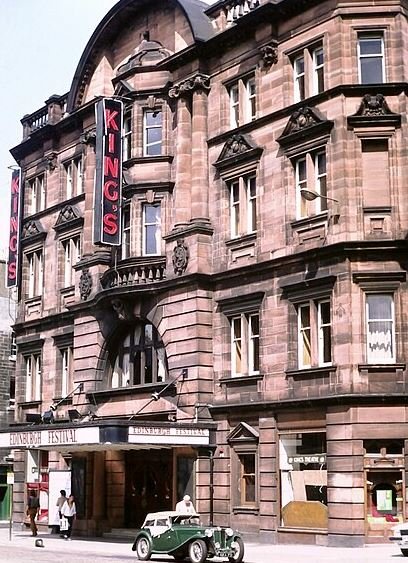
A 1981 photo of King’s Theatre.
Who laid the foundation stone of the theatre, and when?
Andrew Carnegie laid the foundation stone on 18 August 1906.
What was the first performance at the King’s Theatre?
A production of Cinderella on 8 December 1906, starring Phyllis Dare.
What was the impact of the ‘Half Past Eight’ show?
Initially unsuccessful in 1934, it later became a long-running hit from 1937 under Dave Willis.
Why did Edinburgh City Council buy the theatre in 1969?
To secure its future as a venue for the Edinburgh International Festival and Scottish Opera.
What was the major change in seating capacity over time?
Originally 2,500 seats, it was reduced to 1,350 after refurbishments.





