What is Neoplatonism?
Neoplatonism is a profound philosophical movement that emerged in the 3rd century AD, flourishing against the vibrant backdrop of Hellenistic philosophy and diverse religious traditions. Unlike a singular set of doctrines, Neoplatonism is best understood as a lineage of thinkers unified by their reinterpretation of Plato‘s ideas, with a central tenet being the concept of monism. Monism, in this context, suggests that all of reality derives from a single, transcendent principle known as “the One.” Below, World History Edu explores the origins, development, and enduring influence of Neoplatonism through history.
Origins and Foundational Thinkers
Neoplatonism’s inception can be traced to Ammonius Saccas and his most famous student, Plotinus (c. 204/5–271 AD). Plotinus is often regarded as the founder of Neoplatonism, crafting a system that sought to synthesize Platonic philosophy with mystical and religious elements. The philosophy evolved through three primary phases post-Plotinus: the teachings of Porphyry, the contributions of Iamblichus, and the flourishing of Neoplatonic academies in Alexandria and Athens during the 5th and 6th centuries.

Core Concepts of Neoplatonism
At the heart of Neoplatonism lies the metaphysical framework introduced by Plotinus in his seminal work, the “Enneads.” Plotinus describes the One as an indescribable, transcendent source from which emanates the Nous (Intellect) and the World Soul, creating a hierarchical structure of existence. The One, being beyond all categories of existence, serves as the ultimate source of all reality, with the Nous embodying divine intellect and the World Soul mediating between the divine and the material world.
Porphyry and the Expansion of Neoplatonism
Porphyry, a student of Plotinus, played a pivotal role in disseminating Neoplatonic thought. He organized Plotinus’ teachings into the “Enneads” and explored the intersections of philosophy, religion, and mysticism. Porphyry’s critique of Christianity and defense of traditional paganism highlighted the cultural and religious tensions of the time, further embedding Neoplatonism into the intellectual fabric of late antiquity.
Iamblichus and the Integration of Theurgy
Iamblichus, another significant figure, expanded Neoplatonism by integrating theurgy—rituals intended to invoke divine powers—into the philosophical framework. His work emphasized the soul’s ascent to the divine through ritualistic practices, marking a departure from the more abstract metaphysical speculations of Plotinus.
By emphasizing the unity of all existence and the soul’s ascent towards the divine, Neoplatonism continues to inspire philosophical inquiry and spiritual exploration.
Influence on Religious Thought
Neoplatonism profoundly impacted Christian, Islamic, and Jewish thought. Early Christian theologians like Augustine of Hippo incorporated Neoplatonic ideas into Christian doctrine, particularly the concept of evil as a privation of good. In the Islamic world, philosophers like Al-Farabi and Avicenna adapted Neoplatonic concepts to fit Islamic theology, while Jewish thinkers like Solomon ibn Gabirol explored Neoplatonic ideas within a monotheistic framework.
Top Scholars of the Islamic Golden Age and their Major Achievements
Renaissance Revival
The Italian Renaissance saw a resurgence of Neoplatonism, with thinkers like Marsilio Ficino and Giovanni Pico della Mirandola reviving Platonic philosophy in a Christian context. Ficino’s translations of Plato and Plotinus catalyzed a philosophical awakening, influencing art, literature, and theology.

Head of Plotinus
Questions and Answers
Who founded Neoplatonism?
Neoplatonism was founded by Ammonius Saccas, but its most influential thinker was Plotinus (c. 204–270 AD), whose teachings were compiled in the Enneads by his student Porphyry.
What are the key concepts of Neoplatonism?
Neoplatonism describes reality as emanating from “the One” in a hierarchical structure:
- The One – the source of all existence, beyond being and comprehension.
- Nous (Intellect) – the realm of pure thought and Platonic Forms.
- Soul – the link between the intelligible and material world.
- Matter – the lowest, most imperfect level.
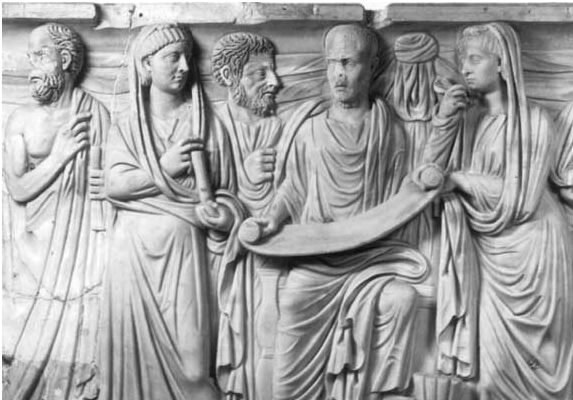
A Roman sarcophagus in the Museo Gregoriano Profano at the Vatican Museums features a depiction of Plotinus surrounded by his disciples.
How did Neoplatonism influence Christianity?
Neoplatonism shaped Christian theology, particularly through thinkers like Augustine of Hippo, Pseudo-Dionysius, and Thomas Aquinas. Concepts such as the transcendence of God, the hierarchy of being, and the idea of evil as the absence of good were integrated into Christian doctrine.
How did Neoplatonism differ from Gnosticism?
Unlike Gnosticism, which saw the material world as evil, Neoplatonism viewed it as a reflection of higher realities. While both traditions emphasized transcendence, Neoplatonists rejected the idea that a flawed demiurge created the world.

What role did Proclus and Iamblichus play in Neoplatonism?
Iamblichus (c. 245–325 AD) introduced theurgy—ritual practices to connect with the divine. Proclus (412–485 AD) expanded Neoplatonism with his complex metaphysical system, including the “henads,” which linked gods to Platonic principles.
How did Neoplatonism influence Islamic and Jewish philosophy?
Islamic philosophers like Al-Farabi, Avicenna, and Maimonides incorporated Neoplatonic ideas into their interpretations of God, creation, and intellect. Jewish mysticism, particularly Kabbalah, also absorbed Neoplatonic thought.
How was Neoplatonism revived during the Renaissance?
Figures like Marsilio Ficino and Giovanni Pico della Mirandola reintroduced Neoplatonism in the Renaissance, blending it with Christian and Hermetic traditions, influencing Western thought, art, and mysticism.





