Life and Major Works of Roman Author Vegetius
Publius (or Flavius) Vegetius Renatus, commonly known as Vegetius, was a Roman author whose works have had a profound influence on military strategy, organization, and thought from antiquity through the Middle Ages and beyond.
While little is known about his life, his major contributions, particularly Epitoma rei militaris (commonly referred to as De re militari), have cemented his legacy as a critical figure in the history of military literature. His other work, Digesta Artis Mulomedicinae, a treatise on veterinary medicine, is lesser-known but still significant within its specific field.
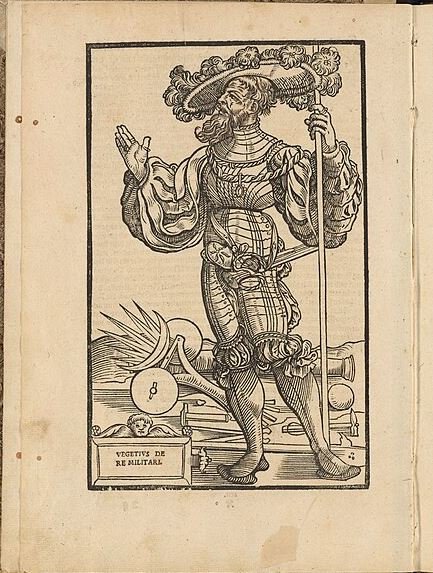
Publius (or Flavius) Vegetius Renatus, known as Vegetius, was a late 4th-century Roman writer. His surviving works include Epitoma rei militaris, a military treatise, and Digesta Artis Mulomedicinae, a veterinary guide. Image: A portrait of Vegetius.
Vegetius’s Life
The exact details of Vegetius’s life remain obscure, as his surviving works provide minimal autobiographical information. Scholars estimate that Vegetius lived and wrote during the late 4th or early 5th century CE, a period marked by the decline of the Western Roman Empire. The instability and weakening of Roman military power during this era are reflected in his works, which often stress the need for reform and a return to the disciplined practices of earlier Roman armies.
Vegetius identifies himself as a Christian in the introduction to Epitoma rei militaris, aligning him with the dominant religious affiliation of the late Roman Empire following Emperor Constantine’s Edict of Milan (313 CE).
His works suggest he was well-educated and likely held a significant administrative position, possibly within the military or imperial bureaucracy. Some scholars have speculated that Vegetius may have been a primiscrinius (a senior official) or an agens in rebus (a member of the imperial courier and intelligence service), though this remains conjecture.
Why did Roman Emperor Constantine the Great convert to Christianity?
Major Works of Vegetius
Epitoma Rei Militaris (De re militari)
Vegetius’s Epitoma rei militaris, or De re militari, is by far his most famous work. It is a comprehensive manual on Roman military practices, reflecting both practical and theoretical approaches to warfare. Written during a time of military decline in the Western Roman Empire, it aims to revive the discipline, organization, and strategies that had characterized Rome’s earlier military successes.
Historical Context and Dedication
The exact date of composition is debated. Vegetius dedicated the work to a reigning emperor, identified in some manuscript traditions as Theodosius. Scholars differ on whether this refers to Theodosius I (r. 379–395) or Theodosius II (r. 408–450). Others argue for a later date, suggesting the reign of Valentinian III (r. 425–455) as a possible timeframe, during which the Western Empire faced increasing external threats and internal disarray.
Vegetius’s plea for military reform reflects his concern over the deterioration of the Roman army, which had become reliant on poorly trained conscripts and mercenaries. His work advocates a return to the rigorous training and discipline of earlier periods, particularly the principate (27 BCE–284 CE).
Structure and Content
The Epitoma rei militaris is organized into five books, each addressing distinct aspects of military affairs:
- Book I: Army Reform and Recruitment
- Vegetius begins with a call for reform, decrying the decline of military discipline in his time.
- He outlines the ideal qualifications for recruits, emphasizing physical fitness, moral character, and proper training.
- The book provides a detailed description of how soldiers in earlier periods were recruited, equipped, and trained to maintain readiness for combat.
- Book II: Strategy and Training
- This book focuses on the organization and logistics required for effective campaigns.
- Vegetius provides advice on fortifying camps, maintaining supply lines, and ensuring discipline among troops.
- He highlights the importance of cohesive and orderly operations, arguing that training and preparation are the foundations of victory.
- Book III: Maxims of War
- The third book is a compilation of military maxims and principles.
- Vegetius stresses the importance of adaptability, preparation, and understanding the enemy.
- Many of these principles became cornerstones of military strategy in medieval and early modern Europe, resonating with commanders like William the Silent and Frederick the Great.
- Book IV: Siegecraft
- This section is dedicated to siege warfare, detailing techniques for attacking and defending fortified positions.
- Vegetius describes siege engines, such as the onager, and offers practical advice for constructing and using these weapons effectively.
- The book also discusses psychological strategies, such as demoralizing enemy forces during prolonged sieges.
- Book V: Naval Warfare
- The final book addresses naval operations, including the organization of fleets and the logistics of maritime campaigns.
- Although less detailed than the preceding books, it provides insights into the role of naval power in Roman military strategy.
Legacy and Influence
The Epitoma rei militaris became one of the most widely copied and studied texts in the Middle Ages. Its practical advice on discipline, siegecraft, and organization resonated with medieval commanders, who faced similar challenges to those described by Vegetius. The work was translated into numerous languages, including English, French, Italian, Spanish, Catalan, Czech, and even Yiddish, ensuring its widespread dissemination.
Vegetius’s work bridged the gap between antiquity and the medieval world, influencing centuries of military practice.
By the Renaissance, however, Vegetius’s reputation began to decline. The rediscovery of classical authors such as Polybius, Livy, and Frontinus led scholars to critique his work for its reliance on earlier sources and its lack of coherence. Despite this, Epitoma rei militaris remains an invaluable historical document, offering a window into Roman military thought and the challenges of the Late Empire.
Digesta Artis Mulomedicinae
Vegetius’s other surviving work, Digesta Artis Mulomedicinae, is a treatise on veterinary medicine, specifically focusing on the care of horses and other pack animals used in the Roman military. While less celebrated than Epitoma rei militaris, it reflects Vegetius’s interest in the practical needs of the army, where the health and maintenance of animals were critical for transportation and logistics.
Content and Structure
- The work provides guidelines for diagnosing and treating various ailments affecting horses, mules, and other beasts of burden.
- It includes remedies, dietary advice, and preventive measures to ensure the animals’ health and performance.
- The treatise reflects the Roman emphasis on efficient logistics, as healthy pack animals were essential for moving supplies and troops across vast distances.
Although overshadowed by his military manual, Digesta Artis Mulomedicinae remains an important text in the history of veterinary medicine. It demonstrates the advanced understanding of animal care in Roman times and highlights the interconnectedness of military success and logistical efficiency.
Vegetius’s Influence Through the Ages
Vegetius’s works, particularly Epitoma rei militaris, enjoyed immense popularity in the medieval period, shaping the development of military thought in Europe.
The manual’s relevance to medieval warfare, especially its rules on siegecraft and discipline, made it a foundational text for knights and commanders. Translations into vernacular languages ensured its accessibility, while manuscripts proliferated in monasteries and royal libraries.
The Renaissance brought a renewed interest in original classical sources, leading scholars to reassess Vegetius’s work. Figures like Justus Lipsius criticized Vegetius for conflating practices from different periods of Roman history, while Niccolò Machiavelli addressed his limitations in L’arte della Guerra (1521).
By the 18th century, Vegetius’s influence had waned, but his principles continued to inspire military professionals sporadically. In modern times, Epitoma rei militaris is valued more as a historical document, providing insights into the military challenges and reforms of the Late Roman Empire.
Conclusion
Vegetius remains a pivotal figure in the history of military literature. His works, shaped by the turbulence of the Late Roman Empire, offer a blend of practical advice, historical reflection, and reformist zeal. While Epitoma rei militaris dominated medieval military thought, his contributions extend to veterinary care and logistical planning, demonstrating his wide-ranging impact on Roman and later military systems.
Frequently Asked Questions
Who was Publius (or Flavius) Vegetius Renatus, and why is he significant?
Vegetius was a late Roman author known for his Epitoma rei militaris, a manual on Roman military practices and strategies. It became a foundational text in medieval and early modern military education.
What is Epitoma rei militaris, and what does it address?
Epitoma rei militaris is a five-book manual that discusses military organization, tactics, training, siegecraft, and naval warfare, focusing on improving discipline and efficiency in the Roman military.
To whom did Vegetius dedicate Epitoma rei militaris?
Vegetius the work to a reigning emperor identified as Theodosius in one manuscript tradition. Scholars debate whether thisrefers to Theodosius I or Theodosius II, with some suggesting Valentinian III as an alternative.
What historical challenges does Vegetius address in his work?
Vegetius emphasizes the decline of the Roman military during the Late Empire, advocating reforms to restore the discipline, training, and organization of earlier Roman armies.
What are the five main topics covered in the books of Epitoma rei militaris?
- Book I: Army reform and early Empire practices.
- Book II: Military strategy, training, and logistics.
- Book III: Maxims of warfare.
- Book IV: Siegecraft and siege engine descriptions.
- Book V: Naval warfare and organization.
How did Vegetius compile his work, and which sources did he use?
Vegetius relied on earlier sources, such as Cato the Elder, Cornelius Celsus, Frontinus, and imperial decrees from Augustus, Trajan, and Hadrian. His work synthesizes ideas from different periods of Roman history.
What made Epitoma rei militaris so influential in the Middle Ages?
Its detailed rules of siegecraft and military organization were practical for medieval warfare. The work was widely copied, translated into numerous languages, and studied by military leaders.
What criticisms have been leveled against Vegetius’s work?
Critics like G.R. Watson and Justus Lipsius argue that Vegetius was neither a historian nor a soldier and that his work lacks coherence, conflates practices from different periods, and contains inconsistencies.
How did the Renaissance affect the reputation of Epitoma rei militaris?
The rediscovery of classical authors like Polybius and Frontinus during the Renaissance diminished Vegetius’s prominence, as scholars preferred more accurate and nuanced sources on Roman military practices.
What is the modern view of Epitoma rei militaris?
Today, the work is valued more as a historical document than as a practical guide. It provides insights into the challenges of the Late Roman Empire and the transmission of Roman military knowledge to later periods.
Why was Epitoma rei militaris widely translated in the Middle Ages?
The manual’s practical advice on siegecraft, training, and discipline made it relevant for medieval warfare, leading to translations in English, French, Italian, Spanish, Catalan, and other languages.





