Life and Political Career of Konrad Adenauer, the First Chancellor of West Germany
Konrad Adenauer was also a fervent advocate of European unity, signing the Treaty of Rome in 1957, which laid the groundwork for the European Economic Community and eventually the European Union. His efforts earned him recognition as one of the “Founding Fathers of the European Union.”
Adenauer is best known for his significant contributions to the reconstruction and integration of West Germany into the European and global community, fostering an era of economic prosperity and international respect for the nation.
In the article below, World History Edu explores the life and political career of Konrad Adenauer.
Early Life and Career
Konrad Hermann Joseph Adenauer was born on January 5, 1876, in Cologne, Germany. He grew up in a devoutly Roman Catholic family and was the third of five children. His father, Johann Konrad Adenauer, was a clerk in the Cologne court, and his mother, Helene Scharfenberg, came from a prosperous farming family. Adenauer’s upbringing in a religious and disciplined environment significantly influenced his values and political orientation.
Adenauer studied law and political science at the universities of Freiburg, Munich, and Bonn. After completing his education, he worked as a lawyer in Cologne. His early career was marked by a rapid rise in local politics, fueled by his association with the Catholic Centre Party, which represented the interests of Catholics in Germany. In 1906, he was elected to the Cologne City Council, and in 1917, he became the Mayor of Cologne, a position he held until 1933.
Political Career in the Weimar Republic
As Mayor of Cologne, Adenauer implemented numerous progressive policies and infrastructural projects. He modernized the city’s transportation system, expanded public housing, and improved social services. His efforts transformed Cologne into a model of urban development and earned him a reputation as a capable and forward-thinking leader. During this period, he also served as the president of the Prussian State Council, where he advocated for greater autonomy for the Rhineland and other regions within Germany.
Adenauer’s political career during the Weimar Republic was characterized by his pragmatic approach to governance and his commitment to Catholic social teachings. He navigated the turbulent political landscape of the time, balancing the interests of various factions within the Centre Party and building coalitions with other political groups. However, the rise of the Nazi Party in the early 1930s posed a significant threat to his career and the democratic institutions he supported.
Conflict with the Nazis
Adenauer was an outspoken critic of Adolf Hitler and the Nazi Party. When Hitler came to power in 1933, Adenauer’s political career was abruptly interrupted. He was removed from his position as Mayor of Cologne and faced persecution from the Nazi regime. In 1934, he was briefly imprisoned, and during the following years, he lived in seclusion, maintaining a low profile to avoid further retribution.
Despite the dangers, Adenauer remained committed to his political ideals and continued to oppose the Nazi regime. He maintained contact with other anti-Nazi figures and participated in efforts to resist the totalitarian state. His resilience during this period demonstrated his steadfast dedication to democracy and human rights.
Post-War Political Reemergence
After World War II, Germany was in ruins, and its political landscape was in disarray. Adenauer, now in his seventies, reemerged as a prominent political figure. He was instrumental in founding the Christian Democratic Union (CDU) in 1945, a party that aimed to unite Catholics and Protestants in a broad-based, center-right political movement. The CDU quickly gained popularity and became a dominant force in West German politics.
In 1949, Adenauer was elected as the first Chancellor of the newly established Federal Republic of Germany (West Germany). His election marked the beginning of a new era in German politics. As Chancellor, Adenauer faced the monumental task of rebuilding a nation devastated by war and division. He prioritized economic recovery, democratic governance, and integration with Western Europe and the United States.

A devout Roman Catholic, Adenauer shifted his focus from denazification to recovery in the early years of the Federal Republic, fostering close relations with France, the United Kingdom, and the United States. Image: A 1952 photograph of Adenauer.
Economic Recovery and the “Economic Miracle”
One of Adenauer’s most significant achievements as Chancellor was his role in orchestrating the West German “Economic Miracle.” Under his leadership, the government implemented policies that promoted industrial growth, investment, and social market economy principles. With the help of the Marshall Plan, which provided financial aid from the United States, West Germany experienced rapid economic growth, rising from the ashes of World War II to become one of the world’s leading economies.
Adenauer’s economic policies focused on free-market principles while ensuring social welfare programs to support the population. His government’s initiatives included the reconstruction of infrastructure, the establishment of a stable currency (the Deutsche Mark), and the promotion of trade and investment. These efforts resulted in high employment rates, improved living standards, and a thriving middle class.
Foreign Policy and European Integration
Adenauer’s foreign policy was characterized by his strong commitment to Western integration and cooperation. He sought to align West Germany with the Western bloc during the Cold War, emphasizing close relations with France, the United Kingdom, and the United States. Adenauer believed that a united Europe was essential for peace and stability, and he worked tirelessly to promote European integration.
One of his most significant achievements in this regard was his role in the creation of the European Economic Community (EEC), the precursor to the European Union. In 1957, Adenauer signed the Treaty of Rome, which established the EEC and laid the foundation for economic cooperation and integration among European nations. His efforts earned him recognition as one of the “Founding Fathers of the European Union.”
Military and Security Policies
Adenauer also played a crucial role in re-establishing West Germany’s military and security apparatus. In 1955, West Germany joined the North Atlantic Treaty Organization (NATO), marking its formal integration into the Western defense alliance. Adenauer was a strong advocate for the rearmament of West Germany, believing that a robust military was essential for national security and deterrence against potential threats from the Soviet Union and its allies.
Under Adenauer’s leadership, West Germany established the Bundeswehr (Federal Defense Force) in 1955 and the Bundesnachrichtendienst (Federal Intelligence Service) in 1956. These institutions played a vital role in ensuring the country’s security and stability during the Cold War.
Domestic Policies and Social Reforms
On the domestic front, Adenauer’s government implemented several significant social reforms that aimed to improve the quality of life for West Germans. These reforms included the expansion of the social security system, the introduction of pension schemes, and measures to support families and promote social welfare. Adenauer’s commitment to social justice and his pragmatic approach to governance helped create a more equitable society in post-war Germany.
Adenauer also placed a strong emphasis on education and cultural development. His government invested in rebuilding and modernizing the education system, promoting access to higher education and vocational training. These efforts contributed to the development of a skilled workforce and further fueled economic growth.
Political Instinct and Leadership Style
Adenauer’s leadership style was marked by his pragmatic approach, political acumen, and ability to build consensus. He was known for his intense work habits, attention to detail, and strategic thinking. Adenauer’s political instinct allowed him to navigate complex challenges and build effective coalitions, both domestically and internationally.
Despite his age, Adenauer remained an active and energetic leader throughout his tenure as Chancellor. He was deeply committed to his vision of a prosperous, democratic, and integrated West Germany. His leadership style earned him respect and admiration from his supporters and colleagues, even as he faced criticism and opposition from some quarters.
Opposition to the German Democratic Republic and the Oder-Neisse Line
Adenauer firmly opposed the recognition of the German Democratic Republic (East Germany) and the Oder-Neisse line as the border with Poland. He believed that accepting these realities would legitimize the division of Germany and undermine efforts for reunification. Adenauer’s stance on these issues reflected his commitment to a united Germany and his refusal to compromise on matters of national sovereignty and territorial integrity.
Did you know…?
Konrad Adenauer negotiated a compensation agreement with Israel, acknowledging the atrocities committed against Jews by the Nazis.
Legacy and Impact
Konrad Adenauer’s impact on Germany and Europe is profound and enduring. His leadership during the formative years of the Federal Republic of Germany laid the foundation for the country’s post-war recovery and integration into the Western community. Adenauer’s economic policies and commitment to democratic governance transformed West Germany into a prosperous and stable nation.
His efforts to promote European integration and cooperation left a lasting legacy, contributing to the creation of the European Union and fostering peace and stability on the continent. Adenauer’s vision of a united Europe continues to shape the policies and aspirations of European leaders to this day.
Adenauer’s commitment to social justice, economic prosperity, and democratic values earned him recognition and respect both in Germany and internationally. He is remembered as a statesman of great integrity, vision, and determination, whose contributions to his country and the world have had a lasting and positive impact.
Conclusion
Konrad Adenauer’s life and political career are a testament to his unwavering commitment to democracy, economic prosperity, and European integration. From his early years as a local politician in Cologne to his tenure as the first Chancellor of the Federal Republic of Germany, Adenauer demonstrated exceptional leadership and vision. His efforts to rebuild post-war Germany, promote social justice, and foster international cooperation have left an indelible mark on history. Adenauer’s legacy as a statesman and a founding father of the European Union continues to inspire leaders and citizens around the world.
Frequently Asked Questions
Konrad Adenauer’s political acumen and tireless work ethic were evident despite his advanced age. A staunch anti-communist, he was committed to an Atlanticist foreign policy and played a crucial role in re-establishing West Germany’s military (the Bundeswehr) and intelligence services (the Bundesnachrichtendienst) in the mid-1950s.
Here are some frequently asked questions about the German politician:
When and where was Konrad Adenauer born?
Konrad Adenauer was born on January 5, 1876, in Cologne, Germany.
What profession did Konrad Adenauer pursue after his education?
Konrad Adenauer became a lawyer after studying at the universities of Freiburg, Munich, and Bonn.
What significant political role did Adenauer hold in Cologne starting in 1917?
Adenauer became the lord mayor of Cologne in 1917.
By 1920, Adenauer had become the president of the Prussian State Council.
How did Adenauer’s political career change when the Nazis came to power?
Adenauer was replaced as mayor of Cologne and was briefly imprisoned in 1934.
What happened to Adenauer in September 1944?
Adenauer was arrested by the Gestapo in September 1944, accused of involvement in the failed July 20 plot against Hitler.
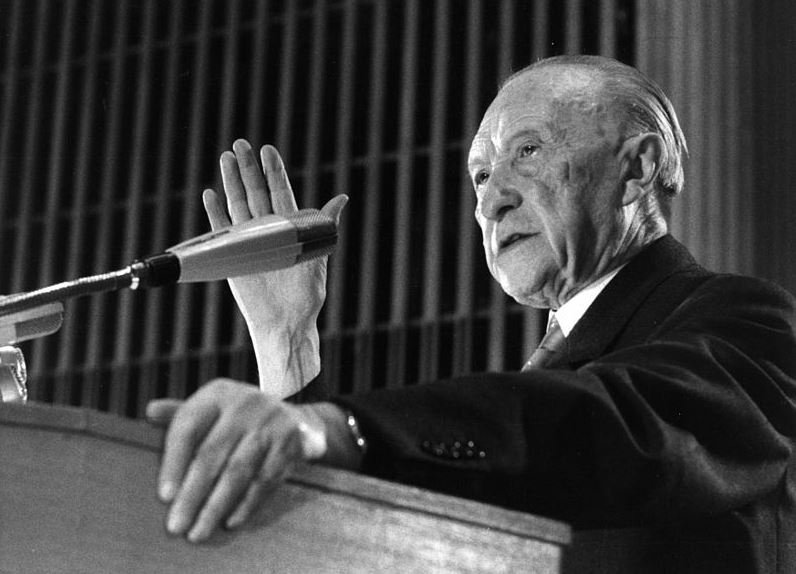
Adenauer’s political career began in the Weimar Republic, where he was a prominent figure in the Catholic Centre Party. He served as the Mayor of Cologne from 1917 to 1933 and as the president of the Prussian State Council. Image: Adenauer during a 1966 CDU party rally.
What role did the American forces play in Adenauer’s political career post-World War II?
The American forces reinstated Adenauer as mayor of Cologne after liberating the city, though he was soon dismissed by the British military government.
What political party did Adenauer help to form after World War II?
Adenauer helped to form the Christian Democratic Union (CDU).
What significant political role did Adenauer take on in 1948?
In 1948, Adenauer was appointed president of the parliamentary council responsible for drafting a constitution for the three western zones of Germany.
When was Adenauer elected as the first chancellor of the Federal Republic of Germany?
Adenauer was elected as the first chancellor of the Federal Republic of Germany on September 15, 1949.
Adenauer’s primary objectives were to transition West Germany into a sovereign, democratic state.

What significant international alliances did West Germany join under Adenauer’s leadership?
Under Adenauer’s leadership, West Germany joined NATO in 1955 and the European Economic Community in 1957.
With which two countries did Adenauer particularly seek to strengthen ties?
Adenauer sought to strengthen ties with the United States and France.
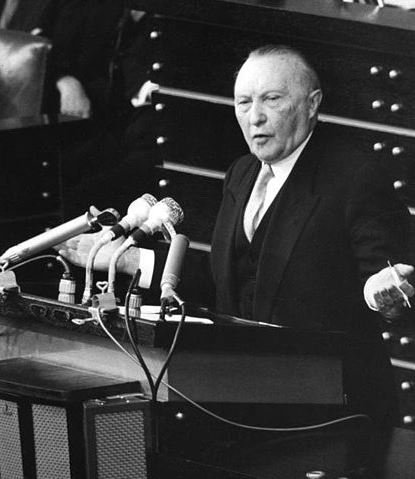
Konrad Adenauer was also the inaugural leader of the Christian Democratic Union (CDU) from 1946 to 1966, a party that he helped establish and led to dominance in post-war Germany. Image: Adenauer in 1955.
What was Adenauer’s stance on the German Democratic Republic (East Germany)?
Adenauer refused to recognize the German Democratic Republic (East Germany).
When did Adenauer retire as chancellor, and when did he step down as the head of the CDU?
Adenauer retired as chancellor in 1963 and remained the head of the CDU until 1966.
When and where did Konrad Adenauer pass away?
Konrad Adenauer passed away near Bonn on April 20, 1967.





