Lorenzo de’ Medici
Lorenzo di Piero de’ Medici (1449–1492), famously known as Lorenzo the Magnificent, was an Italian statesman, de facto ruler of the Florentine Republic, and one of the most influential patrons of Renaissance art and culture. He played a pivotal role in stabilizing the Italian Peninsula through his leadership within the Italic League while fostering an era of unparalleled artistic and intellectual advancement. His political maneuvering, diplomatic acumen, and unwavering support of artists and scholars established Florence as a beacon of Renaissance civilization.
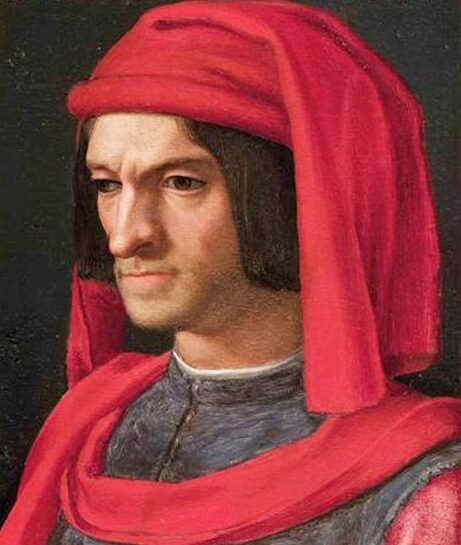
Portrait of Lorenzo de’ Medici by Italian painter Agnolo Bronzino.
Top 10 Renaissance Artists and their Most Famous Masterpieces
Early Life and Education
Born into the powerful Medici family, Lorenzo was groomed for leadership from an early age. His grandfather, Cosimo de’ Medici, was a formidable figure in both Florentine politics and finance, using his immense wealth to bolster the Medici Bank and patronize the arts. Lorenzo’s father, Piero di Cosimo de’ Medici, continued the family’s political and cultural influence, ensuring that Lorenzo received an extensive education befitting a future leader.
Lorenzo’s intellectual upbringing was enriched by some of the greatest minds of the Renaissance. He was tutored by the diplomat and bishop Gentile de’ Becchi and the humanist philosopher Marsilio Ficino, who introduced him to Neoplatonism. Greek scholar John Argyropoulos trained him in classical literature and philosophy, providing Lorenzo with a foundation in both diplomacy and the arts. These formative years shaped him into a statesman whose policies were deeply informed by humanist ideals.
Political Ascendancy and Leadership
Following the death of his father in 1469, Lorenzo assumed control of Florence at the young age of 20. Despite lacking an official title, he wielded immense influence through strategic marriages, financial backing, and political alliances. Unlike his predecessors, Lorenzo ruled with an emphasis on diplomacy rather than outright coercion, ensuring stability and maintaining Florence’s economic prosperity.
Lorenzo’s most significant political achievement was his ability to balance power among the Italian city-states. By maintaining the Italic League, he prevented external forces such as France and the Holy Roman Empire from interfering in Italian affairs. His diplomatic efforts helped maintain peace and secured Florence’s position as a dominant power in the region.
However, Lorenzo’s rule was not without challenges. His dominance bred resentment among rival families, most notably the Pazzi. The Pazzi Conspiracy of 1478, orchestrated with the support of Pope Sixtus IV, sought to overthrow the Medici regime. During a dramatic assassination attempt in the Cathedral of Santa Maria del Fiore, Lorenzo narrowly escaped with his life, while his brother Giuliano was brutally murdered. In response, Lorenzo swiftly executed the conspirators and reinforced Medici control, further solidifying his grip on power.
Florence as the Center of Renaissance Culture
Lorenzo’s most enduring legacy lies in his role as a patron of the arts. He provided support to some of the most celebrated artists and intellectuals of the Renaissance, including Sandro Botticelli, Leonardo da Vinci, Michelangelo, and Domenico Ghirlandaio. Unlike his predecessors, Lorenzo did not commission vast numbers of artworks for himself; instead, he facilitated opportunities for artists to create masterpieces that defined an era.
His patronage extended beyond the visual arts. Lorenzo was a prolific poet and writer, producing works that reflected both the joys and transience of life. His literary pursuits complemented the intellectual environment of Florence, where scholars such as Ficino and Poliziano engaged in philosophical discourse that merged classical traditions with contemporary humanist thought.

Giorgio Vasari’s portrait of Lorenzo de’ Medici.
Diplomacy and Foreign Relations
Lorenzo’s diplomatic skills were tested following the Pazzi Conspiracy, as Pope Sixtus IV excommunicated him and placed Florence under interdict. The situation escalated when the papacy allied with Ferdinand I of Naples, threatening Florence’s security. Rather than resorting to war, Lorenzo personally traveled to Naples, placing himself in the hands of the king. His daring negotiation secured a peace treaty, reestablishing Florence’s standing and demonstrating his effectiveness as a statesman.
Through alliances with the Ottoman Empire, Lorenzo ensured continued economic growth for Florence. He established trade agreements with Sultan Mehmed II, allowing Florentine merchants to access lucrative markets and ensuring a steady flow of wealth into the city. These economic ties contributed to Florence’s dominance in banking and commerce.
The Darker Side of Lorenzo’s Rule
Despite his many achievements, Lorenzo’s reign was not without controversy. The Medici Bank, once the most powerful financial institution in Europe, suffered severe financial difficulties under his leadership. Mismanagement, coupled with risky investments and debts owed by European monarchs, led to its decline. Lorenzo resorted to diverting public funds to sustain the bank, a move that tarnished his reputation and strained Florence’s economy.
Another blemish on his legacy was the brutal suppression of the Volterra uprising. When the citizens of Volterra sought to claim ownership of an alum mine—a valuable resource for dyeing textiles—Lorenzo responded with force. The ensuing sack of the city resulted in significant bloodshed, leading to widespread condemnation of his actions.
Marriage, Family, and Succession
In 1469, Lorenzo married Clarice Orsini, a noblewoman from Rome. Their union was politically motivated, strengthening ties between the Medici and the powerful Orsini family. Though Clarice played a relatively subdued role in Florentine politics, she provided Lorenzo with ten children, securing the Medici lineage.
Their most notable offspring included Piero di Lorenzo de’ Medici, who succeeded Lorenzo but lacked his father’s political acumen, ultimately leading to the family’s temporary downfall. Giovanni di Lorenzo de’ Medici ascended to the papacy as Pope Leo X, ushering in an era of Medici influence in the Vatican. Lorenzo also adopted his nephew Giulio, who later became Pope Clement VII.
Lorenzo de’ Medici’s rule was marked by both triumphs and failures, but his influence on European history is undeniable. The Florence he shaped became the cradle of the Renaissance.
The Influence of Girolamo Savonarola
Toward the end of Lorenzo’s life, Florence witnessed the rise of Girolamo Savonarola, a Dominican friar who decried the corruption and excesses of the Renaissance. Initially, Lorenzo tolerated Savonarola’s sermons, but the friar’s increasing influence posed a challenge to Medici rule. Though there is no evidence that Savonarola directly influenced Lorenzo’s final days, his presence foreshadowed the turbulent years that followed Lorenzo’s death.
Death and Legacy
Lorenzo died on April 8, 1492, at the family villa in Careggi. His death marked the end of an era, as the delicate political balance he maintained soon collapsed. Florence fell into political turmoil, and his son Piero’s ineptitude led to the expulsion of the Medici in 1494.
As a patron, Lorenzo de’ Medici nurtured a golden age of creativity. As a politician, he maintained a delicate balance of power in a fragmented Italy.
Despite these setbacks, Lorenzo’s legacy endured. His contributions to the Renaissance ensured that Florence remained a cultural epicenter for centuries. The Medici family eventually returned to power, with later generations continuing Lorenzo’s tradition of patronage. His impact on art, literature, and diplomacy remains one of the defining aspects of the Italian Renaissance.
Frequently Asked Questions
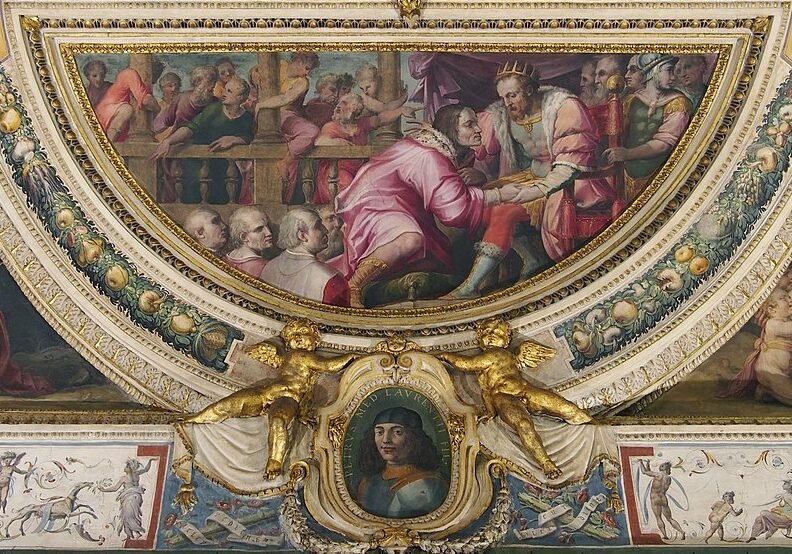
A painting depicting Lorenzo visiting Ferdinand of Aragon, king of Naples.
What role did Lorenzo play in the Italian Renaissance?
Lorenzo was a key patron of artists like Botticelli and Michelangelo, fostering Florence as a center of artistic and intellectual achievement.
How did Lorenzo maintain political stability in Italy?
He upheld the balance of power within the Italic League and used diplomacy to prevent foreign intervention in Italian affairs.
What was the Pazzi Conspiracy?
In 1478, Lorenzo survived an assassination attempt orchestrated by the Pazzi family and Pope Sixtus IV, though his brother Giuliano was killed.
How did Lorenzo handle the conflict with Pope Sixtus IV?
After the Pazzi Conspiracy, Lorenzo defied papal sanctions, then personally negotiated peace with Naples, restoring stability to Florence.
What economic challenges did Lorenzo face?
The Medici Bank declined due to poor management and debt, forcing Lorenzo to use state funds to support it.
How did Lorenzo contribute to literature and philosophy?
He was a poet and patron of scholars like Marsilio Ficino, promoting humanist ideas that merged classical thought with Christian teachings.
What was Lorenzo’s relationship with Girolamo Savonarola?
Savonarola, a Dominican friar, gained influence in Florence towards Lorenzo’s later years, criticizing the Medici’s lavish lifestyle and Renaissance ideals.
Who succeeded Lorenzo de’ Medici?
His son Piero de’ Medici inherited power but was expelled from Florence in 1494. His second son, Giovanni, later became Pope Leo X.
Where is Lorenzo de’ Medici buried?
He was buried in the Medici Chapel in Florence, later reinterred beneath Michelangelo’s statue of the Madonna in the New Sacristy.





