Mediolanum in Ancient Times
Mediolanum, the ancient city that would eventually evolve into modern-day Milan, has a rich and complex history stretching back over two millennia. Originally founded by the Insubrian Celts, it later became a major Roman stronghold and an essential center of administration, commerce, and religion in the Western Roman Empire. Mediolanum played a critical role in the political and cultural transformations of the ancient world, witnessing conquests, imperial decrees, and religious shifts that shaped the course of history.
In the article below, World History Edu explores the origins, development, and ultimate decline of Mediolanum, shedding light on its enduring legacy.

Ancient Mediolanum overlaid on present-day Milan, with the modern Cathedral Square marked at the center-right and Castle Sforzesco positioned in the upper left, beyond the old Roman walls.
Origins and Foundation
Mediolanum was established around 590 BC by a Celtic tribe known as the Insubres, who belonged to the Golasecca culture. The name Medhelanon, from which Mediolanum derives, is believed to have meant “settlement in the middle of the plain,” reflecting its central location in the fertile Po Valley.
According to the Roman historian Livy, the city’s founding was linked to the legendary Gaulish leader Bellovesus, who led a group of settlers into northern Italy during the reign of the early Roman king Tarquinius Priscus.
The Insubres thrived in Mediolanum for several centuries, developing a culture that blended local traditions with influences from other Celtic and Italic groups. They engaged in trade and established the city as a regional hub. However, the rise of Rome brought significant change.
Roman Conquest and Early Integration
Rome’s expansion into northern Italy culminated in the conquest of Mediolanum in 222 BC. Under the command of Consul Gnaeus Cornelius Scipio Calvus, Roman forces defeated the Insubres and took control of the city. The Insubrian leaders ultimately submitted to Roman rule, leading to the incorporation of the region into the Roman Republic as part of the province of Cisalpine Gaul.
Following its conquest, Mediolanum was Latinized and integrated into Rome’s administrative and military framework. The Romans appreciated the strategic importance of the settlement, as it provided a crucial link between the Italian peninsula and the transalpine territories. As a result, the city was gradually transformed, with the construction of Roman roads, public buildings, and military infrastructure.
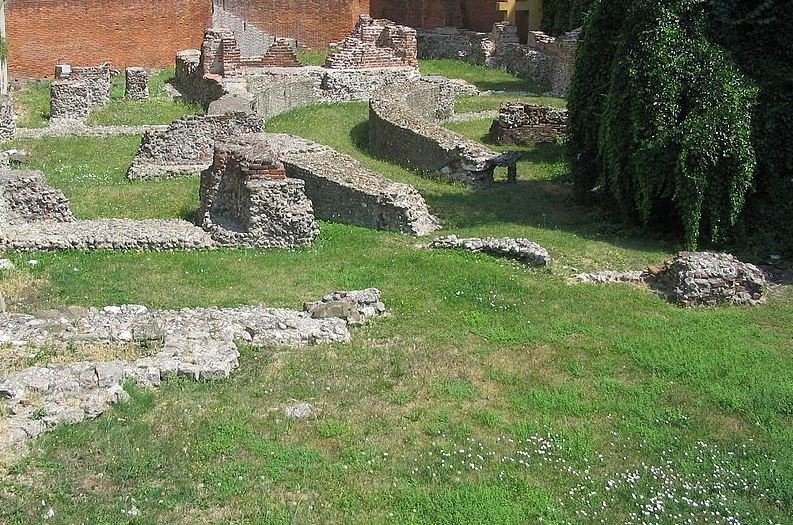
Remains of the Emperor’s palace in Milan.
Growth and Importance in the Roman Empire
Under Roman rule, Mediolanum became one of the most significant cities in northern Italy. By the time of the Augustan Age, it was renowned for its educational institutions, theaters, and amphitheater. The city’s location along major trade routes made it a vital economic center, known for its production of textiles, metals, and fine wool. Polybius, a Greek historian, noted that the region surrounding Mediolanum was abundant in agricultural produce, including grain and wine, and was home to vast herds of swine.
During the early Principate, the population of Mediolanum reached approximately 42,000 by AD 200. With the continued expansion of the Roman Empire, it became a key administrative center, serving as the seat of the prefect of Liguria under Emperor Hadrian. The city also boasted a mint, granaries, and an imperial mausoleum, further solidifying its status as a major provincial capital.
Mediolanum’s strategic location, economic prosperity, and political importance made it one of the most vital cities in the Western Roman Empire.
Mediolanum as the Capital of the Western Roman Empire
A pivotal moment in Mediolanum’s history came in AD 286, when Emperor Diocletian reorganized the Roman Empire into the Tetrarchy. He moved the administrative capital of the Western Roman Empire from Rome to Mediolanum, leaving his co-emperor, Maximian, in charge of the western territories. This decision significantly increased the city’s prominence, leading to rapid urban expansion and grand construction projects.
Maximian oversaw the building of a new set of defensive walls, extending the city’s fortifications to 4.5 kilometers in length and incorporating numerous towers. Other architectural achievements included the construction of a grand circus, the Baths of Hercules, and an extensive imperial palace complex. These projects transformed Mediolanum into one of the largest and most impressive cities in the empire, with its population swelling to around 105,000.
The Edict of Milan and the Rise of Christianity
One of the most historically significant events associated with Mediolanum was the issuance of the Edict of Milan in AD 313. This proclamation, made by Emperor Constantine I and his co-emperor Licinius, granted religious tolerance to Christians within the Roman Empire. The edict marked a turning point in the history of Christianity, paving the way for its eventual dominance as the empire’s official religion.
At the time, Christianity had already taken root in Mediolanum, and the city had a growing Christian community. However, tensions arose during the Arian controversy, leading to conflicts between rival Christian factions. Bishop Ambrose, who became the city’s religious leader in AD 374, played a crucial role in defending Nicene Christianity against Arianism and shaping the city’s religious identity. Ambrose’s influence extended beyond theology, as he also exercised considerable political power, famously confronting Emperor Theodosius I over imperial conduct.
During this period, several important Christian basilicas were constructed in Mediolanum, including San Nazaro, San Lorenzo, and San Simpliciano. These churches not only served as places of worship but also symbolized the city’s growing role in the Christian world.
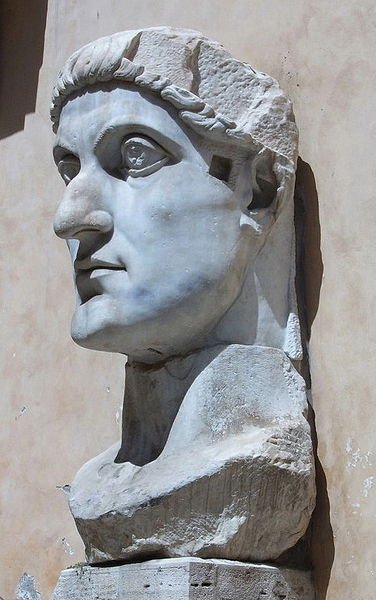
Bust of Constantine I
Decline and Fall
Despite its prominence, Mediolanum faced increasing turmoil as the Roman Empire weakened. In 402, the city was besieged by the Visigoths, forcing the imperial court to relocate to Ravenna, a more defensible location. This move marked the beginning of Mediolanum’s decline as a political and military center.
Further devastation came in AD 452, when Attila the Hun ravaged the region. However, the most severe blow occurred in AD 538 during the Gothic War. The city was captured and brutally sacked by Uraia, the nephew of the Gothic King Vitiges. Thousands of inhabitants were killed, and much of the city’s infrastructure was destroyed.
The final chapter of Mediolanum’s ancient history unfolded in AD 569 when the Lombards invaded Italy. Instead of restoring Mediolanum to its former glory, they chose to establish their capital at Ticinum (modern-day Pavia). This decision relegated Mediolanum to a secondary status, leaving it under the control of its archbishops and ending its era as a major imperial city.

Architectural and Archaeological Legacy
Despite the destruction and decline of ancient Mediolanum, remnants of its Roman past can still be found in modern Milan. Several important structures have survived, providing valuable insights into the city’s rich history:
- The Colonne di San Lorenzo: A row of ancient Roman columns standing in front of the Basilica of San Lorenzo, believed to be from an imperial building.
- The remains of the amphitheater: Though mostly in ruins, the amphitheater’s archaeological park preserves parts of this grand entertainment venue.
- The Imperial Palace ruins: Sections of the palace complex, built during the reign of Maximian, are still visible today.
- Roman walls and towers: Some fragments of Mediolanum’s fortifications, including a 24-sided tower, have been preserved.
- San Vittore Chapel: A richly decorated chapel with mosaics from the late Roman period.
- The Baptistery of San Giovanni alle Fonti: The site where Saint Augustine of Hippo was baptized by Ambrose, reflecting the city’s Christian significance.
Frequently Asked Questions
When and how did the Romans conquer Mediolanum?
The Romans captured Mediolanum in 222 BC under the leadership of Consul Gnaeus Cornelius Scipio Calvus, integrating it into the province of Cisalpine Gaul.
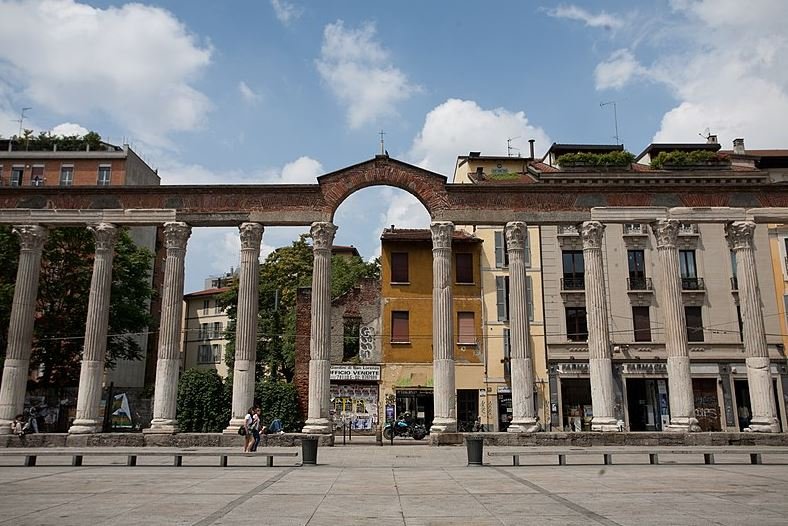
Colonne di San Lorenzo in front of the Roman Catholic Church, Basilica di San Lorenzo in Milan.
Why was Mediolanum significant in the Roman Empire?
Its central location made it a key trade and administrative hub, and it later became the capital of the Western Roman Empire under Emperor Maximian in AD 286.
What was the Edict of Milan and why was it important?
Issued in AD 313 by Constantine I and Licinius, the Edict of Milan granted religious tolerance to Christians, marking a turning point in the empire’s religious policies.
How did Christianity shape Mediolanum?
The city became a major Christian center, with figures like Bishop Ambrose playing a crucial role in religious and political affairs, and several important basilicas being built.
What led to the decline of Mediolanum?
Repeated invasions, including sieges by the Visigoths in 402 and Attila the Hun in 452, along with destruction in the Gothic War of 538, led to its decline.
Why did the Lombards not restore Mediolanum as their capital?
After capturing the city in 569, the Lombards chose Ticinum (modern Pavia) as their capital, leaving Mediolanum under the control of its archbishops.
Surviving structures of Mediolanum include the Colonne di San Lorenzo, remains of the amphitheater, sections of the imperial palace, Roman walls, and the Baptistery of San Giovanni alle Fonti.





