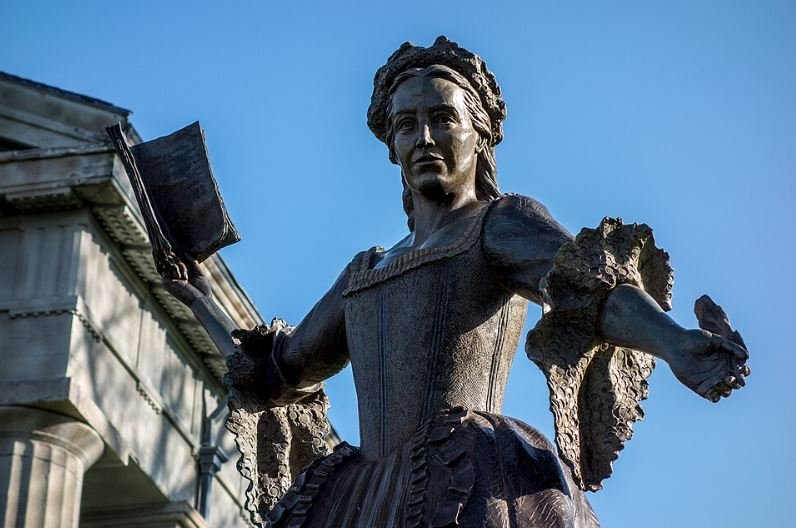
Mercy Otis Warren (September 25, 1728 – October 19, 1814) was a pioneering American writer, activist, and historian whose works played a significant role in shaping the political landscape of the American Revolution and the early United States. Through her poetry, plays, and pamphlets, she championed colonial resistance against British rule, advocated for the inclusion of a Bill of Rights in the U.S. Constitution, and authored one of the earliest histories of the American Revolution.
Merch Otis’s life, both as a wife and mother and as a committed political figure, exemplified the intersection of domesticity and revolutionary activism during a crucial period in American history.
Early Life and Education
Mercy Otis Warren was born on September 25, 1728, in Barnstable, Massachusetts, to Colonel James Otis and Mary Allyne Otis. She was the third of thirteen children in the Otis family. Her father, a prominent farmer, attorney, and judge, was an outspoken critic of British rule and played an active role in local politics, serving as a representative in the Massachusetts House of Representatives and opposing the colonial governor, Thomas Hutchinson. Warren grew up in a household that valued education and political involvement, which had a lasting influence on her intellectual development.
Although she did not receive a formal education, Warren benefited from her father’s progressive attitude toward women’s education. He supported her academic endeavors, which was uncommon in 18th-century New England. Her father’s encouragement allowed her to study under the Reverend Jonathan Russell, who tutored her brothers in preparation for college. She was also deeply influenced by her brother James Otis, a leading patriot and lawyer. His correspondence with her reveals that he regarded her as an intellectual equal, offering both advice and encouragement in her literary pursuits.
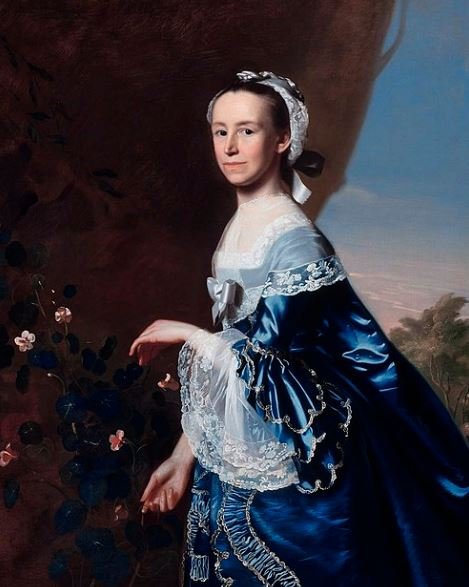
A 1763 portrait of Mercy Otis Warren
Marriage and Family Life
On November 14, 1754, Mercy Otis married James Warren, a prominent political figure who would become deeply involved in the fight for American independence. After their marriage, they settled in Plymouth, Massachusetts, where James inherited his father’s position as sheriff. The couple had five children: James, Winslow, Charles, Henry, and George. Throughout their marriage, Mercy and James exchanged numerous letters expressing mutual admiration, support, and intellectual respect.
Their home in Plymouth became a gathering place for political discussions and revolutionary activities, where figures such as Samuel Adams, John Adams, and other members of the Sons of Liberty would frequently meet. The Warrens’ correspondence reveals their shared commitment to the cause of independence and their support for the growing political movement in the colonies. Mercy Otis Warren’s active involvement in political matters was encouraged by her husband, who referred to her affectionately as “the scribbler” due to her writings.
Revolutionary Writings and Political Activism
Mercy Otis Warren’s literary career flourished in the years leading up to and during the American Revolution. She was a vocal critic of British policies and used her writing to call for resistance to the erosion of colonial rights and liberties. In addition to writing poetry and plays, she authored pamphlets and essays that critiqued the British government’s actions in the colonies.
Her satirical play The Adulateur (1772) targeted Governor Thomas Hutchinson, a Tory who was widely despised in Massachusetts. In this play, she depicted Hutchinson as a sycophantic figure, predicting the outbreak of the Revolution. The play was widely circulated, and Hutchinson became known as “Rapatio” in the public eye, a character from Warren’s work who symbolized the corrupt British officials in the colonies.
Warren also wrote The Defeat (1773), which continued her criticism of Hutchinson and his administration. This work further cemented her reputation as a formidable voice in the revolutionary movement. Her plays and satirical writings were instrumental in rallying colonial support for independence, and they helped to galvanize public opinion against British rule.
In addition to her dramatic works, Warren wrote numerous political poems and essays, many of which were published anonymously. She was deeply involved in the creation of the Committees of Correspondence, a network of colonial leaders that exchanged information and coordinated efforts to resist British authority. Warren viewed these committees as crucial to the success of the American Revolution, and she supported them through both her political writing and her personal involvement in local activism.
Warren’s close relationships with key revolutionary figures such as John Adams, Samuel Adams, and Thomas Jefferson allowed her to play a vital role in shaping public opinion and rallying support for the independence cause. Her writings were well received by patriots, and her work earned the admiration of figures like George Washington and Alexander Hamilton, who praised her contributions to the intellectual life of the Revolution.

Front page of Mercy’s book, titled “History of the Rise, Progress and Termination of the American Revolution”
Opposition to the U.S. Constitution
After the American Revolution, Mercy Otis Warren continued to be politically active. She opposed the ratification of the U.S. Constitution in 1788, believing that it granted too much power to the federal government without adequately protecting individual rights. In her pamphlet Observations on the New Constitution (1788), published under the pseudonym “A Columbian Patriot,” Warren argued for the inclusion of a Bill of Rights to safeguard the freedoms of citizens and prevent the rise of tyranny.
Her opposition to the Constitution was part of her broader commitment to anti-federalism, and her writings were influential in the debate over the new nation’s political structure. Although Observations was initially attributed to other writers, it was later revealed by her descendant Charles Warren that she was its true author. Warren’s critique of the Constitution was grounded in her concern for the protection of liberty and the preservation of the revolutionary ideals that had guided the fight for independence.
Mercy Otis Warren’s works were influential in the intellectual and political debates of her time, and her legacy as a historian, playwright, and political activist continues to be celebrated.
History of the American Revolution
In 1805, Mercy Otis Warren published her monumental work, History of the Rise, Progress, and Termination of the American Revolution, a three-volume history that remains one of the earliest comprehensive accounts of the Revolution. Warren’s history was unique not only because of her firsthand experience as a participant in the revolutionary movement but also because it was written by a woman at a time when female historians were extremely rare.
Warren’s history was praised by many, including President Thomas Jefferson, who ordered copies for himself and his cabinet. He expressed his anticipation of the book’s contribution to understanding the Revolution, noting its potential to offer valuable lessons to future generations. Warren’s history provided a personal perspective on the events of the Revolution and reflected her own political views, including her criticism of John Adams, who became a source of tension between the two. Despite the book’s success, her relationship with Adams deteriorated due to her critical portrayal of his role in the Revolution.
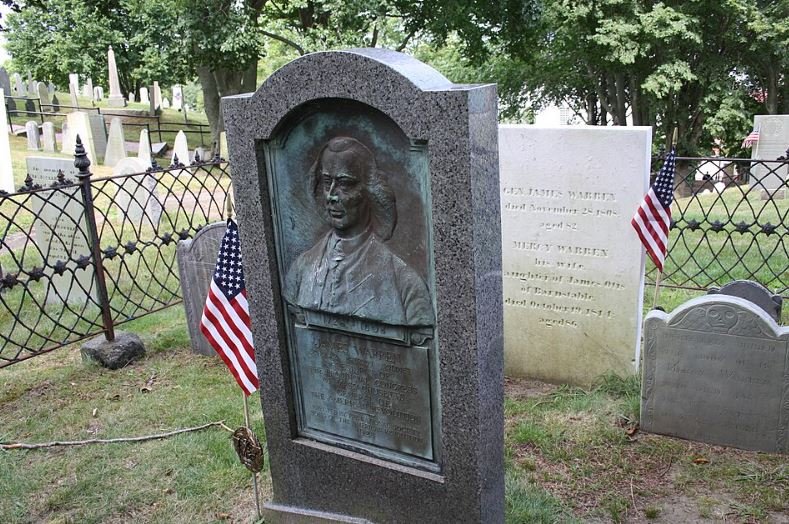
Mercy and James Warren’s gravestone at Burial Hill, Plymouth, Massachusetts.
Legacy and Death
Mercy Otis Warren died on October 19, 1814, at the age of 86, six years after her husband, James, passed away. She was buried beside him at Burial Hill in Plymouth, Massachusetts. In her lifetime, Warren’s contributions to the American Revolution and the intellectual life of the early United States were widely recognized. However, she remained a somewhat controversial figure due to her outspoken political views and her critical writings.
Warren’s legacy continued to grow posthumously. She was inducted into the National Women’s Hall of Fame in 2002, and the SS Mercy Warren, a World War II Liberty ship, was named in her honor. Her works remain a valuable source of insight into the political and intellectual climate of the Revolutionary era, and she is remembered for her contributions to the cause of liberty and independence.