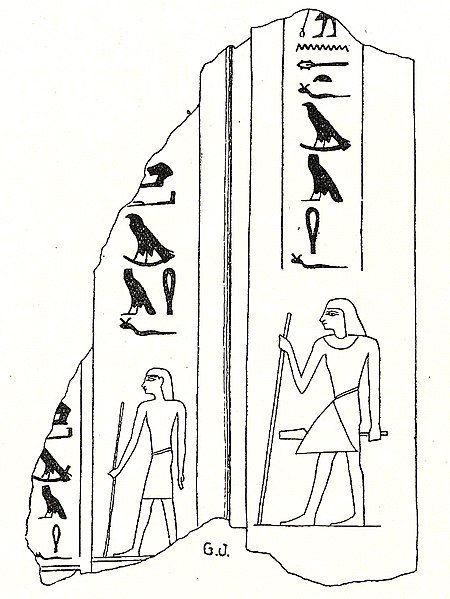
A fragment of a false door depicting Nemtyemsaf II from the pyramid of his mother Neith.
Merenre Nemtyemsaf II was the sixth and penultimate ruler of Egypt’s Sixth Dynasty, ascending the throne during a period of political decline at the end of the Old Kingdom. He ruled for a brief period of one year and one month around 2213 BC, following the exceptionally long reign of his father, Pepi II Neferkare. By the time he became pharaoh, the centralized power of the monarchy had significantly weakened, with local governors, or nomarchs, increasingly asserting their autonomy. His brief reign marked one of the final moments before the collapse of the Old Kingdom and the onset of the First Intermediate Period.
Attestations of Nemtyemsaf II
Nemtyemsaf II’s existence is confirmed by several historical sources, although contemporary records of his reign are scarce. His name appears on the Turin King List, an ancient document compiled during the Ramesside period, where his reign duration is recorded as one year and one month. However, his full name is missing due to damage in the document.
Another key source mentioning Nemtyemsaf II is the Abydos King List, an important record created during the reign of Seti I in the 13th century BC. This list includes his throne name, Merenre, making it the only known record to do so. Additionally, the 3rd-century BC historian Manetho, in his work Aegyptiaca, refers to him as Menthesouphis, assigning him a reign length of one year, which aligns with the Turin King List.
Despite limited records of Nemtyemsaf II’s rule, he is remembered through king lists, inscriptions, and a handful of artifacts, with some speculation about his pyramid.
The only contemporary artifact conclusively linked to Nemtyemsaf II is a damaged false door inscription found near the pyramid complex of Queen Neith, a wife of Pepi II. The inscription reads “Sa-nesu semsu Nemtyemsaf”, meaning “The elder king’s son Nemtyemsaf,” indicating that this was created before his ascension to the throne. This suggests that he was the designated heir during his father’s later years.

Pepi II’s statue at the Metropolitan Museum of Art in New York.
Another possible reference to Nemtyemsaf II is found in a decree discovered in the mortuary temple of Queen Neith, which aimed to protect the funerary cults of queens Ankhesenpepi I and Neith. If this decree was indeed issued by Nemtyemsaf II, it also reveals his Horus name, S[…]tawy, which is partially damaged but seems to translate to “He who causes the two lands to…”
Challenges During His Brief Reign
Ascending the throne after Pepi II’s extraordinarily long rule, Nemtyemsaf II faced an Egypt in crisis. His father’s reign, which may have lasted over six decades, saw the gradual erosion of the central authority, as powerful nomarchs expanded their influence. By the time Nemtyemsaf II took power, the pharaoh’s ability to govern the entire kingdom was severely weakened.
While little is known about his policies or military actions, it is likely that Nemtyemsaf II struggled to maintain order in a fragmented Egypt. The increasing independence of local rulers led to widespread instability, and within just a few years of his death, the Old Kingdom collapsed, giving way to the First Intermediate Period—a time of civil strife and decentralized rule.
Nemtyemsaf II’s reign, overshadowed by the long rule of his father Pepi II, marked the last attempts of the central government to maintain authority before the First Intermediate Period ushered in a new era of division and uncertainty.
It is possible that Nemtyemsaf II began constructing a pyramid for himself in Saqqara, near his father’s pyramid, but no definitive evidence has been found to confirm this. Given the declining power of the central administration, it is unlikely that his burial complex would have been completed or as grand as those of his predecessors.
The Herodotus Legend: Nitocris and the Revenge Plot
A legend about the aftermath of Nemtyemsaf II’s rule appears in the writings of the ancient Greek historian Herodotus. In his Histories, Herodotus recounts a tale of Queen Nitocris, who allegedly avenged the murder of her brother and husband—believed to be Nemtyemsaf II—by orchestrating a dramatic act of vengeance. According to the story, after a rioting mob killed Nemtyemsaf II, Nitocris invited his murderers to a grand banquet in an underground chamber. Once they were gathered, she flooded the room with the Nile’s waters, drowning them before taking her own life.
However, modern scholars have dismissed this story as a later misinterpretation or distortion of historical events. The name “Nitocris” appears to be a corruption of Neitiqerty Siptah, a male pharaoh who succeeded Nemtyemsaf II. There is no credible evidence that Nitocris was a historical female ruler, and the tale likely evolved as an embellished legend rather than a factual account.
The End of the Old Kingdom
The death of Nemtyemsaf II marked the final phase of the Old Kingdom, which had lasted for nearly 500 years. His successor, Neitiqerty Siptah, remains a mysterious figure with little historical documentation. The transition from Nemtyemsaf II’s rule to his successor was accompanied by the collapse of centralized authority, plunging Egypt into the chaotic First Intermediate Period.
During this time, Egypt fragmented into numerous competing local dynasties, with powerful nomarchs ruling over their respective territories. This period lasted for nearly two centuries, until Egypt was eventually reunified by the Middle Kingdom pharaohs.