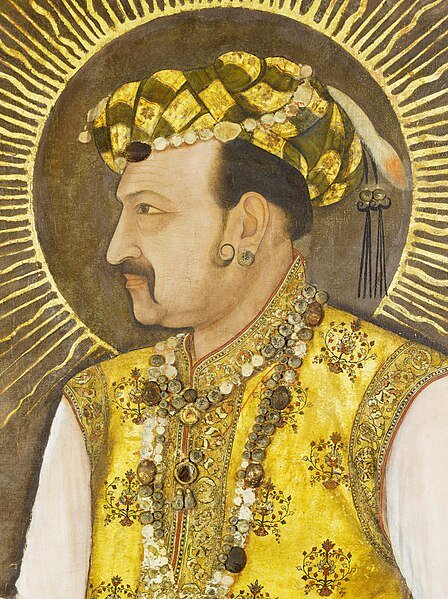
Mughal Emperor Jahangir
Jahangir, born Nur-ud-din Muhammad Salim, was the fourth Mughal Emperor, ruling Hindustan from 1605 to 1627. He was the son of Emperor Akbar and Empress Mariam-uz-Zamani.
Early Life and Education
Jahangir was originally named Prince Salim. He was born on 31 August 1569 in Fatehpur Sikri to Emperor Akbar and his chief consort, Mariam-uz-Zamani.
His birth was seen as a divine blessing following Akbar’s pilgrimage to the shrine of Sufi saint Salim Chishti.
Jahangir lost his two elder twin brothers in infancy, which significantly impacted his family.
Raised in an environment enriched by Persian, Indian, and Islamic influences, he received comprehensive education in Persian, Hindustani, Arabic, history, military tactics, and administration.
His upbringing emphasized the cultural and spiritual traditions of the Mughal Empire, which later influenced his reign.
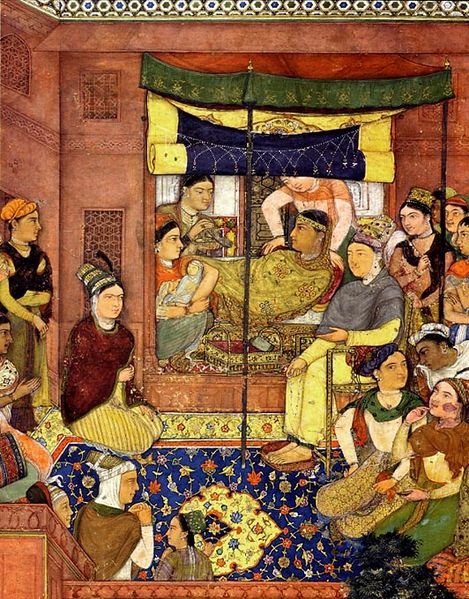
Painting by Bishandas depicting Empress Mariam-uz-Zamani giving birth to Prince Salim at Fatehpur Sikri.
Accession and Political Challenges
Jahangir ascended the throne on 3 November 1605 following Akbar’s death. His reign began with internal challenges, notably the rebellion of his son, Khusrau Mirza. Jahangir swiftly suppressed the revolt, imprisoning Khusrau and executing his followers.
It must also be noted that his reign was marked by attempts to consolidate Mughal authority in the Indian subcontinent, particularly in the Rajput territories and the Deccan. Despite his military efforts, he struggled with succession issues and internal conflicts among the nobility.
Administrative Policies and Governance
Jahangir is often credited for his administrative efficiency and commitment to justice. One of his notable contributions was the establishment of the ‘Chain of Justice,’ a symbolic golden chain with bells that allowed aggrieved subjects direct access to the emperor.
His administration continued Akbar’s policy of religious tolerance, though with sporadic deviations, such as the execution of Sikh Guru Arjan Dev. Jahangir strengthened the Mughal bureaucracy and maintained a balance between imperial authority and noble influence.
Cultural and Artistic Contributions
Jahangir’s reign saw remarkable artistic and architectural achievements. He was an ardent patron of Mughal miniature painting, emphasizing naturalism and portraiture. He encouraged court painters like Ustad Mansur and Abul Hasan, whose works flourished under his patronage.
Jahangir also oversaw the construction of several architectural marvels, including the Akbari Bridge in Allahabad and his own tomb in Lahore. His artistic vision was deeply influenced by Persian and European styles, a result of interactions with Jesuit missionaries and English envoys.
Foreign Relations and European Contacts
Jahangir’s foreign policy was defined by diplomatic engagements with the Safavids of Persia, the Ottomans, and European traders. His interactions with the English East India Company marked the beginning of European influence in India. Sir Thomas Roe, the ambassador of King James I of England, visited Jahangir’s court in 1615 and secured trading rights in Surat. His relations with Persia were marked by both cooperation and conflict, particularly over the strategic city of Kandahar, which the Mughals lost to the Safavids.
Marriage and Influence of Nur Jahan
Jahangir’s marriage to Mehr-un-Nisa, later known as Empress Nur Jahan, significantly shaped his reign. A highly intelligent and politically astute woman, Nur Jahan wielded considerable influence over Mughal affairs. She was instrumental in administrative decisions, appointed her family members to key positions, and even issued coins in her name. However, her dominance in court politics led to tensions within the Mughal dynasty, particularly with Prince Khurram (future Shah Jahan), who later rebelled against his father.

Painting by Indian Hindu artist Manohar depicting Emperor Jahangir weighing Prince Khurram on a scale.
Military Campaigns and Rebellions
Jahangir’s military campaigns were focused on consolidating Mughal authority. His attempts to subdue the Rajputs of Mewar met with limited success, though Rana Amar Singh eventually accepted Mughal suzerainty. He also sought to extend Mughal rule in the Deccan, but faced resistance from the Ahmadnagar Sultanate.
His greatest military challenge came from internal conflicts, particularly the rebellion of Prince Khurram in 1622. Despite initial setbacks, Jahangir managed to quell most insurrections, but the growing influence of Nur Jahan’s faction caused further instability.
Health Decline and Death
Jahangir’s excessive consumption of opium and alcohol took a severe toll on his health. By the 1620s, he suffered from frequent illnesses, which led him to seek the cooler climate of Kashmir for relief. In 1627, during a journey from Kashmir to Lahore, he fell gravely ill and died near Bhimber on 28 October. His body was taken to Lahore and buried in the magnificent tomb built in his honor at Shahdara Bagh.
Legacy and Impact
Jahangir’s reign is often seen as a period of both artistic splendor and political intrigue. While he lacked the military acumen of Akbar or Shah Jahan, his contributions to Mughal culture and governance were significant.
His memoirs, the ‘Tuzk-e-Jahangiri,’ provide valuable insights into his administration, policies, and personal experiences. Despite his weaknesses, he maintained the stability of the empire and left a lasting impact on Mughal art, architecture, and diplomacy.
His successor, Shah Jahan, inherited a relatively consolidated empire but had to navigate the political complexities left behind by Jahangir’s court factions.
Timeline of Mughal Emperor Jahangir
- 1569 – Born as Prince Salim in Fatehpur Sikri to Emperor Akbar and Mariam-uz-Zamani.
- 1585 – Marries Rajput princess Manbhawati Bai; later weds multiple noblewomen.
- 1594 – Leads a Mughal campaign against the Bundela Rajputs in Orchha.
- 1600 – Stages a rebellion against Akbar but is reconciled.
- 1605 – Ascends the Mughal throne after Akbar’s death, taking the title Jahangir.
- 1606 – Crushes a revolt led by his son Khusrau; executes Sikh Guru Arjan Dev.
- 1611 – Marries Nur Jahan, who gains significant political influence.
- 1615 – Grants trade privileges to the English East India Company.
- 1622 – Prince Khurram (Shah Jahan) rebels but is later subdued.
- 1627 – Dies en route to Lahore; Shah Jahan succeeds him.
Frequently Asked Questions
How did Emperor Jahangir come to power?
Jahangir ascended the throne in 1605 after Akbar’s death. He faced an early challenge from his son Khusrau Mirza, whom he defeated and imprisoned.
What were Jahangir’s major achievements?
His reign was notable for the promotion of Mughal painting, architecture, and a commitment to justice. He also expanded Mughal influence in the Deccan and strengthened foreign relations, including engaging with the English East India Company.
What role did Nur Jahan play in Jahangir’s reign?
Nur Jahan, Jahangir’s wife, held immense political power and effectively managed state affairs. She influenced court appointments and policies, leading to tensions with Jahangir’s son, Prince Khurram (later Shah Jahan).
What challenges did Jahangir face as emperor?
His reign saw revolts by his sons, conflicts with Rajput and Deccan rulers, and the loss of Kandahar to the Safavids. His declining health, due to excessive alcohol and opium consumption, also weakened his rule.
What was his religious policy?
Jahangir largely continued Akbar’s religious tolerance but executed Sikh Guru Arjan Dev in 1606 for supporting Khusrau’s rebellion. He also maintained relations with Jain and Hindu religious leaders.
How did Jahangir die and who succeeded him?
Jahangir died in 1627 near Bhimber while returning from Kashmir due to ill health. His death led to a brief succession struggle before his son, Shah Jahan, took the throne.





