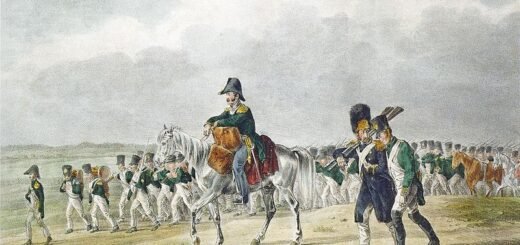
Napoleon’s Retreat from Moscow in 1812

In the annals of military history, few campaigns stand out as starkly as Napoleon Bonaparte’s Russian Campaign of 1812. The retreat from Moscow, in particular, has become emblematic of the broader challenges faced by imperial ambitions against unwavering resistance and the unforgiving wrath of nature. Here, we delve into the specifics of this retreat, its background, and its profound implications.
Background
Napoleon Bonaparte, the Emperor of the French, sought to establish a Continental System, a trade embargo against Britain. Russia, initially compliant, began trading with Britain again by 1811, leading to strains in Franco-Russian relations. Viewing this as a betrayal and an affront to his European dominance, Napoleon decided on a military solution: the invasion of Russia.
The Grand Armée
In June 1812, Napoleon crossed the Neman River into Russia with the Grande Armée, numbering over 600,000 soldiers from various European countries under French control. This force was one of the most impressive in history, equipped with artillery, cavalry, and infantry. Their goal was clear: force Tsar Alexander I into submission.
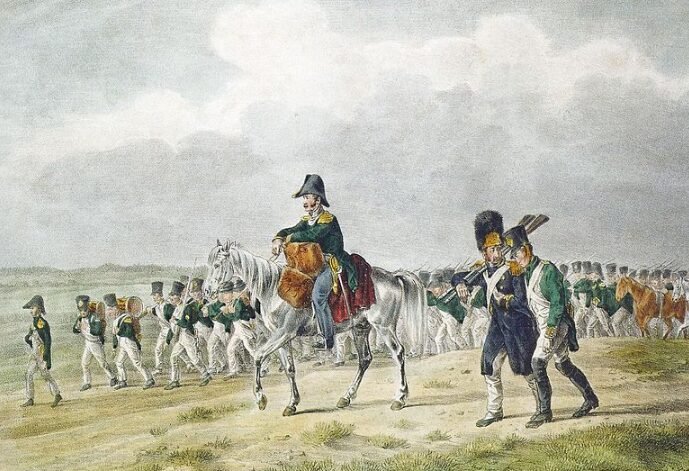
IV corps of the Grande Armeé in the French invasion of Russia (1812)
The Russian Strategy: Scorched Earth
The Russians, understanding the logistical nightmare of supplying such a vast army, adopted a ‘scorched earth’ policy. As they retreated, they burned crops, destroyed infrastructure, and evacuated towns, depriving the French of supplies and shelter. This strategy, combined with the vastness of the Russian lands, meant that the French were always overstretched and under-resourced.
The Battle of Borodino
As the French army marched deeper into Russian territory, they met significant resistance only once: at the Battle of Borodino in September. Although the French claimed victory, it was a Pyrrhic one. They suffered tremendous casualties and couldn’t decisively defeat the Russian army, which retreated and lived to fight another day.

Battle of Borodino
Capture of Moscow
Entering Moscow, Napoleon expected the Russians to sue for peace, but Moscow was not the prize he anticipated. The retreating Russians, true to their scorched-earth strategy, set the city aflame. With Moscow burning and no sign of the Russian capitulation, Napoleon’s situation grew dire. Winter was approaching, and he was in a city that could not sustain his army.
The Retreat
By mid-October, with his position untenable and the Russian army still a threat, Napoleon decided to retreat, marking the beginning of his army’s end.
The journey back was harrowing:
- Harsh Weather: The Russian winter was brutal. Temperatures plummeted, making it impossible for the troops to stay warm. The cold claimed more soldiers than combat did, with many succumbing to frostbite, hypothermia, and other cold-related illnesses.
- Lack of Supplies: As they retraced their steps, the French found little solace in the lands they had pillaged during their advance. The scorched-earth strategy meant there was no food or shelter to be found.
- Russian Guerrilla Warfare: Russian forces continually harassed the retreating French troops. Cossack cavalry would strike quickly, decimating the French and then disappearing before they could react.
- Crossing the Berezina River: In late November, a desperate battle ensued at the Berezina River. The French needed to cross, but Russian troops threatened them from all sides. Although they managed to establish makeshift bridges and cross the river, they suffered heavy losses.
- Morale and Desertion: Seeing the predicament, many soldiers abandoned their posts. Morale plummeted, and the once-great Grande Armée started disintegrating. Officers and enlisted men alike despaired, and the cohesive structure of the French military crumbled.
Aftermath and Implications
By December, the remnants of Napoleon’s army, reduced to a mere fraction of its initial size, limped back into Polish territory. The Russian campaign was a disaster. Of the over 600,000 soldiers that had set out for Moscow, only about 27,000 combat troops returned. Including camp followers and non-combatants, perhaps 100,000 survived. The rest were either captured, killed, or missing.
The retreat had several profound implications:
- Beginning of Napoleon’s End: The disaster in Russia marked the beginning of the end for Napoleon. His aura of invincibility shattered, and his enemies, sensing weakness, formed a coalition that would eventually defeat him in 1815.
- Shift in European Dynamics: The retreat signaled a power shift. France’s dominance waned, and Russia’s prestige grew. Tsar Alexander I became a significant player in determining Europe’s post-Napoleonic shape.
- Military Lessons: Future military leaders took heed. The campaign underscored the importance of logistics, the dangers of overextension, and the challenges of waging war in hostile environments.
- Cultural Impact: The 1812 retreat has been immortalized in various art forms, most notably in Leo Tolstoy’s “War and Peace” and Tchaikovsky’s “1812 Overture”.
Conclusion
Napoleon’s retreat from Moscow in 1812 serves as a potent reminder of the limits of ambition and the unpredictable nature of war. It underscores the reality that even the most powerful armies can be defeated by strategy, endurance, and the environment. In the broader tapestry of history, the retreat serves as a turning point, marking the decline of one empire and the rise of another, and reshaping the geopolitical contours of Europe.
Frequently asked questions about Napoleon’s campaign in Russia

The 1812 campaign remains a study in overreach, illustrating the perils of logistics and the unpredictable variables of warfare. The scale of the disaster and its impact on the Napoleonic empire make it a focal point in European military history. Image: Napoleon watching the fire of Moscow in September 1812
Why did Napoleon invade Russia?
Napoleon invaded Russia in 1812 as a part of his efforts to enforce the Continental System, which was designed to cripple British trade and influence. Russia had been a reluctant partner in this system and had started trading with Britain again, defying Napoleon’s embargo.
How many troops did Napoleon start with?
Napoleon began his invasion with approximately 600,000 troops, often referred to as the “Grande Armée.” This massive force comprised soldiers from various countries under French influence or control.
Why is the campaign called “Napoleon’s Invasion” and not a “war”?
While battles occurred, the term “invasion” is often used because Napoleon’s primary objective was a swift march to Moscow to force the Russian Tsar into submission. The Russians largely avoided direct confrontation, opting instead for scorched earth tactics.
What was the significance of the Battle of Borodino?
The Battle of Borodino, fought on September 7, 1812, was the bloodiest single-day action of the Napoleonic Wars. Though Napoleon claimed victory, he suffered heavy casualties, and the Russians were not decisively defeated.
Why did the Russians burn Moscow?
When Napoleon reached Moscow, he found the city largely abandoned. Shortly after, fires began (the causes are debated but are commonly attributed to Russian sabotage). The fires rendered Moscow uninhabitable, denying Napoleon’s army essential supplies and shelter.

Fire of Moscow in 1812
Why didn’t Napoleon retreat immediately after capturing Moscow?
Napoleon had expected Tsar Alexander I to offer peace after the fall of Moscow. He waited in the ruined city, anticipating a Russian envoy. When it became clear that no offer was forthcoming and winter approached, he began his retreat.
How severe were the conditions during Napoleon’s retreat?
The retreat, particularly in the later stages, was harrowing. The Grande Armée faced sub-zero temperatures, snowstorms, Russian guerrilla attacks, and a lack of provisions. Thousands perished due to cold, starvation, and combat.

Retreat of Napoleon Army from Moscow 1812
How many French soldiers returned from the campaign?
Of the original 600,000 troops, only about 20,000-30,000 returned. The vast majority were killed in combat, succumbed to the harsh conditions, or were captured.
How did the campaign impact Napoleon’s reign?
The failure of the Russian campaign marked the beginning of Napoleon’s decline. The significant losses eroded the French army’s might and morale, emboldening Napoleon’s adversaries in Europe.
Did Russia pursue Napoleon after his retreat?
Yes, Russian forces, seeing the vulnerability of the once-feared Grande Armée, pursued the retreating French and engaged in several confrontations, further depleting Napoleon’s forces.

Napoleon’s withdrawal from Russia, a painting by German painter Adolph Northen