U.S. Presidential Election: When and why was the two-term limit introduced?

A U.S. president can serve two terms in office, as established by the 22nd Amendment to the U.S. Constitution.
The two-term limit for U.S. Presidents, formally codified in the 22nd Amendment to the U.S. Constitution, is a key feature of the American political system that helps ensure a regular transfer of power. Its introduction, motivated by concerns about the dangers of prolonged executive authority, came after more than 150 years of U.S. history where no formal term limit existed.
The two-term limit was introduced in response to President Franklin D. Roosevelt‘s unprecedented four terms in office. In this explanation, we’ll delve into the historical origins of presidential term limits, the circumstances that led to the adoption of the 22nd Amendment, and the rationale behind this significant constitutional change.
Historical Background of Presidential Terms
The idea of limiting presidential terms has its roots in the early history of the United States. The framers of the U.S. Constitution in 1787 discussed term limits but ultimately did not include any restrictions in the original document. Their primary focus was on creating a balance of power among the three branches of government, and they believed that checks and balances would help prevent any one branch, including the presidency, from becoming too powerful.
Though there were no formal term limits, the precedent of serving only two terms was established by the first president, George Washington. Washington voluntarily stepped down after two terms in 1797, setting an informal but powerful precedent for future presidents. In his farewell address, Washington warned against the dangers of concentrated power and the potential for tyranny if a president were to remain in office for too long.
Following Washington’s example, most U.S. presidents voluntarily adhered to the two-term tradition. Thomas Jefferson, the third president, reinforced this norm by serving only two terms and affirming that stepping down after two terms was essential for preserving the republic. The idea of limiting presidential terms became a widely accepted convention, though it remained unofficial for over 150 years.
Early Debates on Term Limits
Despite the informal two-term precedent, there were several instances in the 19th century where term limits became a topic of public and political debate. After the election of Andrew Jackson in 1828, some political leaders argued for a constitutional amendment to formalize term limits. Jackson was a highly polarizing figure who wielded considerable executive power, leading his opponents to advocate for legal restrictions on the presidency.
In 1876, President Ulysses S. Grant considered running for a third term, reigniting the debate over presidential term limits. Grant ultimately chose not to run, but his contemplation of a third term heightened concerns about the potential for an entrenched presidency. Despite these discussions, no formal efforts to impose term limits gained significant traction in Congress during the 19th century.
Franklin D. Roosevelt and the Four-Term Presidency

The issue of presidential term limits came to the forefront during the presidency of Franklin D. Roosevelt (FDR). Roosevelt, first elected in 1932, served an unprecedented four terms in office, which shattered the long-standing two-term tradition. His extended time in office was a response to the extraordinary circumstances of his presidency, which spanned two major crises in U.S. history: the Great Depression and World War II.
When Roosevelt was elected in 1932, the country was in the midst of the Great Depression, the most severe economic downturn in U.S. history. His leadership and New Deal programs were seen by many as critical to the nation’s recovery. As a result, Roosevelt was reelected in 1936 with a landslide victory.
By 1940, however, World War II was looming, and the American public faced the possibility of being drawn into the global conflict. Roosevelt believed that continuity in leadership was crucial during this time of uncertainty, and he ran for a third term, breaking the two-term tradition. He won the 1940 election, becoming the first president to serve more than two terms.

Image: A poster of Uncle Sam and FDR by James Montgomery Flagg. Source: Library of Congress.
By 1944, the U.S. was fully involved in World War II, and Roosevelt’s leadership was viewed as indispensable by many Americans. He ran for a fourth term and won, though he was in poor health. Roosevelt died in April 1945, just months into his fourth term, leaving Vice President Harry S. Truman to assume the presidency.
Roosevelt’s four-term presidency alarmed many political leaders and citizens who were concerned about the concentration of power in the executive branch. While Roosevelt’s leadership during crises was generally respected, his prolonged time in office led to fears that future presidents might exploit a lack of term limits to entrench themselves in power. Roosevelt’s presidency demonstrated the need for formal limits to prevent future executives from holding office indefinitely.
The Passage of the 22nd Amendment

In response to Roosevelt’s four terms, political leaders began to advocate for a constitutional amendment to limit the number of terms a president could serve. Following Roosevelt’s death and the end of World War II, there was a growing consensus that formal limits were needed to preserve the democratic principles of the American government.
The push for a constitutional amendment began in earnest with the Republican-controlled Congress in 1947. Republicans, who had been out of the presidency for much of the previous two decades, were especially motivated to prevent any future president from serving indefinitely, particularly in light of the political dominance the Democratic Party had achieved under Roosevelt.
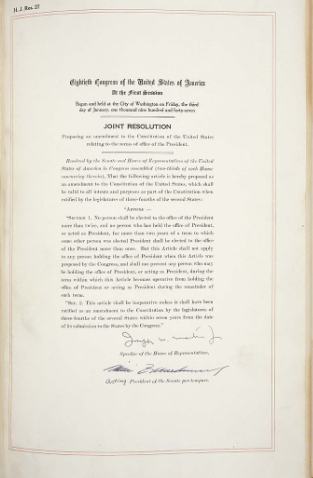
The result was the proposal of the 22nd Amendment, which would limit presidents to two terms in office. The amendment was passed by Congress on March 21, 1947, and sent to the states for ratification. By February 27, 1951, the necessary three-fourths of the states had ratified the amendment, and it was added to the U.S. Constitution.
The text of the 22nd Amendment reads as follows:
Section 1: No person shall be elected to the office of the President more than twice, and no person who has held the office of President, or acted as President, for more than two years of a term to which some other person was elected President shall be elected to the office of the President more than once. But this Article shall not apply to any person holding the office of President when this Article was proposed by the Congress, and shall not prevent any person who may be holding the office of President, or acting as President, during the term within which this Article becomes operative from holding the office of President or acting as President during the remainder of such term.
Section 2: This article shall be inoperative unless it shall have been ratified as an amendment to the Constitution by the legislatures of three-fourths of the several States within seven years from the date of its submission to the States by the Congress.
The 22nd Amendment effectively limits presidents to two elected terms in office. It also stipulates that if a vice president or other successor assumes the presidency and serves more than two years of a predecessor’s term, that individual can only be elected president once. However, if a successor serves less than two years of a predecessor’s term, they are still eligible to be elected to two full terms of their own.

A badge showing support for presidential term limits. Source: The Franklin Delano Roosevelt Foundation.
Rationale for the Two-Term Limit
The primary motivation behind the two-term limit was to prevent any single individual from accumulating too much power in the executive branch, thereby ensuring that the presidency remained accountable to the people and did not evolve into a position of autocratic control. The framers of the 22nd Amendment were concerned that without formal limits, a popular or charismatic president could maintain power indefinitely, undermining the system of checks and balances that is central to the U.S. Constitution.
There were several key reasons for imposing the two-term limit:
- Preserving Democratic Principles: The two-term limit was seen as a way to protect the republic from the dangers of concentrated power. By limiting presidents to two terms, the amendment ensures that the executive branch remains accountable to the electorate and that no individual can dominate the office for too long.
- Ensuring a Peaceful Transfer of Power: One of the hallmarks of American democracy is the peaceful transfer of power between presidents. The two-term limit reinforces this tradition by ensuring regular turnover in the presidency, thereby reducing the risk of political instability or authoritarianism.
- Preventing Executive Overreach: Limiting the number of terms a president can serve helps prevent the executive branch from becoming too powerful relative to the other branches of government. It reinforces the system of checks and balances by ensuring that no president can remain in office long enough to consolidate too much power.
- Reflecting Popular Will: The two-term limit reflects the idea that the presidency should be a temporary position of public service, not a lifetime appointment. It ensures that new leaders and new ideas can enter the political arena, reflecting the changing will of the American people.
- Historical Precedent: The two-term limit formalized the precedent set by George Washington and followed by most presidents before Franklin D. Roosevelt. By enshrining this tradition in the Constitution, the 22nd Amendment solidified the principle of limited presidential tenure.
Exceptions and Challenges to the Two-Term Limit
Since its passage, the 22nd Amendment has been largely uncontroversial, and no president has successfully challenged the two-term limit. However, there have been occasional discussions about repealing the amendment or modifying its provisions.
For example, during the presidency of Ronald Reagan in the 1980s, some conservative politicians and supporters floated the idea of repealing the 22nd Amendment to allow Reagan to run for a third term. Reagan, who was immensely popular, dismissed the idea and chose not to pursue it. Similarly, discussions have arisen during the presidencies of Bill Clinton and Barack Obama, both of whom enjoyed strong approval ratings at various points during their time in office. However, no serious effort has been made to repeal the two-term limit.
One notable exception to the two-term rule occurred during the presidency of Harry S. Truman. Because the 22nd Amendment was not retroactive, Truman, who had succeeded Roosevelt and served almost two full terms, was eligible to run for a third term in 1952. However, Truman chose not to seek reelection, and the two-term limit has remained firmly in place for all subsequent presidents.
Conclusion
The introduction of the two-term limit for U.S. presidents, formalized in the 22nd Amendment, was a direct response to the unprecedented four terms served by Franklin D. Roosevelt. The amendment was designed to prevent any future president from holding office indefinitely and to preserve the democratic principles of the American system of government. By limiting presidents to two terms, the 22nd Amendment ensures that the executive branch remains accountable to the people, fosters a peaceful transfer of power, and prevents the concentration of power in any one individual.
Questions and Answers on U.S. Presidential Term Limits
22nd Amendment to the U.S. Constitution in the National Archives





