Nazca Lines
The Nazca Lines are a series of ancient geoglyphs etched into the arid desert plains of southern Peru, near the modern town of Nazca. These lines and designs, some spanning hundreds of meters, depict a variety of shapes, animals, and abstract patterns. They remain one of the most intriguing and enigmatic archaeological phenomena in the world, inspiring awe and speculation for centuries.
Discovery and History
The Nazca Lines were first brought to global attention in the 1920s and 1930s when pilots flying over the Nazca Desert noticed the strange, large-scale designs on the ground. Although local people were likely aware of their existence for centuries, their full scope and intricacy were not apparent until they were seen from the air.
The lines are believed to have been created by the Nazca culture, which flourished between approximately 200 BCE and 600 CE. This ancient civilization was known for its advanced pottery, textiles, and irrigation systems. The lines are considered their most enduring legacy.

Aerial view of one of the Nazca lines, showing “The Monkey’ shape.
Geography and Formation
The Nazca Lines are located in one of the driest regions on Earth, the Peruvian coastal desert. This area receives less than 1 inch (25 mm) of rainfall annually, creating conditions ideal for preserving the geoglyphs. The desert’s consistent aridity and lack of wind ensure that the lines remain remarkably intact despite their age.
The geoglyphs were made by removing the reddish-brown iron oxide-coated stones on the desert surface to reveal the lighter, sandy soil underneath. This contrast creates the visible patterns. Some lines were also created by piling up stones to form defined edges. The method is simple yet ingenious, requiring minimal tools but a significant amount of labor and coordination.
Scale and Design
The Nazca Lines cover an area of nearly 1,000 square kilometers (about 385 square miles). There are over 800 straight lines, 300 geometric shapes, and around 70 animal and plant figures (called biomorphs). These designs vary in size, with some spanning over 1,200 feet (370 meters).
Prominent Designs
Many geoglyphs depict animals, including a monkey with a coiled tail, a hummingbird, a spider, a condor, a whale, and a dog. Each is stylized yet recognizable.
Several designs resemble flowers and trees, though these are less common than the animal figures.
Straight lines, trapezoids, spirals, zigzags, and triangles dominate the landscape. Some extend for miles and seem to connect various geoglyphs.
A few human-like figures exist, such as “The Astronaut,” which resembles a figure with large eyes waving, adding an air of mystery.
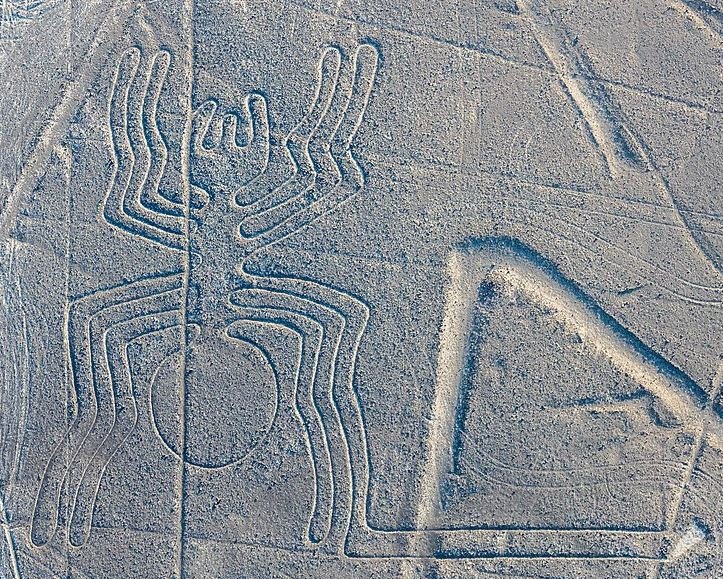
Spider shape of the Nazca lines.
Purpose and Theories
The purpose of the Nazca Lines has puzzled researchers, archaeologists, and historians for decades. Several theories attempt to explain their significance:
Astronomical Alignments
One of the earliest theories proposed by German mathematician Maria Reiche suggested that the lines functioned as an astronomical calendar. She argued that the geoglyphs aligned with celestial events, such as solstices and equinoxes, and were used to mark planting and harvesting times. While some lines align with astronomical phenomena, this theory does not account for all designs.
Religious and Ceremonial Use
Another prevailing theory is that the Nazca Lines were part of religious or ceremonial practices. The Nazca people may have created the lines to honor their gods, particularly those associated with water and fertility, given the region’s arid environment. Some researchers believe the geoglyphs were meant to be seen by deities from the sky.
Ritual Pathways
Some scholars suggest that the lines served as ritual pathways. Participants in religious ceremonies might have walked along these lines in processions, invoking divine blessings or engaging in other ceremonial activities.
Water Cult and Irrigation
Considering the Nazca’s reliance on water in an arid climate, some researchers propose that the geoglyphs were linked to water rituals. The lines may symbolize rivers, canals, or other water-related features, reflecting the importance of sustaining agriculture and life.
Alien and Extraterrestrial Theories
Popularized by writers like Erich von Däniken, some theories suggest that the Nazca Lines were created by or for extraterrestrial beings. Proponents of this idea argue that the scale and precision of the designs imply advanced technology beyond the Nazca people’s capabilities. This theory is widely dismissed by mainstream scholars as speculative and lacking evidence.
Construction and Technology
The construction of the Nazca Lines is remarkable, considering the tools and resources available to the Nazca culture. Despite their simplicity, creating such large-scale designs required:
The geoglyphs’ symmetry and scale suggest careful planning. Scholars believe the Nazca used grids, stakes, and ropes to scale up smaller designs onto the desert floor.
The construction of the lines likely involved coordinated efforts by large groups of people, emphasizing the social and cultural importance of the project.
The Nazca understood the desert’s geology and how to manipulate its surface to create durable patterns.
Preservation and Challenges
The Nazca Lines have survived for centuries due to the region’s climate, but they are not immune to threats. Human activities, such as urban expansion, mining, and tourism, pose risks. For example, in 2014, a Greenpeace protest damaged part of the site. Additionally, climate change and occasional heavy rains can erode the geoglyphs.
Efforts to preserve the Nazca Lines include their designation as a UNESCO World Heritage Site in 1994. Ongoing archaeological research, monitoring, and education aim to protect this cultural treasure.
Cultural Significance and Legacy
The Nazca Lines offer profound insights into the creativity, ingenuity, and spirituality of the Nazca people. They reflect a society deeply connected to its environment and invested in expressing its beliefs and identity on a monumental scale.
Beyond their archaeological importance, the lines have inspired modern art, literature, and popular culture. They symbolize the enduring mystery of human creativity and our quest to understand the past.
Modern Research and Discoveries
Technological advancements, such as satellite imagery and drones, have revolutionized the study of the Nazca Lines. These tools have led to the discovery of new geoglyphs, including previously unknown designs of animals and abstract patterns. Researchers continue to analyze the lines, seeking to uncover more about their purpose, construction, and cultural context.
Questions and Answers

Map of the location of Nazca lines in Peru.
What are the Nazca Lines, and where are they located?
The Nazca Lines are a series of ancient geoglyphs created by the Nazca civilization, located in southern Peru. They span across the arid plains of Peru’s eastern coast and extend into northern Chile.
What types of designs do the Nazca Lines depict?
The designs include stylized representations of animals (e.g., hummingbirds, condors, monkeys, and killer whales), plants, humans, geometric shapes (e.g., triangles, spirals, and trapezoids), and abstract forms. Some also depict objects like tripods and looms.
How were the Nazca Lines created?
The lines were created by removing the darker, oxidized surface rocks to expose the lighter-colored soil beneath. This simple yet effective technique has preserved the designs due to the arid climate of the region.
How large are the Nazca Lines, and what is their total extent?
The Nazca Lines vary in size, with some stretching over vast distances. The longest line measures up to 20 kilometers, and the total combined length of all the lines exceeds 1,300 kilometers. The geoglyphs collectively cover over 640 square kilometers.
To get such large-scale designs, the Nazca likely used proportional scaling, possibly employing grids or ropes to transfer smaller designs onto the expansive desert floor. This demonstrates their impressive organizational and artistic skills.
What are some theories about the purpose of the Nazca Lines?
- Astronomical Markers: Used as an astronomical calendar for tracking celestial events and agricultural cycles.
- Sacred Pathways: Walked during religious ceremonies to honor deities or seek blessings for fertility and rain.
- Water and Agriculture: Associated with water sources, symbolizing rivers, canals, or rituals for rain.
- Cultural Expression: Reflecting reverence for nature and spiritual beliefs, as seen in similar motifs on pottery and textiles.
- Navigation: Hillside geoglyphs might have served as guides for travelers.
- Extraterrestrial Theories: Speculative ideas suggest creation by or for extraterrestrial beings, though these lack evidence.
How do the lines reflect the Nazca civilization’s connection to water?
Many lines and shapes point toward water sources like hills and mountains. Trapezoid shapes often align with water directions, and major sites such as Ventilla and Cahuachi were connected by geoglyphs. This suggests a connection to water rituals and agricultural practices.
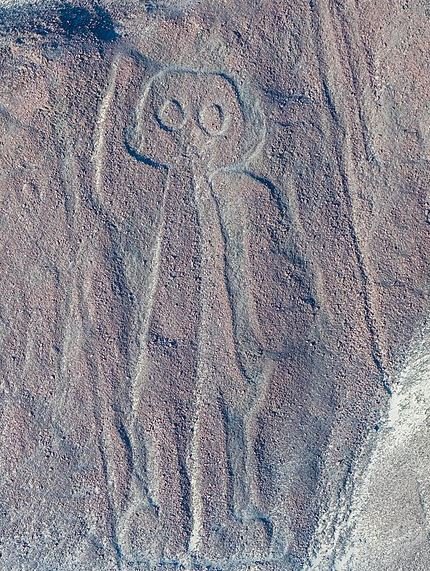
“The Astronaut”, one of the various shapes of the Nazca lines.
How do we know the lines were created over time by different groups?
Newer designs often overlap older ones, indicating that the lines were made by different groups across several centuries. This lack of centralized planning suggests the geoglyphs served evolving purposes.
What factors have helped preserve the Nazca Lines?
The arid climate of the region, minimal rainfall, and lack of wind have contributed to the preservation of the Nazca Lines. However, prolonged sunlight can darken the exposed soil.
What threats do the Nazca Lines face today?
Human activities like urban development, mining, and tourism pose risks to the preservation of the lines. Climate change and occasional heavy rains also threaten their integrity.
Why do some people speculate about extraterrestrial involvement?
The scale and precision of the lines have led to speculative theories about extraterrestrial involvement. However, experiments show that these designs can be created using simple tools and modest labor, debunking such ideas.