Ogdoad: The Eight Primordial Deities in Ancient Egypt
The Ogdoad refers to eight primordial gods, divided into four male–female pairs, who embodied fundamental cosmic conditions before the creation of the ordered universe.

The veneration of the Ogdoad in Hermopolis, depicted with frog and serpent heads, and referenced in inscriptions from the Eighteenth Dynasty through the Ptolemaic Kingdom, underscores their enduring resonance.
What is the Ogdoad in ancient Egyptian mythology?
In the mythology of ancient Egypt, the Ogdoad stands out as a unique grouping of eight primordial deities. Referred to in ancient Greek as “the Eightfold,” and known in Egyptian as ḫmnyw, these gods were revered in the city of Hermopolis. Though their precise origin stories remain somewhat elusive, references to the Ogdoad appear in surviving inscriptions and religious texts, especially from the New Kingdom onward. Their collective identity rests on the notion that they personified abstract, cosmic qualities which predated the ordered universe.
READ MORE: Greatest Cities in Ancient Egypt
Earliest Mentions in Egyptian Texts
The earliest certain attestation of the Ogdoad dates to the Eighteenth Dynasty, found in a dedicatory inscription of Queen Hatshepsut at the Speos Artemidos. This reference places the Ogdoad within an established mythological tradition, revealing that they were no mere late invention but a deeply ingrained feature of Hermopolitan theology.
Because ancient Egyptian religious beliefs underwent many interpretations over time, the Ogdoad’s presence in this period underscores their enduring importance. This textual evidence also sets a chronological marker that confirms the presence of these deities at least by the New Kingdom.
Visual Representations
During the Late Period, which witnessed broader theological expansions, the Ogdoad began to appear in artistic depictions as four male-female pairs. The males often bore the heads of frogs, while the females bore the heads of serpents. These symbolic choices emphasized the deities’ primal, watery, and transformative essence, as amphibians are linked to water and serpents to regenerative cycles.
The Ogdoad provides a clearer perspective on how the Egyptians envisioned the elemental conditions that shaped creation.
In certain images from the last dynasty and the Ptolemaic Kingdom, these frog-headed and snake-headed pairs were shown in reliefs, underscoring their essential ties to creation’s earliest stages. Such iconography connected the Ogdoad to fertility, fluidity, and the act of bringing forth life from a formless domain.
The Four Male-Female Pairs
Central to the Ogdoad is the arrangement of their eight deities into four complementary pairs. Each pair represents a masculine and feminine aspect, underscoring the balanced duality that the ancient Egyptians believed lay at the heart of cosmic processes. These pairs are:
- Nu and Naunet: Their names are linked with the primordial waters. Determinative signs for sky and water in their hieroglyphs reinforce their essence as the swirling, boundless chaos from which life emerges.
- Ḥeḥ and Ḥeuḥet: Often connected to the idea of infinite space or an unbounded expanse, these two deities personified boundlessness. One hypothesis suggests an affiliation with ḥeḥ, signifying a countless or limitless number—an echo of endless time or space.
- Kek and Kauket: Associated with darkness, their names incorporate a determinative that merges the sky hieroglyph with an implement representing obscurity. Reflecting primal gloom, Kek and Kauket embody night and the transitional shifts that herald daybreak and dusk.
- Amun and Amunet (or Other Variants): This pair, unlike the preceding three, displays less consistency in the surviving texts. Sometimes they bear different names—Qerḥ, Ni, Nenu, or Ennit—yet all forms suggest an attribute of hiddenness or inactivity. Amun eventually rose to prominence as a principal state god, indicating the fluidity of Egyptian religious development.
Conceptual Roles and Symbolism
Although the Ogdoad is divided into four distinct couples, attributing unique, standalone functions to each pair poses challenges. Some scholars have observed that the ancient Egyptians themselves may not have uniformly agreed on each pair’s precise role.
However, some modern interpretations propose they represent four fundamental states: (1) the watery abyss, (2) darkness, (3) the endless or boundless, and (4) invisibility or dormancy.
The above conceptual framework mirrors the earliest conditions from which the ordered cosmos arose: a fathomless sea of potential, enveloped by obscurity, stretching infinitely, yet hidden from sight until creation’s spark.
Interpretations in Hermopolitan Theology
The city of Hermopolis, where this pantheon flourished, took its name from the Greek association with Hermes. However, in Egyptian terms, Hermopolis was a significant cult center dedicated to Thoth. Given that Thoth was considered a patron of knowledge, writing, and the moon, the presence of the Ogdoad there tied primeval energies to wisdom traditions.
Whether described as swirling waters, limitless expanse, enveloping darkness, or hidden stillness, these eight gods bridged the gap between pure potential and the emerging universe.
Their worship in this locale helped preserve the notion of a chaotic, yet fertile, wellspring that set the stage for the birth of gods and humans alike. Rituals in Hermopolis likely stressed synergy among these eight forces, encouraging cosmic stability through harmonic balance.
Comparable Concepts in Other Myths
Although the Ogdoad is firmly rooted in ancient Egypt’s religious landscape, parallels exist across global mythologies. In Greek cosmology, the concept of Erebus shares similarities with the notion of primordial darkness.
The Egyptian expression of an unbounded realm (Ḥeḥ) resonates with the Greek idea of aion, a boundless or timeless quantity. These overlaps illustrate how disparate cultures grappled with explaining a primal, pre-creation state.
However, the Ogdoad’s amphibious and serpentine iconography is a characteristically Egyptian touch, reflecting the Nile’s life-giving waters and the cyclical flooding that permeated cultural identity.
Evolving Significance Over Time
Throughout dynastic history, the Ogdoad’s role shifted in response to theological innovation. Their identities sometimes merged with or were overshadowed by more prominent gods.
For instance, Amun, initially part of the Ogdoad, ascended as a supreme deity in Thebes, blending the unseen primordial force with a national god’s political and spiritual clout.
Despite these changes, the Ogdoad persisted in local rituals, ensuring the symbolic memory of eight essential creative powers remained influential in cosmological thought.
Questions and Answers
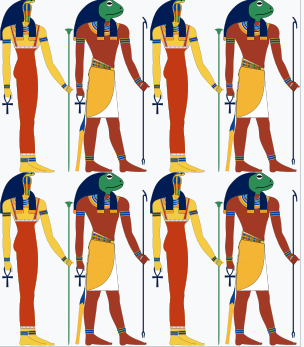
By portraying four pairs of male and female deities, each associated with distinct cosmic principles, Egyptian theologians articulated a subtle vision of creation’s origins. Image: A Roman-era relief at Dendera’s Hathor temple depicts the Ogdoad with frog-headed males and serpent-headed females.
Where were they primarily worshiped?
Their main cult center was in Hermopolis (called ḫmnw in Egyptian), reflecting the city’s connection to these archetypal deities.
Why are they often depicted with frogs’ and serpents’ heads?
The males typically have frogs’ heads and the females serpents’ heads to symbolize fertile, transformative energy and allude to the watery, primordial realm they represent.
Who are the four male–female pairs?
They are commonly known as Nu and Naunet, Ḥeḥ and Ḥeuḥet, Kek and Kauket, and Amun and Amunet (with some variations in names for the last pair).
What concepts did Nu and Naunet personify?
They symbolized the formless primeval waters, the chaotic reservoir from which all existence emerged.
How did Ḥeḥ and Ḥeuḥet differ from the others?
They were linked to boundlessness or infinity, representing the limitless expanse or infinite space preceding structured reality.
In what way did Kek and Kauket represent darkness?
Their names and hieroglyphic determinatives suggest primordial gloom, yet they also relate to the cyclical transition between night and day.
Why did Amun and Amunet sometimes have different names in texts?
Over time, Egyptian theology evolved, leading to multiple designations and attributes for this pair, reflecting qualities of hiddenness or inactivity prior to creation.





