The Ptolemaic Kingdom: History, Major Facts, & Accomplishments
by World History Edu · November 28, 2024
The Ptolemaic Kingdom, also known as the Ptolemaic Empire, stands as one of the most remarkable Hellenistic states in ancient history. Spanning nearly three centuries from 305 BC to 30 BC, it was the last dynasty to rule Egypt before its incorporation into the Roman Empire.
Founded by Ptolemy I Soter, a trusted general of Alexander the Great, the Ptolemaic Kingdom was a fusion of Greek and Egyptian cultures, leaving a lasting legacy in governance, culture, and architecture.
Below, World History Edu delves into the kingdom’s origin story, highlights its major rulers, and outlines its significant accomplishments.
Origin Story

The Ptolemaic Kingdom was an ancient Greek state based in Egypt that existed from 305 BC to 30 BC. It was founded by Ptolemy I Soter, a companion and general of Alexander the Great, and was ruled by the Ptolemaic dynasty until the death of Cleopatra VII.
Alexander the Great’s Conquest of Egypt
The genesis of the Ptolemaic Kingdom can be traced back to the expansive campaigns of Alexander the Great. In 332 BC, during his conquests against the Achaemenid Empire, Alexander successfully invaded Egypt, which was then under Persian control.
The Egyptians welcomed Alexander as a liberator from Persian rule, recognizing his divine status as a god-king. Embracing Egyptian customs, Alexander founded the city of Alexandria, which would later become the heart of the Ptolemaic Kingdom.
Division of Alexander’s Empire and the Rise of the Diadochi
Alexander’s untimely death in 323 BC in Babylon left his vast empire without a clear successor. This led to a power struggle among his closest generals, known as the diadochi. The empire was divided among them, with each general taking control of different regions. Ptolemy I Soter, one of Alexander’s most capable and trusted generals, secured Egypt as his domain. His strategic acumen and loyalty to Alexander positioned him to establish a lasting dynasty.
Establishment of the Ptolemaic Kingdom
In 305 BC, Ptolemy I formally declared himself king of Egypt, marking the beginning of the Ptolemaic Kingdom. He adopted the title of pharaoh to legitimize his rule in the eyes of the native Egyptian population while maintaining his Greek heritage through the title of basileus (king). Ptolemy’s governance was characterized by a blend of Greek administrative practices and Egyptian traditions, ensuring stability and acceptance among both Greek settlers and native Egyptians.
Established by a close companion of Alexander the Great, the Ptolemaic Kingdom sustained Egyptian independence and prosperity for nearly three centuries while fostering a unique synthesis of Greek and Egyptian traditions.
Under Ptolemy I’s leadership, Alexandria flourished as a center of Greek culture, learning, and trade. The city became renowned for its architectural marvels, including the famous Library of Alexandria and the Lighthouse of Alexandria, one of the Seven Wonders of the Ancient World. These institutions attracted scholars, artists, and traders from across the Mediterranean, making Alexandria a beacon of knowledge and cultural exchange.

The capital of the Ptolemaic Kingdom was Alexandria, a city founded by Alexander the Great in 331 BC. Alexandria became a major center of Greek culture, learning, and trade, renowned for its library and the Lighthouse of Alexandria. Image: Lighthouse of Alexandria
Major Rulers of the Ptolemaic Kingdom
Ptolemy I Soter (305–283 BC)
Ptolemy I Soter, the founder of the Ptolemaic Kingdom, was instrumental in establishing Egypt’s independence from the other diadochi. His reign focused on consolidating power, developing Alexandria, and fostering economic prosperity. Ptolemy I also engaged in numerous military campaigns to expand his territories, securing regions like eastern Libya, the Sinai Peninsula, and northern Nubia. His diplomatic and military strategies ensured the stability and longevity of the Ptolemaic Dynasty.

Ptolemy I Soter was a Macedonian general and one of Alexander the Great’s closest companions. After Alexander’s death, Ptolemy seized control of Egypt and established the Ptolemaic Kingdom, becoming its first ruler and founding the Ptolemaic dynasty.
Ptolemy II Philadelphus (283–246 BC)
Ptolemy II Philadelphus, the son of Ptolemy I, continued his father’s legacy of cultural and economic development. His reign is often considered the Golden Age of the Ptolemaic Kingdom. Ptolemy II expanded Alexandria’s library and museum, attracting scholars such as Euclid and Archimedes. He also undertook extensive building projects, including the restoration of temples and the construction of new public buildings.
Ptolemy II’s marriage to his sister, Arsinoe II, was both a political and religious move, aligning with Egyptian traditions and promoting the divine status of the royal family. This practice of sibling marriage became a hallmark of the Ptolemaic Dynasty, reinforcing their legitimacy and blending Greek and Egyptian royal customs.
Ptolemy III Euergetes (246–222 BC)
Ptolemy III Euergetes, whose epithet means “Benefactor,” further strengthened the kingdom through military and economic policies. His reign saw the expansion of the empire during the Third Syrian War against the Seleucid Empire, resulting in territorial gains in the eastern Mediterranean. Ptolemy III’s successful campaigns increased Egypt’s influence and secured its borders against rival Hellenistic states.
Domestically, Ptolemy III continued to patronize the arts and sciences, maintaining Alexandria’s status as a cultural hub. He also implemented economic reforms that enhanced agricultural productivity and trade, ensuring the kingdom’s wealth and stability.

Ptolemy III Euergetes
Ptolemy IV Philopator (222–204 BC)
Ptolemy IV Philopator’s reign was marked by both cultural achievements and internal challenges. While he continued the Ptolemaic tradition of supporting the arts and architecture, his rule faced significant opposition from the native Egyptian population and the powerful priesthood. Ptolemy IV’s inability to effectively manage internal dissent led to increased instability within the kingdom.
One of the most notable events during his reign was the construction of the Luxor Temple, a testament to the Ptolemies’ dedication to Egyptian religious traditions. However, Ptolemy IV’s failure to address internal issues and his eventual assassination in 204 BC underscored the vulnerabilities of the Ptolemaic Dynasty.
Ptolemy V Epiphanes (204–181 BC)
Ptolemy V Epiphanes ascended to the throne as a child following the tumultuous reign of Ptolemy IV. His early reign was dominated by regents who struggled to maintain control over the kingdom. Ptolemy V faced significant challenges, including revolts by native Egyptians and the loss of territories to the Seleucid Empire.
Despite these difficulties, Ptolemy V managed to restore some stability through diplomatic efforts and military campaigns. His reign also saw the famous Rosetta Stone being inscribed, which later became crucial in deciphering Egyptian hieroglyphs.

Tetradrachm of Ptolemy V Epiphanes, minted around 200 BC.
Cleopatra VII (51–30 BC)

Cleopatra VII was the last active ruler of the Ptolemaic Kingdom of Egypt. She is famous for her political acumen, her relationships with Roman leaders Julius Caesar and Mark Antony, and her efforts to preserve Egypt’s independence. Image: Head of Cleopatra VII.
Cleopatra VII, the last active ruler of the Ptolemaic Kingdom, remains one of history’s most renowned figures. Her reign was marked by political acumen, strategic alliances, and efforts to restore Egypt’s prominence. Cleopatra VII sought to revive the kingdom’s power by forming alliances with powerful Roman leaders Julius Caesar and later Mark Antony.
Cleopatra VII’s defeat alongside Mark Antony led to the end of the Ptolemaic Dynasty and the annexation of Egypt by Rome.
Her relationships with these Roman figures were both personal and political, aiming to secure Egypt’s independence in the face of Rome’s growing dominance. Cleopatra’s reign culminated in the Battle of Actium in 31 BC, where her forces, allied with Mark Antony, were defeated by Octavian’s fleet. Following their defeat, Cleopatra and Antony committed suicide in 30 BC, leading to Egypt’s annexation by Rome and the end of the Ptolemaic Dynasty.
Why did Cleopatra’s father Pharaoh Ptolemy XII pay huge bribes to Roman politicians?
Accomplishments of the Ptolemaic Kingdom

Cultural and Religious Syncretism
One of the most significant accomplishments of the Ptolemaic Kingdom was the successful blending of Greek and Egyptian cultures. The Ptolemies adopted Egyptian titles and religious practices to legitimize their rule while maintaining Greek traditions in governance and culture. This cultural syncretism is evident in the art, architecture, and religious practices of the period, where Greek and Egyptian elements coexisted harmoniously.
The Ptolemaic rulers built and restored temples, supported the priesthood, and participated in Egyptian religious life. This integration fostered a unique cultural milieu that attracted scholars, artists, and traders from various backgrounds, enhancing Alexandria’s reputation as a cosmopolitan center.
Establishment of Alexandria as a Cultural Hub
Alexandria, founded by Alexander the Great and developed under the Ptolemaic rulers, became one of the most important cities of the ancient world. It served as the capital of the Ptolemaic Kingdom and was renowned for its architectural marvels, including the Library of Alexandria and the Lighthouse of Alexandria.
The Library of Alexandria was a premier center of learning, housing countless scrolls and attracting scholars from around the Mediterranean. It played a crucial role in the preservation and advancement of knowledge in various fields such as astronomy, mathematics, medicine, and philosophy. The Lighthouse of Alexandria, one of the Seven Wonders of the Ancient World, served as a symbol of the city’s maritime prowess and architectural ingenuity.
Architectural and Scientific Achievements
The Ptolemaic Kingdom is celebrated for its architectural innovations and contributions to science. The construction of grand temples, public buildings, and monuments showcased the kingdom’s wealth and cultural sophistication. Temples dedicated to both Greek and Egyptian gods were built, reflecting the syncretic religious practices promoted by the Ptolemies.
In science, Alexandria became a beacon of intellectual pursuit. Scholars like Euclid, who is often referred to as the “father of geometry,” and Archimedes, a pioneer in engineering and mathematics, conducted their research in the city. The advancements made in Alexandria laid the groundwork for future scientific discoveries and continued to influence both Greek and Roman scholars.
Military and Territorial Expansion
The Ptolemaic Kingdom achieved significant military and territorial expansion, particularly during the reigns of Ptolemy I and Ptolemy II. Through strategic military campaigns and alliances, the Ptolemies secured control over key regions in the eastern Mediterranean, including parts of Libya, the Sinai Peninsula, and northern Nubia.
The Syrian Wars against the Seleucid Empire were pivotal in expanding the Ptolemaic territories. These conflicts resulted in the consolidation of Ptolemaic power and the acquisition of strategic territories, enhancing Egypt’s influence and security. The kingdom’s military strength was supported by a well-organized army and navy, which played crucial roles in both defense and expansion efforts
Economic Prosperity through Agriculture and Trade
The Ptolemaic Kingdom thrived economically due to Egypt’s fertile Nile Delta, which supported extensive agricultural production. The cultivation of wheat, barley, and papyrus not only ensured food security but also generated substantial exports that fueled the kingdom’s wealth. The efficient irrigation systems and agricultural innovations contributed to high productivity and economic stability.
Alexandria’s strategic location as a major port facilitated robust trade networks across the Mediterranean, Red Sea, and beyond. The kingdom engaged in commerce with Europe, Asia, and Africa, importing goods such as spices, textiles, and precious metals while exporting agricultural products, papyrus, and crafted goods. The bustling trade contributed to the kingdom’s prosperity and sustained its economic dominance.
Political and Administrative Structures
The Ptolemaic Kingdom developed a sophisticated administrative system that effectively managed its vast territories and resources. The governance model was heavily influenced by Greek political structures, with a centralized bureaucracy that ensured efficient administration. Key positions in the military, political, and economic spheres were held by the Greek elite, who leveraged their skills and education to maintain control over the kingdom’s affairs.
The Ptolemies implemented policies that promoted economic development, such as tax reforms and infrastructure projects. These measures enhanced the kingdom’s efficiency and supported its long-term stability. Additionally, the Ptolemaic rulers employed a network of officials and governors to oversee various regions, ensuring consistent governance and the implementation of royal policies.
Contributions to Art and Culture
The Ptolemaic Kingdom made significant contributions to art and culture, fostering a vibrant and diverse cultural scene. The fusion of Greek and Egyptian artistic styles resulted in unique forms of sculpture, pottery, and architecture that reflected the kingdom’s dual heritage. The Ptolemies patronized artists, poets, and musicians, promoting cultural expression and innovation.
The Library of Alexandria and the associated Museum were not only centers of learning but also hubs for artistic and literary activities. The exchange of ideas and the collaboration among scholars and artists from different backgrounds enriched the kingdom’s cultural landscape. This period saw the creation of enduring works of art and literature that continue to influence modern understanding of ancient cultures.
Religious Integration and Syncretism
The Ptolemaic rulers skillfully integrated Greek and Egyptian religious practices, fostering a syncretic religious environment that appealed to both Greek settlers and native Egyptians. The Ptolemies built temples dedicated to both Greek and Egyptian gods, promoting the worship of deities that represented the union of these cultures. For instance, the worship of Serapis, a deity combining aspects of Greek and Egyptian gods, was a significant development under Ptolemy I and II.
This religious syncretism helped legitimize the Ptolemaic rule and ensured the support of the diverse population. By actively participating in Egyptian religious life and supporting the priesthood, the Ptolemies strengthened their political authority and cultural influence.
Diplomatic Alliances and Foreign Relations
The Ptolemaic Kingdom maintained a network of diplomatic alliances and relationships with other Hellenistic states, such as the Seleucid Empire, Pergamon, and Rhodes. These alliances were crucial in managing external threats and securing the kingdom’s borders. Diplomatic marriages, treaties, and trade agreements were common tools used by the Ptolemies to enhance their strategic position.
The Ptolemies also engaged in cultural diplomacy, promoting Greek education and culture in Alexandria to attract scholars and foster intellectual exchanges. This approach not only strengthened the kingdom’s cultural standing but also facilitated peaceful relations with neighboring states.
Military Innovations and Naval Power
The Ptolemaic Kingdom invested heavily in its military and naval forces, recognizing their importance in maintaining power and expanding influence. The Ptolemaic navy, based in Alexandria, was one of the most formidable maritime forces in the Mediterranean. It played a crucial role in protecting trade routes, securing maritime dominance, and supporting military campaigns.
Military innovations, such as the use of warships equipped with advanced weaponry and strategies, enhanced the kingdom’s defensive and offensive capabilities. The standing army was well-trained and equipped, allowing the Ptolemies to respond effectively to internal rebellions and external invasions.
Administration and Legal Reforms
The Ptolemaic rulers implemented legal and administrative reforms that streamlined governance and reinforced their authority. The establishment of a centralized bureaucracy ensured efficient management of the kingdom’s resources and territories. Legal codes were developed to address the needs of both Greek settlers and native Egyptians, promoting a sense of order and stability.
The Ptolemies also promoted education and literacy, establishing schools and libraries that supported the kingdom’s intellectual and administrative functions. These reforms contributed to the kingdom’s long-term stability and prosperity, enabling it to adapt to changing political and economic circumstances.
Economic Infrastructure and Public Works
The Ptolemaic Kingdom invested in extensive public works and infrastructure projects that enhanced economic productivity and urban development. Irrigation systems were improved to support agriculture in the Nile Delta, ensuring consistent agricultural output and food security. The construction of roads, canals, and ports facilitated trade and communication across the kingdom, strengthening economic integration and regional connectivity.
Public buildings, temples, and monuments were constructed to demonstrate the kingdom’s wealth and cultural achievements. These projects not only served practical purposes but also symbolized the Ptolemies’ commitment to fostering a prosperous and culturally vibrant society.
Legacy and Influence
The Ptolemaic Kingdom left a profound legacy on both Greek and Egyptian cultures, fostering a unique synthesis that influenced subsequent civilizations. The kingdom’s emphasis on cultural and religious syncretism set a precedent for the blending of different traditions, promoting tolerance and diversity.
Under Roman rule, Egypt retained much of its Hellenistic character, with Alexandria continuing to be a major center of learning and culture. The legacy of the Ptolemaic Kingdom is evident in the enduring prominence of Alexandria as a hub of intellectual and commercial activity well into the Roman and Byzantine periods.
Furthermore, the Ptolemaic contributions to science, art, and architecture had a lasting impact on the broader Mediterranean world. The advancements made in fields such as astronomy, mathematics, and medicine during the Ptolemaic era laid the groundwork for future scientific discoveries and intellectual developments.
Conclusion
The Ptolemaic Kingdom represents a remarkable chapter in ancient history, characterized by its successful integration of Greek and Egyptian cultures, economic prosperity, and significant contributions to art, science, and architecture. Founded by Ptolemy I Soter, the kingdom flourished under the leadership of its major rulers, including Ptolemy II Philadelphus and Cleopatra VII, who each played pivotal roles in shaping its destiny.
Despite its eventual decline due to internal strife and external pressures from the rising Roman Republic, the Ptolemaic Kingdom left an indelible mark on the ancient world. Its legacy of cultural syncretism, intellectual achievement, and architectural grandeur continues to be celebrated as a testament to the enduring influence of this Hellenistic state.
Through its innovative governance, strategic alliances, and commitment to cultural and scientific advancement, the Ptolemaic Kingdom exemplified the complexities and achievements of Hellenistic civilization.
Frequently Asked Questions
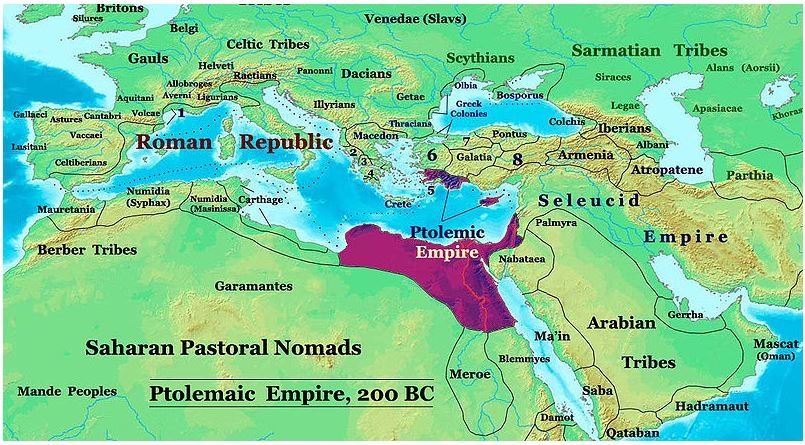
The Ptolemaic Empire in 200 BC, depicted with its territories and interactions with neighboring powers such as the Seleucid Empire, Macedon, and Rome.
What was the Ptolemaic Kingdom and when did it exist?
The Ptolemaic Kingdom, also known as the Ptolemaic Empire, was an ancient Greek state that ruled Egypt from 305 BC until the death of Cleopatra VII in 30 BC. It was founded by Ptolemy I Soter, a trusted general of Alexander the Great, and lasted for nearly three centuries as the final dynasty of ancient Egypt.
Who founded the Ptolemaic Kingdom and how did he establish his rule?
The Ptolemaic Kingdom was founded by Ptolemy I Soter, one of Alexander the Great’s most trusted generals. After Alexander’s death in 323 BC, his empire was divided among his generals, known as the diadochi. Ptolemy secured control over Egypt by leveraging his close relationship with Alexander and his military strength, thereby establishing the Ptolemaic dynasty.
What role did Alexandria play in the Ptolemaic Kingdom?
Alexandria, founded by Alexander the Great in 331 BC, served as the capital of the Ptolemaic Kingdom. Under Ptolemy I’s leadership, it developed into a thriving Greek polis and a major center of Greek culture, learning, and trade. The city was renowned for its Library of Alexandria and the Lighthouse of Alexandria, one of the Seven Wonders of the Ancient World.

How did the Ptolemaic rulers legitimize their authority in Egypt?
To legitimize their rule and gain acceptance from the native Egyptian population, the Ptolemies adopted the traditional Egyptian title of pharaoh alongside their Greek title of basileus (king). They were depicted in Egyptian style and attire on public monuments, blending Greek and Egyptian iconography. Additionally, they incorporated Egyptian religious and cultural practices into their governance.
In what ways did the Ptolemaic Kingdom integrate Greek and Egyptian cultures?
The Ptolemaic Kingdom fostered cultural integration by adopting Egyptian titles and styles while maintaining Greek traditions and governance structures. The rulers built and restored temples, supported the priesthood, and participated in Egyptian religious life. Starting with Ptolemy II Philadelphus, the dynasty incorporated more Egyptian customs, such as sibling marriages to align with Egyptian myths, promoting a blend of Greek and Egyptian religious and cultural practices.
What were the major achievements of the Ptolemaic Kingdom during its Golden Age?
During its Golden Age from the mid-third century BC, the Ptolemaic Kingdom became the wealthiest and most influential of Alexander’s successor states. Major achievements included the establishment of Alexandria as a leading center of knowledge and trade, the construction of the Library of Alexandria and the Lighthouse of Alexandria, advancements in science and learning, and the promotion of arts and culture that blended Greek and Egyptian elements.
What factors contributed to the decline of the Ptolemaic Kingdom?
The decline of the Ptolemaic Kingdom was caused by internal dynastic conflicts, economic difficulties, and a series of foreign wars. Dynastic struggles weakened central authority, leading to instability and infighting among rulers. External conflicts drained resources and diminished military strength, making the kingdom increasingly reliant on the rising power of the Roman Republic for support and protection.
Who was Cleopatra VII and what was her significance in the Ptolemaic Kingdom?
Cleopatra VII was the last active ruler of the Ptolemaic Kingdom of Egypt. She is renowned for her political intelligence, strategic alliances with Roman leaders Julius Caesar and Mark Antony, and efforts to restore Egypt’s power and independence. Her reign marked the final chapter of the Ptolemaic Dynasty, culminating in Egypt’s annexation by Rome after her defeat.
How did Cleopatra VII’s alliances influence the fate of the Ptolemaic Kingdom?
Cleopatra VII formed strategic alliances with powerful Roman leaders Julius Caesar and later Mark Antony to secure political support and military assistance for maintaining her throne and Egypt’s independence. These alliances ultimately led to her involvement in the Roman civil wars. Her alliance with Mark Antony against Octavian (the future Emperor Augustus) resulted in their defeat at the Battle of Actium in 31 BC, leading to Egypt’s annexation by Rome.
What was the outcome of the Battle of Actium for the Ptolemaic Kingdom?
The Battle of Actium in 31 BC was a decisive confrontation between the forces of Cleopatra VII and Mark Antony against Octavian’s fleet. The defeat of Antony and Cleopatra at Actium marked the end of the Ptolemaic Kingdom. In 30 BC, following their defeat, both Cleopatra and Antony committed suicide, and Egypt was annexed by the Roman Republic, becoming the province of Roman Egypt.
What legacy did the Ptolemaic Kingdom leave on Greek and Egyptian cultures?
The Ptolemaic Kingdom left a lasting legacy through significant cultural and religious blending of Greek and Egyptian traditions. Alexandria remained a major center of learning and culture, housing the famous Library of Alexandria and continuing as a focal point of intellectual and commercial activity into the Roman period. The fusion of Greek and Egyptian art, architecture, and religious practices influenced subsequent cultures and maintained the prominence of Alexandria as a leading Mediterranean city.
How did the Ptolemaic Kingdom manage governance and administration?
The Ptolemaic Kingdom featured a sophisticated bureaucracy that exploited Egypt’s vast economic resources. The administration primarily benefited the Greek elite, who dominated military, political, and economic affairs. Integration between the Greek rulers and the native Egyptian populace was limited, with native Egyptians retaining significant influence over local and religious institutions. Over time, native Egyptians could gain more power within the bureaucracy by adopting Hellenistic practices, although the ruling class remained predominantly Greek.
What economic activities supported the prosperity of the Ptolemaic Kingdom?
The Ptolemaic Kingdom’s prosperity was supported by Egypt’s fertile Nile Delta, ensuring abundant agricultural production, particularly of wheat and papyrus, which were major exports. Alexandria served as a thriving trade hub, facilitating commerce with Europe, Asia, and Africa. Additionally, skilled artisans, mining operations, and manufacturing contributed to the kingdom’s economic strength. The strategic control of key trade routes through the Mediterranean and Red Sea further enhanced Egypt’s wealth and economic stability.





