Osman I: Founder of the Ottoman Empire
Osman I was the founder of the Ottoman Empire, initially leading a small Turkoman principality in Anatolia that later expanded into a vast empire.
Early Life and Ancestry
Osman I, also known as Osman Ghazi, was the eponymous founder of the Ottoman Empire. His birth date remains uncertain, but he is believed to have been born around 1254/5.
According to later Ottoman traditions, he belonged to the Kayı tribe of the Oghuz Turks. However, some modern historians consider this lineage a later fabrication to solidify the legitimacy of the Ottoman dynasty. The Kayı tribe, originally from Central Asia, migrated to Anatolia, where Osman’s father, Ertuğrul, established a small principality in Söğüt under the authority of the Seljuk Sultanate of Rûm.
Osman grew up in an era of political fragmentation, witnessing the decline of the Seljuks and the rise of various Turkoman beyliks. His early life remains largely undocumented, as no contemporary sources about him exist. Most historical accounts were written more than a century after his death, blending facts with legends.

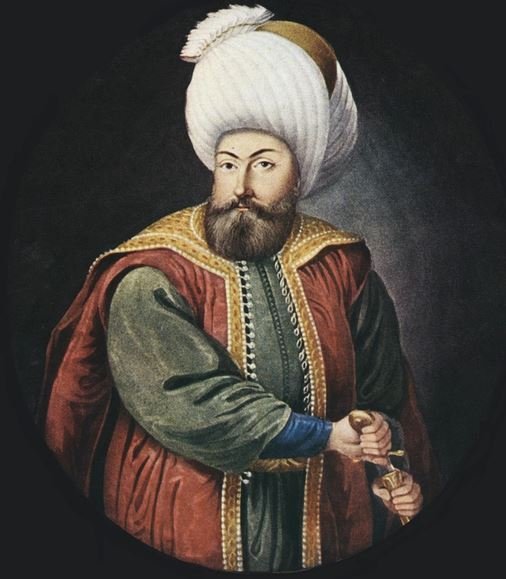
A portrait of Osman I by Italian painter, Paolo Veronese
Rise to Power
Upon the death of his father, Osman took control of the beylik around 1281. Some sources suggest he had to fight off internal opposition, particularly from his uncle Dündar Bey, whom he allegedly executed for opposing his military ambitions. Osman was known for his charismatic leadership and warrior skills, quickly gaining the loyalty of other Turkoman groups who sought new lands and opportunities for conquest. His principality was well-positioned along the Byzantine frontier, making it a prime location for expansion.
Osman’s ability to attract followers was also aided by his close ties to religious leaders, particularly Sheikh Edebali. One of the most famous legends about Osman is “Osman’s Dream,” in which he envisioned a tree growing from his navel, symbolizing the expansion of his future empire. Sheikh Edebali interpreted this as a divine prophecy, solidifying Osman’s status as a leader chosen by fate.
Military Expansion and Conflict with Byzantium
The early years of Osman’s rule were marked by constant warfare against the Byzantine Empire. He launched a series of raids against nearby Byzantine fortresses, gradually expanding his control over the region. His first significant victory was the conquest of Kulucahisar around 1286, followed by Karacahisar. These conquests provided Osman with valuable strongholds that facilitated further expansion.
One of the major turning points in Osman’s military career was the Battle of Bapheus in 1302. Facing a Byzantine force sent to check his advance, Osman’s light cavalry overwhelmed the enemy, securing a decisive victory. This battle established the Ottomans as a formidable force and led to increased migration of Turkoman warriors into his territory. Many of these warriors saw Osman’s principality as a new Islamic frontier, further strengthening his military power.
Osman I’s leadership, military strategy, and political acumen transformed the Ottomans from a minor beylik into a rising power, setting the stage for centuries of expansion and dominance.
Governance and State Formation
Osman’s success was not solely due to his military prowess; he also demonstrated political and administrative skills. Unlike other beyliks that remained decentralized, Osman gradually built a more structured state. He established a taxation system, appointed governors, and promoted settlement in newly conquered lands to consolidate his rule. This marked the beginning of a transition from a nomadic warrior principality to a centralized state.
Furthermore, Osman ensured that his rule had a religious and ideological foundation. His alliance with religious scholars and dervishes, including the Bektashi order, provided spiritual legitimacy to his leadership. These connections attracted a steady flow of warriors who sought both material gains and religious fulfillment.

Osman I, as depicted on an Ottoman miniature.
The Fall of the Seljuks and Osman’s Independence
By the early 14th century, the Seljuk Sultanate of Rûm was collapsing under Mongol pressure. The Mongols had reduced the Seljuks to mere puppets, leaving Anatolia fragmented among various Turkoman beyliks. With no central authority left, Osman declared independence around 1299, an event that later Ottoman historians marked as the official founding of the Ottoman state.
This declaration did not immediately change the political landscape, as Osman still faced strong rivals among neighboring beyliks and the Byzantines. However, it allowed him to expand without external interference. He continued his campaigns, capturing key locations such as Yenişehir, which he made his new capital.
Final Campaigns and the Siege of Bursa
In his later years, Osman focused on expanding towards Bursa, a strategically important city in northwestern Anatolia. Since Osman’s forces lacked the siege technology to storm such a well-fortified city, they instead resorted to a prolonged blockade. The siege lasted several years, gradually cutting off supplies to the city.
By 1326, Bursa was on the brink of surrender. Although Osman did not live to see its capture, his son Orhan completed the conquest shortly after his father’s death. Bursa’s fall was a major milestone, as it became the first major urban center under Ottoman control and the new capital of the growing state.
Death and Legacy
Osman died in 1323 or 1324, possibly due to gout, a condition that affected several Ottoman rulers. His body was initially buried in Söğüt but later moved to Bursa, where his tomb remains a revered site.
Osman’s legacy extends far beyond his lifetime. He laid the foundations for an empire that would last over six centuries, expanding across three continents. His descendants continued his vision, with Orhan, Murad I, and later rulers building upon the state he founded. The Ottoman dynasty carried his name, and his warrior ethos became central to Ottoman identity.

Osman I was succeeded by his son, Orhan. Image: Paolo Veronese’s depiction of Orhan Ghazi.
Frequently Asked Questions
FACT CHECK: At World History Edu, we strive for utmost accuracy and objectivity. But if you come across something that doesn’t look right, don’t hesitate to leave a comment below.





