Divine Comedy Illustrated by Botticelli
Sandro Botticelli, one of the most distinguished painters of the Italian Renaissance, created a series of 92 illustrations for Dante Alighieri’s Divine Comedy. These drawings, often regarded as masterpieces, reflect Botticelli’s artistic brilliance and his deep engagement with Dante’s epic poem. Although only a few of the illustrations were fully completed in color, the silverpoint drawings worked over in ink represent an extraordinary achievement in Renaissance art. Over time, the manuscript was lost and later rediscovered in the 19th century. Today, these drawings are considered some of the most significant visual interpretations of Dante’s work.
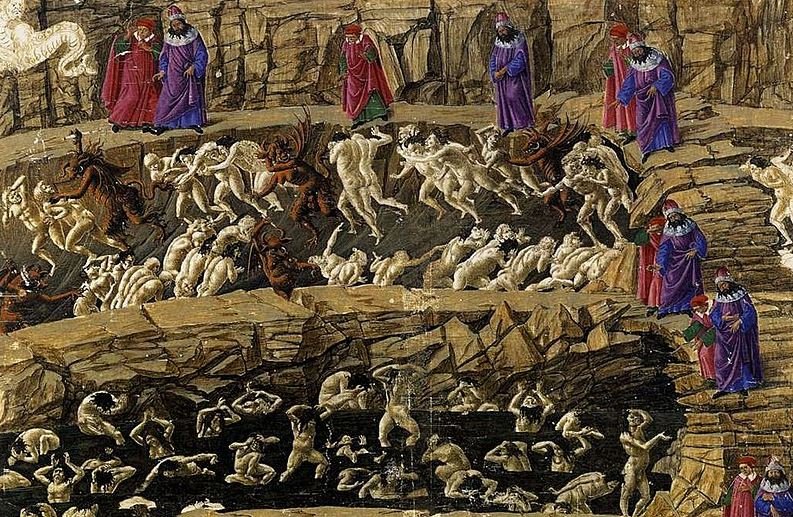
“Canto XVIII”, one of the illustrations of the “Devine Comedy”.
READ MORE: 10 Most Renowned Italian Renaissance Painters and their Masterpieces
Rediscovery and Preservation of the Manuscript
The fate of Botticelli’s manuscript remains somewhat mysterious. After disappearing for centuries, most of the drawings resurfaced in the late 19th century. Gustav Friedrich Waagen, a German art historian, identified the manuscript within the collection of the Duke of Hamilton. Subsequently, in 1882, 85 of Botticelli’s drawings were acquired by the Kupferstichkabinett Berlin (Museum of Prints and Drawings) under the leadership of its director, Friedrich Lippmann. The transaction was met with controversy, particularly in Britain, where the sale prompted a public outcry.
Meanwhile, eight additional illustrations were found in the Vatican Library, having once been part of Queen Christina of Sweden’s collection. Following her death in Rome in 1689, Pope Alexander VIII acquired these drawings for the Vatican archives. Although it remains unclear when the drawings were separated, the Map of Hell, one of the most famous illustrations, is housed in the Vatican collection today. In 2000–01, all 92 surviving illustrations were reunited for an exhibition in Berlin, Rome, and London’s Royal Academy for the first time in centuries.
Botticelli’s Earlier Engravings for the 1481 Printed Edition
Before embarking on the manuscript illustrations, Botticelli contributed drawings for a printed edition of The Divine Comedy, published in Florence in 1481 by Nicholo di Lorenzo della Magna. This edition featured engravings executed by Baccio Baldini, based on Botticelli’s designs. Unfortunately, Baldini, though an experienced engraver, struggled to capture Botticelli’s delicate artistic style.
The project faced numerous challenges. While the printed book reserved space for one engraving per canto, only 19 out of the 100 cantos were actually illustrated. Most copies contain just the first two or three illustrations, either printed directly on the page or pasted in later. Production delays and Botticelli’s likely departure to Rome in 1481 to work on frescoes in the Sistine Chapel may have contributed to the project’s premature abandonment.
Despite its limited success, Botticelli’s attempt to create illustrations for a printed book was groundbreaking. At a time when leading painters typically focused on frescoes and panel paintings, his involvement in printmaking demonstrated a forward-thinking approach to artistic production, though Giorgio Vasari later criticized Botticelli for dedicating too much time to it at the expense of his painting career.

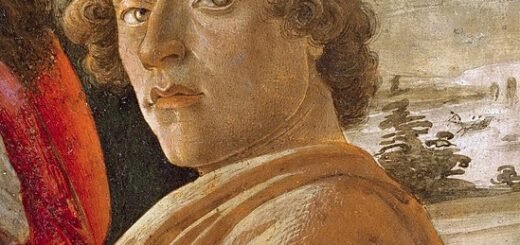
A self-portrait of Sandro Botticelli.
Commission and Conception of the Manuscript
The large-scale manuscript illustrations of The Divine Comedy are believed to have been commissioned by Lorenzo di Pierfrancesco de’ Medici, a prominent patron of Botticelli and a cousin of Lorenzo the Magnificent. According to a 16th-century writer known as Anonimo Magliabecchiano, Botticelli created a Dante on parchment for Lorenzo, although it is unclear whether this refers to the existing drawings or another, now-lost work. Some scholars suggest that Botticelli may have also produced these illustrations for his personal artistic exploration.
Although illuminated manuscripts were becoming less common by the late 15th century due to the rise of printed books, wealthy bibliophiles continued to commission them. Botticelli’s project was particularly ambitious, as he planned to illustrate each canto with a full-page drawing, a significant departure from the tradition of depicting only a single scene per canto. His approach combined narrative storytelling with the continuous narrative technique, where Dante, Virgil, and Beatrice appear multiple times within a single illustration.
Artistic Technique and Structure
The manuscript’s illustrations were executed using silverpoint, a technique involving a metal stylus that leaves faint lines on the paper. These initial outlines were later reinforced with ink, and in a few cases, completed with tempera colors. Only four pages received full illumination, while others remained in varying stages of completion. The decision to leave most illustrations uncolored remains a subject of debate among scholars. Some argue that Botticelli or his patron may have preferred the aesthetic of uncolored drawings, while others believe the project was simply left unfinished.
Through his meticulous technique and innovative compositional methods, Botticelli not only honored Dante’s legacy but also left an indelible mark on the history of illustrated manuscripts.
Botticelli’s technique evolved over time. The early illustrations feature larger figures, while later drawings incorporate more refined detail. The earliest and most completed drawings are from Inferno, suggesting that Botticelli initially worked sequentially. However, missing pages and inconsistencies in canto numbering complicate efforts to fully understand his progress.
Botticelli’s Innovations in Illustration
Botticelli’s approach to illustrating The Divine Comedy was highly innovative. Unlike earlier manuscript illustrations, which often divided a canto across multiple pages with small framed scenes, Botticelli used a single large illustration per canto. The accompanying text was arranged in four vertical columns, allowing for a clearer visual-textual relationship. This vertical format was particularly effective for Inferno, where Dante and Virgil descend through progressively deeper circles of Hell.
Additionally, two illustrations—the Map of Hell and Lucifer’s portrait—fall outside the canto-illustration structure, serving as unifying elements. The Map of Hell, a striking visual representation of Dante’s infernal landscape, provides a geographical overview of the entire Inferno. The Lucifer drawing, spanning two pages, uniquely captures the dramatic final canto of Inferno, emphasizing the poet’s journey through the lowest depths of Hell.
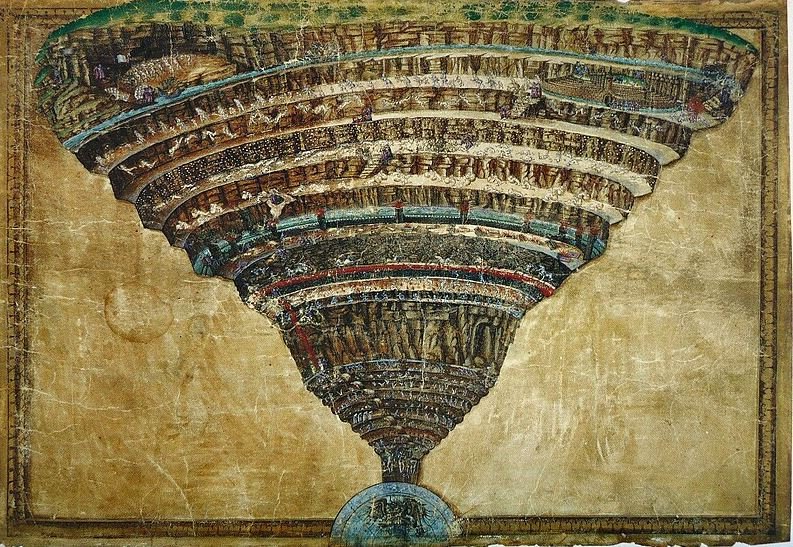
“Map of Hell”, an important illustration included in the “Devine Comedy”.
The Layout and Binding Hypothesis
The manuscript’s original binding remains unknown, but scholars suggest it was likely designed to open vertically. A horizontally arranged book would have been impractical due to the width required to fit both text and illustration on a single spread. Instead, a vertical binding would have allowed for a more natural reading experience, with the illustration placed above the text. Based on this assumption, the manuscript would have measured approximately 47 cm wide by 64 cm high, an unusual but effective format for integrating images and text.
Surviving Illustrations and Their Locations
Today, the illustrations are divided between the Berlin Museum of Prints and Drawings and the Vatican Library. The Vatican Library holds the Map of Hell and seven Inferno illustrations (for cantos I, IX, X, XII, XIII, XV, and XVI). Meanwhile, the Berlin Museum houses the remaining extant drawings. After World War II, the Berlin collection was split between East and West Germany but was later reunited following German reunification.
The Paradiso sequence remains incomplete. Although text pages exist for cantos XXXI to XXXIII, no corresponding drawings were ever started. This suggests that Botticelli may have abandoned the project before reaching the final stages of Dante’s celestial vision.
Cultural and Artistic Legacy
Botticelli’s Divine Comedy illustrations are among the most celebrated artistic interpretations of Dante’s work. Despite remaining unfinished, they showcase the artist’s extraordinary ability to convey narrative drama and emotional depth. Unlike conventional illuminated manuscripts, Botticelli’s images integrate continuous storytelling within a unified pictorial space, an approach that influenced later depictions of Dante’s epic.
In modern times, these illustrations have been widely studied and exhibited. The 2016 Italian-German documentary Botticelli Inferno explores the history of the manuscript. Directed by Ralph Loop, the documentary explores Botticelli’s Map of Hell and examines his artistic intent and lesser-known, darker side beyond The Birth of Venus.
Frequently Asked Questions
What materials and techniques did Botticelli use for the illustrations?
He primarily used silverpoint drawings, later inked over, with only four pages fully colored, demonstrating a meticulous but unfinished artistic process.
Where was the manuscript rediscovered, and where is it housed today?
Most of the manuscript was found in the Duke of Hamilton’s collection in the 19th century and later acquired by the Kupferstichkabinett Berlin, while some pages were located in the Vatican Library.
Portrait of Dante Alighieri
What was the reaction to the manuscript’s sale in 1882?
The sale to the Berlin museum caused an outcry in Britain, as it was acquired quietly by Friedrich Lippmann without British institutions securing it.
What was unique about Botticelli’s approach to illustrating the Divine Comedy?
Unlike other manuscripts, he illustrated each canto with a single full-page drawing, integrating a continuous narrative structure instead of isolated scenes.
Did Botticelli create other illustrations for the Divine Comedy?
Yes, he designed illustrations for a 1481 printed edition with engravings by Baccio Baldini, but they failed to capture Botticelli’s artistic finesse.
Who likely commissioned Botticelli’s manuscript drawings?
Lorenzo di Pierfrancesco de’ Medici is believed to have commissioned them, though some scholars suggest Botticelli created them for personal artistic exploration.
What modern significance does the manuscript hold?
It remains one of Botticelli’s most important surviving works, central to Renaissance art, and was exhibited in full for the first time in 2000–01 in Berlin, Rome, and London.