Ottoman Sultan Abdul Hamid II
Abdul Hamid II was the 34th sultan of the Ottoman Empire. Reigning from 1876 to 1909, his tenure marked the last phase in which a sultan wielded substantial authority over a state gradually succumbing to internal fractures and external pressures.
Summary
Born on September 21, 1842, Abdul Hamid II inherited a realm beset by uprisings, territorial disputes, and financial instability. Despite earnest attempts to modernize state institutions—such as introducing the empire’s inaugural constitution—he adopted increasingly authoritarian measures once confronted by severe domestic challenges and European intervention.
During his time in power, the empire suffered critical territorial losses, including Egypt and Cyprus, though it briefly regained some prestige with military success against Greece in 1897. Even so, Western powers often curtailed any lasting gains. This tension between reform and autocracy defined Abdul Hamid’s rule: he supported educational development while relying on pervasive censorship and secret police.
Ultimately, growing dissatisfaction among intellectuals, nationalist groups, and reformist military officers converged into the Young Turk movement, pushing the sultan to restore parliamentary life.
His eventual deposition in 1909 followed an unsuccessful attempt to reassert absolute power, making him both the final absolute monarch of a crumbling empire and a ruler whose rule catalyzed the transformations he had tried to restrain.

Prince Abdul Hamid at Balmoral Castle during his 1867 visit.
Early Life and Upbringing
Prince Abdul Hamid was the son of Sultan Abdulmejid I and Tirimüjgan Kadın, though he lost his mother in early childhood. Adopted by Perestu Kadın, who also cared for one of his half-sisters, he grew up under the protection of the imperial harem.
It is believed he was born in either Çırağan Palace or Topkapı Palace in Constantinople, centers of Ottoman dynastic life. Educated in a blend of Islamic and modern subjects, he developed linguistic skills and gained some familiarity with European thought.
Abdul Hamid II was born on September 21, 1842, in Constantinople (modern Istanbul). He was the son of Sultan Abdulmejid I and Tirimüjgan Kadın, a Circassian.
His formative experiences included accompanying his uncle, Sultan Abdulaziz, on a grand tour of France, Britain, and other European states in 1867. That journey exposed him to Western institutions, creating a mixed impression of admiration and suspicion.
Growing tensions within the empire, fueled by economic difficulties and nationalist rumblings, shaped Abdul Hamid’s perspective. Although his early surroundings were relatively stable, the dramatic events unfolding in Balkan provinces and the empire’s heavy debt foretold the challenges awaiting him once he ascended to the throne.
Ascension to the Throne
Abdul Hamid came to power after the deposition of his brother Murad V in August 1876, when the empire was nearly bankrupt and beset by uprisings in Balkan provinces. To appease foreign powers, he promulgated the empire’s first constitution in December 1876. Yet his early rule was overshadowed by the Great Eastern Crisis.
Attempts by European creditors to control Ottoman finances, along with multiple Balkan rebellions, weakened imperial authority. These pressures signaled the complexity Abdul Hamid faced in preserving the empire’s unity amid waves of reformist and nationalist sentiment.
Initial Reforms and Foreign Entanglements
Abdul Hamid’s opening moves, such as the 1876 constitution and parliamentary sessions, briefly buoyed liberal hopes. But the empire soon went to war with Russia in 1877–78 without allies, suffering major losses. The ensuing Treaty of San Stefano freed several Balkan states and demanded steep indemnities.
Abdul Hamid II ascended the throne on August 31, 1876, following his brother Sultan Murad V’s deposition.
Though the Congress of Berlin softened some terms, the empire ceded territories like Cyprus to Britain. Egyptian affairs eventually led to British takeover. These defeats exposed Ottoman vulnerability and prompted Abdul Hamid to tighten his grip, limiting freedoms and suspending constitutional provisions to maintain control.
Autocratic Turn and Suppression of Opposition
By 1878, Abdul Hamid had grown deeply suspicious of real or perceived threats to his power. After suspending the constitution and dissolving parliament, he ruled under a system often referred to as İstibdad, meaning autocracy.
A dense network of informants and a rigorous censorship apparatus targeted anyone suspected of harboring liberal, constitutional, or nationalist sentiments. Journalists, intellectuals, and reform-minded bureaucrats either toned down their critiques or faced exile.
Abdul Hamid II inherited a realm facing financial turmoil, political instability, and military threats, particularly from the Balkans and Russia.
In daily administration, the Sublime Porte’s influence waned as the sultan centralized authority at Yıldız Palace. Fearful of coups, he kept watch on officials and demanded loyalty from military leaders. Religious legitimacy was also invoked, as Abdul Hamid claimed the mantle of caliph to rally Muslim solidarity across the empire and beyond.
Ironically, these very tactics—spying on suspected conspirators and stifling political debate—alienated many educated groups who had once seen him as a hope for substantive reform. Over time, his paranoia and habitual centralization became emblematic of his long rule, prompting frustration among those yearning for a more open and accountable government.
Reforms in Administration and Education
Despite ruling through autocratic methods, Abdul Hamid recognized the importance of modernizing the empire’s institutional framework. He invested in extensive infrastructure projects, such as expanding railway lines across Anatolia and Rumelia, eventually paving the way for the Baghdad and Hejaz Railways.
These developments spurred economic integration among the empire’s far-flung provinces, allowing better troop movement and facilitating trade. Another critical aspect of Abdul Hamid’s reign was the overhaul of educational systems. He championed the founding of professional schools in areas such as law, the arts, engineering, and veterinary science.
The sultan’s aim was to develop a cadre of professionals proficient in both Western scientific knowledge and the empire’s unique requirements. Primary and secondary schools were established throughout Ottoman domains, while military academies grew in prominence.
Notably, the legal reform that allowed for the opening of the empire’s first modern law school in 1898 underlined his recognition of the need for skilled bureaucrats. However, the new wave of young graduates from these schools would become his most vocal critics. They demanded greater rights and constitutional governance, chafing against the stifling atmosphere of censorship and the sultan’s reliance on arbitrary arrest.
The Pan-Islamic Policy and Relations with Europe
Facing both European encroachment and internal discontent, Abdul Hamid embraced a Pan-Islamic approach, hoping to unify Muslim populations within and beyond Ottoman borders. As the caliph, he attempted to rally global Muslim sentiment against Western imperialism.
Although this approach appealed to many Muslims abroad, European powers perceived his policy as a threat. Notably, Germany emerged as an imperial partner, motivated by its own strategic interests. Kaiser Wilhelm II courted the sultan through high-profile visits, securing railway concessions and economic privileges.
Meanwhile, Britain tightened its hold on territories like Egypt and Cyprus, while France moved into North African areas, steadily diminishing the empire’s influence. Abdul Hamid also sought to counteract foreign dominance by restricting foreign creditors’ privileges and encouraging domestic industry. Yet, financial exigencies forced him to accept conditions set by the Ottoman Public Debt Administration, which managed revenues for foreign bondholders.
Despite these constraints, Abdul Hamid remained resolute in asserting the empire’s sovereign identity. However, his Pan-Islamic campaigns did not address the grievances of non-Muslim subjects, and ongoing insurgencies in the Balkans, along with unrest among various religious minorities, fueled the empire’s disintegration.
Growing Dissent and the Young Turk Revolution
The sultan’s authoritarian methods galvanized diverse opposition movements. Intellectuals who had benefited from the educational expansions led organized efforts for constitutional restoration. These critics coalesced into organizations like the Committee of Union and Progress (CUP), whose membership was strong among the officers stationed in the empire’s European provinces.
Ethnic minorities, including Armenians, also mobilized for political representation and the cessation of repressive policies. Notoriously, the Hamidiye Regiments, comprised largely of Kurdish cavalry, perpetuated atrocities against Armenian communities, prompting international condemnation. Meanwhile, the empire’s handling of various nationalist stirrings—Greek, Bulgarian, Serbian—exacerbated tensions in the Balkans.
Over time, the CUP garnered enough military support to stage the 1908 Young Turk Revolution. Confronted by an army advancing from Salonica, Abdul Hamid was compelled to reinstate the suspended constitution and reconvene parliament. This event inaugurated the Second Constitutional Era, reversing decades of autocratic rule. Yet, the sultan’s efforts to mount a countercoup in 1909—capitalizing on conservative sentiments in the military—only consolidated the resolve of constitutionalists.
The attempt failed, culminating in the uprising known as the 31 March Incident, which ended in the sultan’s final removal from power by the very parliament he had been forced to revive.

An 1899 portrait of Abdul Hamid II.
Deposition and Later Life
Following the 31 March Incident, Abdul Hamid’s half-brother ascended as Mehmed V, and the deposed sultan was exiled to Salonica. During his captivity, he led a quieter existence, focusing on personal interests such as carpentry and reading.
The outbreak of hostilities in the Balkan regions caused his relocation back to Constantinople, where he spent his final years in the Beylerbeyi Palace. He died on February 10, 1918, witnessing the empire’s further deterioration.
His deposition symbolized the decisive victory of reformist forces over a dynasty reluctant to relinquish absolute power, setting the stage for the empire’s eventual transition toward a republican framework.
Personal Pursuits and Legacy
Abdul Hamid was known for his carpentry, love of opera, and wide reading. He wrote poetry and undertook philanthropic efforts yet was highly cautious in relationships. Labeled the “Red Sultan,” he oversaw modernization projects alongside oppressive policies.
His downfall reflected demands for greater governance. Over decades, he was the empire’s final absolute monarch and an unwitting catalyst for transformation toward a modern republic.
Frequently Asked Questions
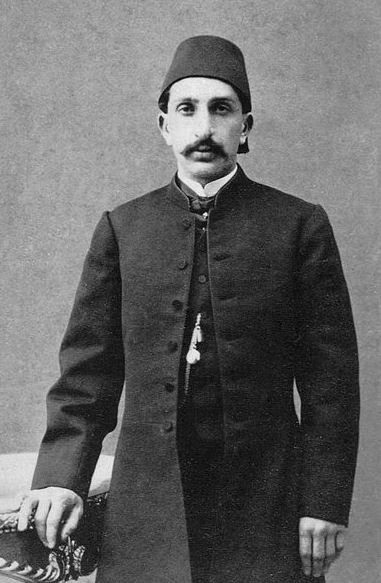
An 1868 photo of Abdul Hamid II
What role did Abdul Hamid II play in Ottoman governance?
He was the last Ottoman sultan to wield effective control over the empire, ruling as an absolute monarch from 1876 to 1909. His reign saw significant modernization efforts but also repressive policies and territorial losses.
What were Abdul Hamid II’s major reforms?
He modernized education, expanded railways and telegraphs, and restructured the Ottoman bureaucracy. He established professional schools and a system of primary and secondary education while enhancing military infrastructure.
Why did Abdul Hamid II suspend the Ottoman Constitution?
Amid the Russo-Turkish War and internal instability, he suspended the 1876 Constitution in 1878 to consolidate power, ruling without a parliament for three decades.
What led to his deposition?
His autocratic rule, censorship, and repression of minorities fueled opposition from groups like the Young Turks. In 1909, after the 31 March Incident, he was deposed following the reinstatement of the constitution in 1908.
How did Abdul Hamid II address minority issues?
He suppressed uprisings but faced criticism for the Hamidian massacres against Armenians. His Pan-Islamist policies sought to unify Muslims but alienated Christian minorities.
What marked the end of his life?
After his deposition, Abdul Hamid lived in captivity, studying, writing, and practicing carpentry until his death in 1918, leaving a complex legacy of modernization and autocracy.





