Trajan’s Market
Trajan’s Market, a complex of ancient Roman ruins located in Rome, Italy, is often considered one of the earliest examples of a shopping mall. Constructed between 107-110 AD under Emperor Trajan, it represents an innovative architectural feat that not only served as a commercial center but also had political, administrative, and social functions. As an integrated part of Trajan’s Forum, the Market reveals insights into ancient Roman life, architecture, urban planning, and imperial ideology.
Historical Context
The Markets of Trajan were built as part of a larger urban development project initiated by Emperor Trajan. Trajan, known for his military conquests and extensive public building programs, sought to celebrate his victories over the Dacians and showcase Rome’s wealth and power through monumental architecture.
To accommodate this grand project, architect Apollodorus of Damascus, a skilled engineer and designer, was commissioned to oversee the construction. Apollodorus not only directed the Markets but also contributed to the construction of Trajan’s Forum, which would include a basilica, libraries, and the famed Trajan’s Column.
Trajan’s Market not only represented the commercial hub of Rome but also displayed Emperor Trajan’s ability to reshape the landscape and redefine the city’s geography in pursuit of a lasting legacy.
At the time, Rome was a thriving city of over a million people, and its urban center was congested with buildings and narrow streets. The construction of Trajan’s Market required massive excavation and leveling of the Quirinal Hill to make space for a grandiose complex.
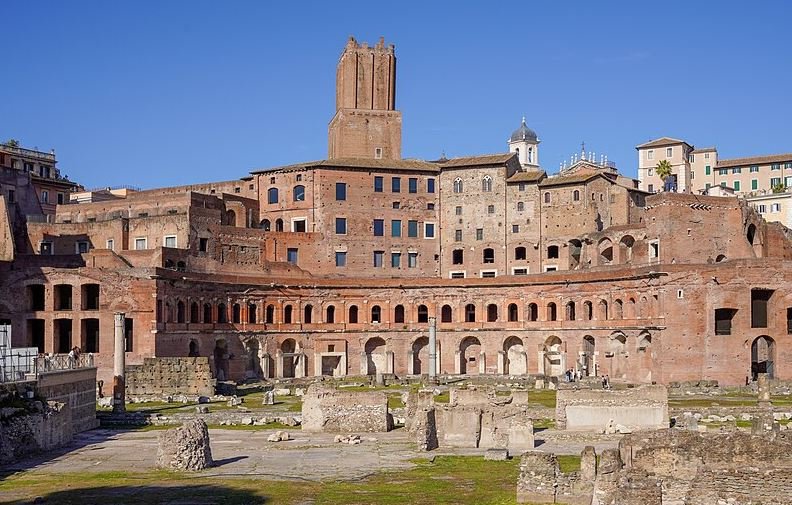
A 2022 picture of Trajan’s Market
Architectural Structure
Trajan’s Market is a multi-level complex, distinguished by its semicircular shape and multi-purpose design, making it one of the most sophisticated structures of ancient Rome. The entire complex consisted of over 150 rooms and spaces, including small shops, large halls, administrative offices, and even open-air areas. The complex’s layout includes six main levels, with each level serving distinct purposes.
The Great Hall, a large covered space located at the heart of the complex, is among the most impressive elements of Trajan’s Market. The Great Hall featured high vaulted ceilings, supported by robust concrete walls and piers, demonstrating the advanced construction techniques employed by the Romans.
Apollodorus of Damascus employed concrete in a way that was both structurally sound and flexible, allowing for the creation of wide open spaces that would have otherwise been impossible to build with traditional materials like stone or brick.
Built under the guidance of Apollodorus of Damascus, Trajan’s Market combined functionality with aesthetic beauty, offering a sophisticated commercial and administrative hub for the people of Rome.
The ground floor and lower levels of the market primarily consisted of small shops, known as “tabernae.” These tabernae were organized in a repetitive, uniform pattern, featuring arched doorways that opened onto the main street. The upper levels contained larger administrative offices and possibly residential spaces. Some historians believe that the upper levels might have housed imperial offices where government officials managed the empire’s commercial and financial activities.
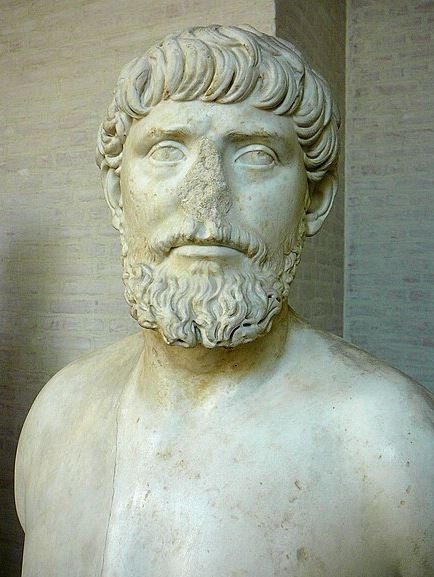
Bust of Apollodorus of Damascus.
Innovative Architectural Features
One of the most remarkable features of Trajan’s Market is its use of concrete and brick masonry, both of which contributed to its longevity and stability. The Romans were pioneers in concrete technology, using a mixture that included volcanic ash, which gave their concrete exceptional durability. This innovation allowed for the creation of curved walls, high ceilings, and arched openings, all of which are visible in Trajan’s Market. The complex’s semicircular shape is thought to have been designed to harmonize with the surrounding urban landscape and to serve as a natural extension of Trajan’s Forum.
The vaulted ceilings in the Great Hall exemplify the Roman mastery of the arch and vault, techniques that had a lasting influence on Western architecture. By using cross-vaults and barrel vaults, Apollodorus was able to create a series of open, interconnected spaces that allowed light to filter through the market, enhancing the shopping and administrative experience. The design not only optimized space but also facilitated movement and airflow, making it a comfortable environment for both merchants and visitors.
Another innovative element of Trajan’s Market is the terraced layout, which rises up the slope of the Quirinal Hill. This terraced design allowed the complex to maximize space vertically, rather than expanding outward into the already crowded city. The higher levels of the market were accessible by a series of staircases and ramps, creating a fluid transition between levels and providing panoramic views of the surrounding areas, including Trajan’s Forum and the cityscape of Rome.
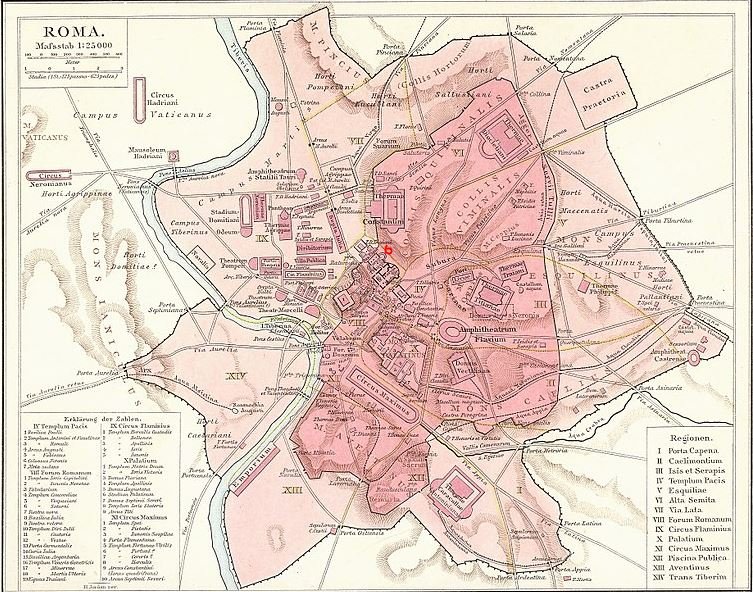
Map of Rome showing the location of Trajan’s Market (in red).
Commercial and Social Function
Trajan’s Market was primarily a commercial center, where merchants sold goods ranging from food and spices to textiles and precious metals. The market served as a one-stop shopping destination for Roman citizens, allowing them to purchase a variety of products in a single location. The design of the tabernae, small shop spaces with arched doorways, reflects this commercial purpose, with each shop serving as a miniature storefront for merchants to display their wares.
In addition to its commercial functions, Trajan’s Market also played an important social and administrative role. The complex was a place where people from different social classes could interact, providing an environment for networking and exchanging information. The upper levels, which housed larger rooms and offices, are believed to have served as administrative spaces, possibly for the management of Trajan’s Forum and other public affairs. These rooms could have been used by government officials, financial administrators, and bureaucrats responsible for overseeing various aspects of the empire’s economic and commercial life.
Trajan’s Market served as a commercial hub, connecting people from various backgrounds and offering a vibrant shopping experience.
The Market of Trajan also served as a venue for political propaganda. The presence of imperial offices and administrative spaces within the market complex suggests that Trajan’s government wanted to maintain control over commercial activities and to assert the emperor’s authority in all aspects of Roman life. By placing his own forum and market at the center of Rome’s commercial and social life, Trajan was able to project an image of a powerful, organized, and benevolent ruler, concerned with the welfare and prosperity of his people.
Did you know…?
The street that ran along the upper level of Trajan’s Market was called Via Biberatica, possibly named after the Latin word biber, meaning “drink,” suggesting it may have had drinking establishments.
Cultural Significance and Legacy
Trajan’s Market was more than just a shopping mall; it was a testament to the architectural and engineering prowess of the Roman Empire. It showcased the empire’s ability to create monumental structures that were both functional and beautiful, serving as a source of pride for the Roman people and as a symbol of imperial power. The market’s architectural innovations, such as the use of concrete and the terraced, multi-level design, influenced later architectural developments in Rome and beyond.
In later centuries, the concept of a centralized marketplace would inspire similar structures across Europe and the Middle East. The design and function of Trajan’s Market can be seen as a precursor to modern shopping centers and malls, where various types of shops and services are gathered in a single complex to facilitate commerce and social interaction.
The Museo dei Fori Imperiali
Over the centuries, Trajan’s Market has suffered damage from natural disasters, neglect, and repurposing. During the Middle Ages, parts of the market were transformed into a fortress by the Frangipane family, and later the complex was used for residential purposes. These changes altered some of the original structures, though significant portions of the complex remain intact.
In the 20th century, extensive restoration efforts were undertaken to preserve Trajan’s Market as an important historical and cultural site.
Today, Trajan’s Market is an archaeological site and museum, known as the Museo dei Fori Imperiali. The museum houses artifacts from ancient Rome and provides visitors with insight into the city’s history and the role of Trajan’s Market within it. Through a combination of original artifacts, reconstructions, and informative displays, the museum allows visitors to experience what the market might have looked like in its prime.
Questions and Answers about the Trajan’s Market

When was Trajan’s Market built?
Trajan’s Market was built between 107-110 CE during the reign of Emperor Trajan.
Where is Trajan’s Market located in relation to Trajan’s Forum?
Trajan’s Market is situated at one end of Trajan’s Forum in Rome.
What were the primary functions of Trajan’s Market?
The primary function was commercial, with small shops, a covered market, and residential apartments. However, it also served various other purposes.
The market was built into a hillside on three levels, with terraced construction and staircases connecting different floors.
What architectural features are found on the ground level of Trajan’s Market?
The ground level includes shallow alcoves designed for small shops, which follow the contours of the bedrock, resulting in uneven depths.
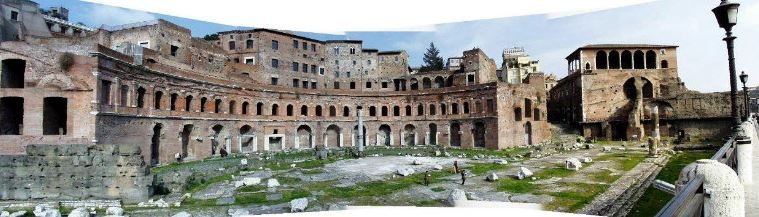
A wider view of Trajan’s Market as it appeared in 2000.
What material was originally used to frame the alcoves on the ground level?
Travertine was used to frame the alcoves, enhancing the shop displays and adding elegance.
What additional structures were on the upper level?
The upper level housed more shops, a large central apartment block, and a covered shopping arcade.
What separates Trajan’s Market from the Exhedra and Porticus of Trajan’s Forum?
A tufa wall separates them, but access is provided through a large central gateway.
What materials were used in the construction of Trajan’s Market, and why are they significant?
Concrete and brick were used, showcasing Imperial Roman architecture’s advanced construction techniques.
What decorative elements are present on the semicircular façade of the market?
The façade includes brick pilasters with travertine bases and capitals, decorative brickwork, carved brick entablatures, and pediments. The pilasters, entablatures, and pediments were originally painted red and covered with white stucco.
What types of goods were sold in Trajan’s Market?
Goods from across the Roman Empire, including fruits, vegetables, fish, wine, oil, and spices such as pepper, were sold.
What happened to Trajan’s Market in the 12th and 13th centuries?
It became part of a medieval fortress, marked by the addition of the Torre delle Milizie tower.
When was Trajan’s Market excavated, and why is this significant?
The market was excavated in the 1920s and 1930s, revealing its architectural grandeur and earning it the name Trajan’s Market.
What does Trajan’s Market house today, and why is it important?
Today, it houses the Museum of the Imperial Forums, offering insights into ancient Roman commerce, architecture, and urban planning.