The Greek Junta
The Greek Junta, known as the Regime of the Colonels, was a right-wing military dictatorship that ruled from 1967 to 1974. Led initially by Colonel Georgios Papadopoulos and later by the hardliner Dimitrios Ioannidis, it seized power in a sudden coup on 21 April 1967. This abrupt takeover ousted the caretaker government just weeks before scheduled elections favoring the Centre Union of Georgios Papandreou. The regime’s hallmarks included intense anti-communism, clampdowns on civil liberties, and the systematic imprisonment and torture of opponents. Eventually, it collapsed after the Turkish invasion of Cyprus, paving the way for democratic restoration.
Historical Background
Greece had endured decades of turmoil before the coup. The Axis occupation in World War II led to resistance groups, including communists and right-wing forces, vying for dominance. Winston Churchill and Joseph Stalin signed the Percentages Agreement, dividing Southeastern Europe’s spheres of influence, with Britain intent on keeping Greece out of Soviet control.
After liberation in 1944, the Greek Civil War ensued (1946–1949), culminating in the defeat of communist insurgents. Tensions between left and right persisted, fueled by lingering distrust. Consequently, Greek politics remained polarized, setting the stage for the Colonels’ eventual power grab.

Flag of Greece between 1970 and 1975.
The 1967 Coup
Months before national elections in May 1967, rumors spread of potential collusion between left-leaning groups and centrist politicians. Fearing a strong showing by Papandreou’s Centre Union, conservative elements hinted at imposing martial law. Acting preemptively, a group of mid-ranking officers, including Papadopoulos, Makarezos, and Pattakos, initiated “Operation Prometheus.”
In the early hours of 21 April 1967, tanks rolled into Athens, key officials were detained, and emergency defense plans were exploited to seize control. By morning, the Colonels suspended constitutional guarantees. King Constantine II reluctantly endorsed their cabinet, thereby granting a semblance of legality to the new regime.
Papadopoulos and Ideological Justifications
Georgios Papadopoulos emerged as the junta’s chief architect. Maintaining that communists threatened Greek society, he presented the dictatorship as a “national revolution” aimed at saving the country from anarchy. Deploying patriotic rhetoric, Papadopoulos claimed the regime would guide Greece back to stability by defending “Helleno-Christian” values.
Government propaganda often employed medical metaphors, depicting Greece as a patient in need of drastic surgery. The Colonels saw themselves as guardians tasked with realigning the nation’s moral compass. In practice, this ideology justified severe repression: political dissent was criminalized, and the military’s authority reigned supreme.

The key figures of the 1967 coup d’état: From left, Stylianos Pattakos, Georgios Papadopoulos, and Nikolaos Makarezos.
American Influence and Cold War Context
During the early Cold War, Greece’s strategic location made it crucial for NATO. The Truman Doctrine of 1947 funneled millions in U.S. aid to bolster anti-communist forces. Although direct American involvement in the 1967 coup remains debated, the United States tolerated the junta as a bulwark against Soviet expansion.
The era of the Greek Junta fostered anti-Americanism, since many Greeks believed the U.S. had tacitly endorsed the Colonels.
U.S. officials prioritized stability over democracy, which later triggered widespread anti-American sentiment among Greeks. Despite occasional criticism from Western European powers, international condemnation was muted by Cold War imperatives. The regime exploited its alliance with the West to consolidate power and weaken domestic opposition.
Civil Rights Clampdown
Once in power, the junta abolished political parties, censored the press, and banned public gatherings. Suspected leftists or dissidents were routinely arrested, often subjected to harsh treatment or exile on remote islands. Torture emerged as a standard interrogation method in facilities run by the Greek Military Police (ESA). Widespread surveillance amplified fear and silence among citizens.
Meanwhile, constitutional protections were suspended under martial law, giving junta officials near-limitless authority. International organizations, including the Council of Europe, documented extensive human rights violations. The dictatorship justified repression as necessary to safeguard national security and combat subversion.
Counter-Coup Attempt by King Constantine II
Although King Constantine II endorsed the Colonels’ initial government, he soon tried to recapture power. On 13 December 1967, from Kavala in northern Greece, he launched a counter-coup, rallying loyal units to restore constitutional order.
However, poor coordination, loyalist confusion, and the junta’s control of communications thwarted his effort. Forced into exile in Rome, Constantine’s failure further eroded the monarchy’s standing.
The regime appointed a figurehead prime minister and consolidated power, sidelining the king. Decades later, a referendum in 1974 ended the monarchy entirely, a move reflecting its tarnished reputation after Constantine’s ill-fated rebellion.

A portrait of Constantine II by English photographer Allan Warren
Cultural Engineering and Social Freedoms
Despite severe crackdowns, the Colonels strove to project normalcy. They permitted certain Western cultural imports, like popular music and select films, hoping to placate the middle class. Folk traditions were glorified, presenting the regime as defenders of Greek heritage.
Education was policed to enforce traditional values, with a preference for the Katharevousa form of Greek. Writers, artists, and musicians deemed subversive faced censorship or imprisonment. This contradictory blend of cultural openness and strict political repression aimed to depoliticize society. Ultimately, those who dared critique the dictatorship’s policies faced arrest, while the cultural domain remained under careful surveillance.
Papadopoulos’s Liberalization Efforts
In the early 1970s, Papadopoulos attempted a measured relaxation of the dictatorship to appease international critics and domestic opponents. He ended martial law in certain areas and proposed an “Advisory Council” as a step toward constitutional governance. Some press restrictions loosened, allowing minimal critique of government actions. Yet core repressive structures persisted, and the Colonels maintained sweeping emergency powers.
Many Greeks saw these efforts as cosmetic. Underlying tensions continued to simmer, especially among students and intelligentsia. Despite minor liberties, Papadopoulos’s control over security forces and the judiciary guaranteed that the regime’s authoritarian framework remained firmly in place.
Student Protests and the Athens Polytechnic
Student activism flourished despite intimidation. The prime example came in November 1973, when Athens Polytechnic students occupied their campus, broadcasting anti-junta slogans and demanding basic freedoms. The movement attracted wide support, and the dictatorship answered with brutality.
In the pre-dawn hours of 17 November, a tank crashed through the Polytechnic’s gates, resulting in deaths and countless injuries. This heavy-handed response shattered any lingering notions of genuine liberalization. The Athens Polytechnic uprising became a rallying point for the broader population, highlighting the regime’s incapacity to address grassroots demands for democracy and intensifying its internal fissures.
Ioannidis’s Hardline Regime
In the wake of the Polytechnic crackdown, hardliner Dimitrios Ioannidis, head of the ESA, initiated a coup against Papadopoulos on 25 November 1973. Labeling the latter’s liberalization measures as betrayals of the “revolution,” Ioannidis seized power behind the scenes. He reimposed martial law and systematically reversed Papadopoulos’s moderate gestures.
Although Phaedon Gizikis held the presidency nominally, Ioannidis dominated policy. His administration, widely condemned for its increased suppression, operated with even less tolerance for dissent. As the second junta tightened control, it also embarked on a reckless path regarding Cyprus, with catastrophic repercussions.
The Cyprus Fiasco and Collapse
Ioannidis sought to unify Cyprus with Greece through force. In July 1974, he backed a coup against President Makarios III, prompting Turkey’s invasion of the island. Unable to counter effectively, the junta faced widespread condemnation at home and abroad. Greek armed forces, demoralized by the fiasco, turned against Ioannidis.
Political leaders capitalized on the crisis to demand the restoration of civilian rule. Under intense pressure, the Colonels ceded authority. Konstantinos Karamanlis, exiled since the 1960s, returned to form a new government on 24 July 1974. This marked the abrupt end of the regime and the start of Metapolitefsi.
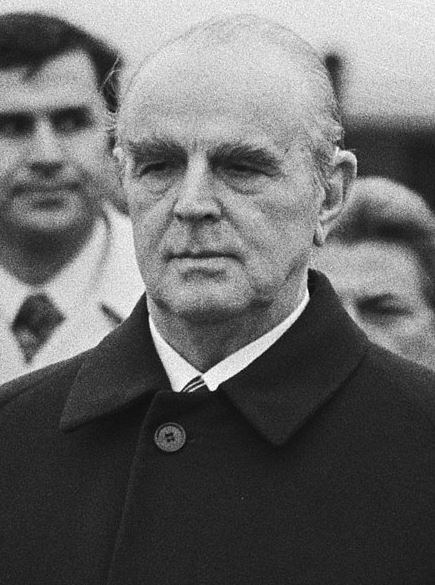
A 1978 photo of Konstantinos Karamanlis.
Transition to Democracy and Trials
Karamanlis quickly reestablished parliamentary institutions, leading to free elections and a 1974 referendum that abolished the monarchy. Greece embraced the Third Hellenic Republic, moving toward political normalization. Trials of former junta members began in 1975, reflecting public outrage at years of oppression.
Georgios Papadopoulos, Dimitrios Ioannidis, and other key figures faced charges for high treason and human rights violations. Though initial sentences included the death penalty, most were commuted to life imprisonment. New constitutional safeguards reinforced civil liberties, and Greece’s eventual entry into the European Economic Community ushered in broader integration with Western Europe.

Frequently Asked Questions
What event triggered the junta’s rise to power?
They staged a coup on 21 April 1967, just before scheduled elections that were expected to favor Georgios Papandreou’s Centre Union, claiming they were preventing a communist takeover.
What defined the regime’s rule?
They imposed strict anti-communism, censored the press, restricted civil liberties, and used imprisonment, torture, and exile to silence political opponents.
Who led the junta government?
Colonel Georgios Papadopoulos was the main leader from 1967 to 1973, and he attempted to institute limited reforms before being overthrown by the more hardline Dimitrios Ioannidis.

A 1973 phot of Georgios Papadopoulos.
Why did King Constantine II fail to stop the coup?
Although urged by his government to mobilize against the putschists, he hesitated, ultimately swore in their chosen prime minister, and then attempted a counter-coup that quickly collapsed, forcing him into exile.
How did the regime handle opposition and dissent?
They outlawed leftist parties, arrested and exiled dissenters to remote islands, regularly tortured political prisoners, and imposed pervasive censorship to stifle criticism.
What role did the United States play?
While there is no evidence that the U.S. actively engineered the coup, it supported the anti-communist junta during the Cold War, contributing to strong anti-American sentiment among many Greeks.
What caused the junta’s downfall?
Its collapse was accelerated by infighting, the failed liberalization effort by Papadopoulos, the brutal crackdown on student protests (notably at the Athens Polytechnic), and especially the Turkish invasion of Cyprus following the junta’s coup on the island.
How was democracy restored?
After the Cyprus fiasco, senior military officers withdrew support from Ioannidis. A transitional government under Konstantinos Karamanlis took over in July 1974, leading to free elections, the abolition of the monarchy, and the establishment of the Third Hellenic Republic.





