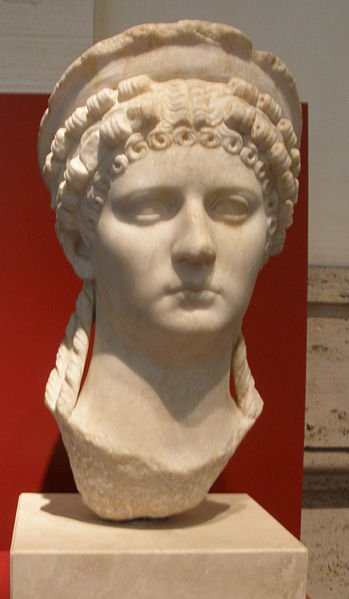
Bust of Poppaea Sabina
Poppaea Sabina was a Roman empress, the second wife of Emperor Nero, and previously married to the future emperor Otho. She was known for her beauty and political intrigues.
Early Life and Background
Poppaea Sabina, also known as Ollia in her early years, was born around AD 30 in Pompeii. She was the daughter of Titus Ollius, a man of equestrian rank who had a promising career but was disgraced due to his association with the praetorian prefect Sejanus. Her mother, Poppaea Sabina the Elder, was widely admired for her beauty and was a victim of the political intrigues of her time, leading to her suicide in AD 47. The maternal lineage of Poppaea was more prestigious, as her grandfather, Gaius Poppaeus Sabinus, had been a respected senator and governor of multiple provinces.
Poppaea’s early years were shaped by the fortunes and misfortunes of her family. The disgrace of her father might have motivated her to adopt her mother’s name instead of retaining her patronymic nomen “Ollia.” Raised in an environment of Roman aristocracy, she likely received an education befitting noblewomen of the time, learning rhetoric, philosophy, and literature, as well as the social graces that would later make her an influential figure in Roman society.
Marriage to Rufrius Crispinus
At the age of 14, Poppaea was married to Rufrius Crispinus, an equestrian officer who commanded the Praetorian Guard during Emperor Claudius’s reign. Their marriage aligned her with a powerful faction in Roman politics, though it would not last long.
In AD 51, Agrippina the Younger, the new wife of Claudius, sought to consolidate her own influence by removing figures loyal to her predecessor, Valeria Messalina. Crispinus, being associated with Messalina’s circle, was dismissed from his command, weakening his standing. Later, under Emperor Nero, he was executed, accused of conspiring against the emperor.
Poppaea bore a son from this marriage, also named Rufrius Crispinus. However, after her own demise, her son suffered a tragic fate, drowned by Nero on a fabricated charge during a staged fishing trip.
Marriage to Otho and Relationship with Nero
After her first marriage ended, Poppaea became the wife of Otho, a close friend of the new emperor, Nero. Otho was a man of considerable influence and one of Nero’s most trusted allies. However, Poppaea reportedly used this marriage as a stepping stone to gain access to Nero himself. Ancient sources suggest that she seduced Nero and gradually manipulated him into falling deeply in love with her.
In time, Poppaea convinced Nero to distance himself from Otho, who was conveniently assigned the governorship of Lusitania (modern Portugal), effectively removing him from Rome. This maneuver left Poppaea free to pursue her ambition of becoming empress. Some sources claim she directly influenced Nero’s decision to rid himself of his mother, Agrippina, to clear the path for their union.
Marriage to Nero and Role as Empress
Poppaea and Nero officially married in AD 62, after he had divorced and subsequently executed his first wife, Claudia Octavia. The execution of Octavia, who was widely popular among the Roman people, was met with significant outrage. Poppaea’s role in this event cemented her reputation as a cunning and ruthless woman in historical accounts. However, some modern scholars argue that political circumstances rather than personal ambition played a more significant role in these developments.
As empress, Poppaea wielded substantial influence over Nero. She was a strong proponent of luxury and grandeur, reflected in the magnificent Villa Poppaea in Oplontis, which has been excavated and is believed to have been one of her residences. She was known for her lavish lifestyle and her dedication to enhancing Nero’s prestige, encouraging his artistic and theatrical pursuits.
Despite the negative portrayals in Tacitus and Suetonius’ writings, the Jewish historian Josephus presents a different view of Poppaea. He describes her as sympathetic to the Jewish people and suggests that she played a role in securing favorable treatment for them in the imperial court. This more nuanced portrayal hints at her political acumen and ability to navigate Rome’s complex power dynamics.

READ MORE: Greatest Roman Historians and their Major Works
Death and Uncertain Circumstances
Poppaea’s death in AD 65 remains one of the most controversial aspects of her life. Ancient historians provide conflicting accounts of how she died. The most infamous version, recorded by Suetonius and Tacitus, claims that Nero, in a fit of rage, kicked his pregnant wife, fatally injuring her. Tacitus, however, also mentions other versions, including the possibility that Nero poisoned her.
Cassius Dio further elaborates on the story, suggesting that Nero leapt upon her stomach, either intentionally or in a moment of blind fury. However, these accounts must be understood in the context of the historians’ biases against Nero, who was widely vilified after his death. Some modern scholars argue that Poppaea may have died from complications of pregnancy or miscarriage, as high mortality rates during childbirth were common in antiquity.
Nero deeply grieved Poppaea’s death, gave her a state funeral, and had her embalmed with spices. She was also deified, receiving divine honors alongside their daughter, Claudia Augusta.
Despite the tragic circumstances of her death, Nero went into deep mourning, treating her funeral with great honors. He ensured that she was embalmed rather than cremated, a rare practice for Romans, and arranged an elaborate ceremony where vast quantities of incense were burned in her honor. She was deified posthumously, and her memory was revered, at least during Nero’s remaining years.
Poppaea’s Cultural Legacy
Poppaea Sabina has continued to capture the imagination of historians, artists, and writers throughout history. She has been portrayed in various operas, films, and literary works, often depicted as the ultimate femme fatale who used her beauty and intelligence to ascend to power.

A statue of Poppaea displayed in the Archaeological Museum of Olympia, Greece.
In Opera
One of the most famous artistic interpretations of Poppaea’s life is found in Claudio Monteverdi’s opera L’incoronazione di Poppea (The Coronation of Poppaea), first performed in 1642. The opera presents her as a scheming but ultimately successful woman who manipulates events to become empress. Unlike traditional morality plays, this opera does not end with divine justice but rather with the triumph of Poppaea and Nero’s love.
Another opera in which Poppaea plays a significant role is Handel’s Agrippina (1709), where she is portrayed as an innocent pawn in the grander schemes of Nero’s mother, Agrippina. This depiction contrasts sharply with the more common portrayals of Poppaea as the manipulative figure.
Did you know…?
- Poppaea has appeared in various adaptations of Polish author Henryk Sienkiewicz’s novel Quo Vadis, which fictionalizes events from Nero’s reign. Notable portrayals include Patricia Laffan’s performance in the 1951 film adaptation and Agnieszka Wagner’s role in the 2001 version.
- She has also been depicted in other historical films and TV series, including The Sign of the Cross (1932), where she is shown as a decadent and sensual figure, and the BBC’s I, Claudius (1976), where she appears as a secondary character.

Frequently Asked Questions
What was Poppaea’s family background?
She was the daughter of Titus Ollius and Poppaea Sabina the Elder. Her maternal grandfather, Gaius Poppaeus Sabinus, was a consul and governor, and her stepfather was Publius Cornelius Lentulus Scipio.
Why is the Villa Poppaea significant?
The luxurious Villa Poppaea at Oplontis, near Pompeii, is believed to have been her residence and contains archaeological evidence linking it to her.
How did Poppaea become Nero’s wife?
She divorced Otho and became Nero’s mistress, allegedly persuading him to murder his mother, Agrippina, and later to divorce and execute his first wife, Claudia Octavia, to marry her in 62 AD.
What was her influence on Nero’s rule?
Sources depict her as manipulative, encouraging Nero’s ruthless decisions, but the historian Josephus describes her as sympathetic toward Jews and influential in their favor.
How did Poppaea Sabina die?
Ancient historians give conflicting accounts—Suetonius and Cassius Dio claim Nero killed her by kicking her during pregnancy, while others suggest she died from childbirth complications.





