Revolutionary War General John Cadwalader
John Cadwalader (1742–1786) was an influential leader during the American Revolutionary War, known for his loyalty to George Washington and active participation in key revolutionary efforts. From his early days as a merchant and militia leader in Philadelphia to his role in critical military campaigns and post-war political involvement, Cadwalader’s life embodied both the ideals and contradictions of the revolutionary generation.
Early Life and Background
Born in Trenton, New Jersey, on January 10, 1742, John Cadwalader came from a well-connected family with Quaker roots. His father, Thomas Cadwalader, was a respected physician, and his mother, Hannah Lambert, was of English heritage. The Cadwalader family moved to Philadelphia in 1750, where John and his younger brother Lambert became prominent merchants. The family’s Welsh heritage and social connections allowed them to integrate into Philadelphia’s elite society, where they were involved in civic and intellectual circles.
In 1768, Cadwalader joined the American Philosophical Society, an esteemed organization dedicated to the pursuit of knowledge and advancement of society, which included prominent figures like Benjamin Franklin. Around this time, Cadwalader became a senior officer in the Philadelphia Associators, a volunteer militia organized by Franklin in 1747. This militia experience would prepare him for his role in the Revolutionary War, and he soon emerged as a capable leader committed to the cause of American independence.

Portrait of John Cadwalader by American painter Charles Wilson Peale.
The Philadelphia Associators and Early Revolutionary Activities
As the American colonies moved toward open rebellion against British rule, Cadwalader’s role within the Philadelphia Associators became increasingly significant. He organized local support for the revolutionary movement and helped build up the militia’s strength and readiness. His position as senior officer allowed him to wield considerable influence, and he was instrumental in rallying Philadelphians to the cause of independence. Under his command, the Philadelphia Associators provided essential support to the Continental Army, bolstering the American forces.
Role in the Crossing of the Delaware and the Battle of Trenton
One of Cadwalader’s most notable contributions came during the winter of 1776, a low point for the Continental Army. British forces had captured much of New Jersey, and the army was suffering from low morale and dwindling numbers. On Christmas night, 1776, George Washington planned a bold surprise attack on the Hessian garrison stationed in Trenton, New Jersey. Cadwalader was tasked with leading a column of Pennsylvania militia across the Delaware River, south of Trenton, to support Washington’s main attack from the north.
However, due to river ice, Cadwalader was unable to transport his artillery across the river, leaving his forces without adequate firepower. He made the difficult decision to return his troops to the Pennsylvania side, inadvertently leaving Washington’s force to carry out the attack alone. Despite Cadwalader’s absence, Washington’s plan succeeded, resulting in a critical victory at Trenton and revitalizing the American cause.
Cadwalader joined Washington the following day, crossing the river and supporting additional actions in New Jersey. His efforts in these engagements helped force the British and their Hessian allies to retreat from much of New Jersey, marking a turning point in the war. The successful New Jersey campaign bolstered Cadwalader’s reputation, and he became a trusted advisor and ally of Washington.
The Conway Cabal and Cadwalader’s Defense of Washington
In 1778, Cadwalader became embroiled in the political controversy known as the “Conway Cabal,” an informal movement among certain officers and politicians who questioned Washington’s leadership. The cabal was named after General Thomas Conway, who had written a critical letter to General Horatio Gates, suggesting that Washington was a “weak general.” Conway and Gates, who had led the Continental Army to victory at Saratoga, were seen by some in Congress as potential leaders who could replace Washington.
Cadwalader, a staunch supporter of Washington, was outraged by Conway’s remarks and took a public stand against the cabal. To defend Washington’s honor, Cadwalader challenged Conway to a duel, which became one of the most famous duels in Revolutionary War history. In the duel, Cadwalader shot Conway in the mouth, seriously injuring him.
According to legend, as Conway lay wounded, Cadwalader reportedly said, “I have stopped that damned rascal’s lying anyway.” Believing himself to be near death, Conway wrote a letter to Washington, apologizing for his criticisms. Conway survived but ultimately left the Continental Army, and the cabal dissolved, with Washington’s position as commander-in-chief secure.
Post-War Life and Political Career
After the Revolutionary War, Cadwalader returned to civilian life. In 1779, he became a trustee of the University of Pennsylvania, demonstrating his ongoing commitment to public service and education. Cadwalader then moved to his estate on the Sassafras River in Shrewsbury, Kent County, Maryland. Here, he shifted his focus to regional politics, serving in the Maryland State Assembly, where he contributed to shaping the newly independent state.
Cadwalader continued to advocate for the principles of the Revolution and became a respected figure in Maryland. His influence extended to various aspects of local governance, where he worked to implement policies that reflected the values of the newly formed United States. He remained active in political circles until his death on February 10, 1786, from pneumonia. He was buried at Shrewsbury Chapel in Maryland, and his epitaph, written by Thomas Paine, highlighted Cadwalader’s patriotism, honor, and commitment to the cause of American independence.
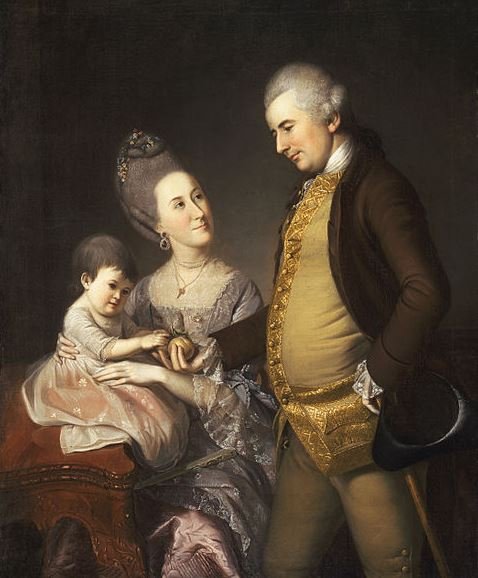
Image: John Cadwalader and his family.
Family and Marriages
Cadwalader’s family connections were notable, as they linked him to other prominent figures in early American society. In 1768, he married Elizabeth Lloyd, daughter of Edward Lloyd, a well-known figure from Talbot County, Maryland. Elizabeth’s brother, Edward Lloyd IV, served as a delegate to the Continental Congress, further cementing Cadwalader’s connections within the revolutionary leadership. Together, John and Elizabeth had three daughters: Anne, Elizabeth, and Maria. Maria married Samuel Ringgold, a future congressman from Maryland. Two of their sons, Samuel Ringgold and Cadwalader Ringgold, went on to have distinguished military careers, continuing the family’s legacy of service.
After Elizabeth’s death in 1776, Cadwalader married Williamina Bond, daughter of Dr. Phineas Bond, a Philadelphia physician. With Williamina, Cadwalader had three more children: Thomas Cadwalader, who became a general in the Pennsylvania militia; Frances Cadwalader, who married David Erskine, a British diplomat and later the 2nd Baron Erskine; and John Cadwalader. Through Frances, John Cadwalader became the grandfather of Thomas Americus Erskine, the 3rd Baron Erskine, and John Cadwalader Erskine, the 4th Baron Erskine, expanding his influence into British aristocracy.
Legacy and Estate
Cadwalader’s legacy is marked by both his military contributions and the complexities of his time. He was a slaveholder, a fact documented in the Cadwalader family papers at the Historical Society of Pennsylvania. His estate inventory listed 107 enslaved men, women, and children, a reality that reflects the contradictions of his life and the era. Though he fought for American liberty, his wealth and influence were partly sustained by slave labor, highlighting a troubling aspect of his legacy that contrasts with his revolutionary ideals.
In addition to his role in the war, Cadwalader left a lasting mark on American cultural history. He and Elizabeth commissioned fine Chippendale-style furniture for their Philadelphia home from cabinetmakers like Thomas Affleck and Benjamin Randolph. These pieces, now in major institutions like the Metropolitan Museum of Art, the Philadelphia Museum of Art, and the Winterthur Museum, are considered some of the finest examples of American colonial furniture. In 1987, a Cadwalader wing chair sold at Sotheby’s for $2.75 million, setting a record for the highest price paid for a piece of furniture at auction.
Conclusion
John Cadwalader’s life and career reflect the complexity of the Revolutionary era, embodying both the dedication and contradictions that marked the American struggle for independence. From his early support for the revolutionary cause to his leadership in the Philadelphia Associators, Cadwalader demonstrated a strong commitment to American ideals. His role in the Battle of Trenton, his defense of Washington during the Conway Cabal, and his service in the Maryland State Assembly underscore his influence as a patriot and public servant.
However, his legacy is also complicated by his role as a slaveholder, an aspect of his life that underscores the contradictions within the early American Republic. Despite fighting for liberty, Cadwalader’s wealth and status relied partly on the labor of enslaved people, reflecting a common but troubling reality among the Revolutionary generation.
In addition to his military and political achievements, Cadwalader’s cultural impact endures through the preservation of his Chippendale furniture, which remains highly valued and admired in American art and decorative history. His life is a testament to both the virtues and complexities of the revolutionary spirit, capturing the ambition, honor, and privilege that defined the early years of the United States.
Frequently Asked Questions

What was John Cadwalader’s background before the Revolutionary War?
John Cadwalader was born in 1742 in Trenton, New Jersey, to a Quaker family. His family moved to Philadelphia in 1750, where he and his brother became merchants. He became active in Philadelphia’s political and social circles and joined the American Philosophical Society in 1768.
How did Cadwalader become involved in the Revolutionary War?
Cadwalader became senior officer of the Philadelphia Associators, a volunteer militia formed by Benjamin Franklin. His leadership in rallying local support and organizing forces positioned him as an influential figure in the revolutionary movement.
What role did Cadwalader play in the crossing of the Delaware?
In December 1776, Cadwalader was ordered to cross the Delaware River to support Washington’s attack on Trenton. He successfully crossed with light forces, but ice prevented his artillery from crossing, and he returned to Pennsylvania. Washington’s attack succeeded despite Cadwalader’s absence.
How did Cadwalader support Washington during the Conway Cabal?
During the Conway Cabal, an attempt by some officers to replace Washington, Cadwalader defended Washington’s leadership. In 1778, he challenged Thomas Conway, who had criticized Washington, to a duel, injuring Conway and symbolizing his loyalty to Washington.
What did Cadwalader do after the Revolutionary War?
After the war, Cadwalader became a trustee of the University of Pennsylvania in 1779 and served in the Maryland State Assembly. He retired to his estate in Shrewsbury, Maryland, where he remained active in politics until his death in 1786.
Who were Cadwalader’s spouses, and what were his family connections?
Cadwalader married Elizabeth Lloyd in 1768, and they had three daughters. After her death in 1776, he married Williamina Bond in 1779, and they had three more children. His family connections linked him to prominent figures in Maryland and the Continental Congress.
How is Cadwalader’s legacy complicated by his estate?
Cadwalader’s estate included 107 enslaved individuals, a troubling aspect of his legacy. His ownership of enslaved people reflects the complexities of his time and highlights the contradictions in his commitment to liberty while participating in slavery.
What is Cadwalader’s significance in American furniture history?
Cadwalader and his first wife, Elizabeth, commissioned fine Chippendale furniture for their Philadelphia home. These pieces, crafted by artisans like Thomas Affleck and Benjamin Randolph, are considered some of the finest colonial furniture and are preserved in major museums.
What does John Cadwalader’s life represent in American history?
Cadwalader’s life exemplifies the dedication, loyalty, and contradictions of the Revolutionary generation. His military service, loyalty to Washington, and cultural legacy, along with his status as a slaveholder, capture the complex spirit of the early American Republic.





