Roman Emperor Maxentius
Roman Emperor Maxentius (r. 306–312 AD) ruled Italy and North Africa amid political turmoil. Known for his architectural projects and opposition to Constantine, he met his end at the Battle of the Milvian Bridge.

Bust of Maxentius.
Summary
Marcus Aurelius Valerius Maxentius (c. 283 – 28 October 312) was a Roman emperor who ruled from 306 until his death in 312. Despite his authority in Italy and North Africa and the support of the Roman Senate, he was never fully recognized as a legitimate ruler by his contemporaries. His reign was marked by political turmoil, civil war, and significant architectural contributions to Rome. Ultimately, he was defeated by Constantine at the Battle of the Milvian Bridge, where he died under unclear circumstances, reportedly drowning in the Tiber River.
Early Life and Family
Maxentius was born around 283 AD into a distinguished imperial family. He was the son of Maximian, a former emperor of the Western Roman Empire, and his Syrian wife, Eutropia. Due to his father’s position, Maxentius was likely raised with expectations of future power. However, unlike some other imperial heirs, he did not seem to have held significant administrative or military roles before his accession.
His marriage to Valeria Maximilla, the daughter of Emperor Galerius, strengthened his imperial ties. The couple had at least two children, including Valerius Romulus, who died young and was deified by his father. Despite these powerful connections, Maxentius was overlooked when the Tetrarchy was reorganized in 305 AD, a decision that may have stemmed from political maneuvering or a lack of confidence in his military abilities.
Rise to Power
Maxentius came to power in 306 AD during a period of political instability. When Emperor Constantius I died, his son Constantine was proclaimed emperor by his troops. The success of this move encouraged Maxentius to claim the purple for himself in Rome on October 28, 306, in response to unpopular policies imposed by the Tetrarchic rulers. The main grievances were the imposition of a capitation tax on Rome and the possible dissolution of the Praetorian Guard, both of which angered the city’s elite and military forces.
His claim to the throne was largely supported by the Roman Senate and the city’s population. He initially took the title princeps invictus (“unconquered prince”), possibly to avoid direct confrontation with the senior emperor, Galerius. However, he soon assumed the full imperial title of Augustus.
Maxentius’s rule was not immediately recognized by the other emperors, particularly Galerius, who sought to depose him. In early 307 AD, the Western Augustus, Severus, was sent to challenge Maxentius. However, Severus’s forces, composed largely of soldiers who had once served under Maximian, defected to Maxentius, forcing Severus to retreat and ultimately surrender. This victory solidified Maxentius’s control over Italy and Africa, though his rule remained contested.
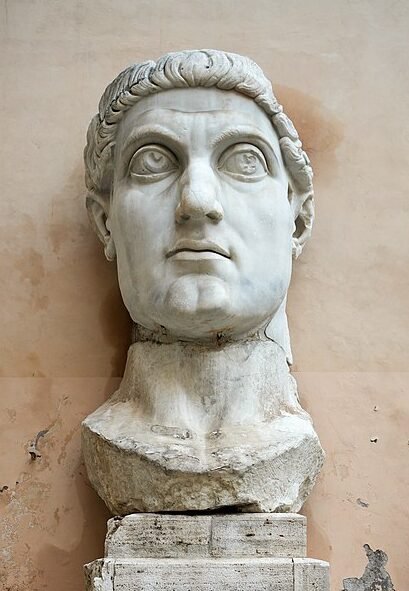
Head of the Colossus of Constantine at the Capitoline Museums in Rome, Italy.
Challenges to His Rule
Despite securing Italy, Maxentius faced multiple threats. In 307 AD, Galerius personally led an invasion of Italy but suffered the same fate as Severus—many of his troops defected to Maxentius, leading to a disorderly retreat. By 308 AD, Maxentius appeared to have a firm hold on Italy and parts of North Africa. However, internal and external threats continued to challenge his position.
A key moment of instability came in 308 when his father, Maximian, attempted to usurp him in Rome. After gathering troops, Maximian tried to persuade the army to abandon Maxentius, but the soldiers remained loyal to the younger ruler. Forced to flee, Maximian sought refuge with Constantine, effectively ending his claim to power.
Maxentius also faced a rebellion in North Africa led by Domitius Alexander, who declared himself emperor in Carthage. This rebellion threatened Rome’s crucial grain supply, making it a significant challenge to Maxentius’s rule. By 310 AD, he had crushed the revolt, securing his control over Africa.
Maxentius as Emperor
Although much of his reign was defined by warfare and political maneuvering, Maxentius also sought to reinforce his legitimacy through public works and policies. He portrayed himself as a restorer of Rome, funding extensive construction projects in the city. Among his most notable contributions were:
- The Basilica of Maxentius: An enormous civic building in the Roman Forum, later completed by Constantine, which remains one of the most impressive architectural remnants of the era.
- The Temple of the Divine Romulus: Dedicated to his deceased son, Valerius Romulus, this temple symbolized both his personal grief and his attempts to tie his rule to Rome’s traditional religious practices.
- The Circus of Maxentius: A grand chariot-racing stadium, showcasing his desire to promote Roman entertainment and culture.
Despite these projects, Maxentius’s rule was not particularly stable. By 312 AD, he had become increasingly unpopular. His imposition of taxes, particularly in Italy, alienated many of his early supporters. Additionally, while he initially enjoyed some support from Christian communities due to his repeal of Diocletian’s persecution, he ultimately failed to secure widespread backing from them, especially as Constantine positioned himself as a pro-Christian ruler.
He was a prolific builder, commissioning projects like the Basilica of Maxentius, the Temple of Romulus, and the Circus of Maxentius. However, many of his accomplishments were overshadowed by Constantine’s rule.
Conflict with Constantine and the Battle of the Milvian Bridge
The greatest challenge to Maxentius came from Constantine, who had been consolidating power in the West. By 312 AD, relations between the two had deteriorated beyond repair, and Constantine launched an invasion of Italy. Moving quickly, Constantine won a series of battles against Maxentius’s forces, including a decisive victory at Verona.
Rather than remaining in Rome to withstand a siege, as he had done successfully against Severus and Galerius, Maxentius chose to meet Constantine in open battle near the Milvian Bridge on October 28, 312. The reasons for this decision remain debated—some sources suggest he relied on omens that predicted victory on the anniversary of his accession, while others argue that he hoped to prevent Constantine from gaining control of the city’s food supplies.
The battle proved disastrous for Maxentius. Constantine’s forces overwhelmed his troops, forcing them into a retreat toward the Tiber River. During the chaos, Maxentius fell into the water and drowned. His body was later recovered and displayed as proof of his defeat.
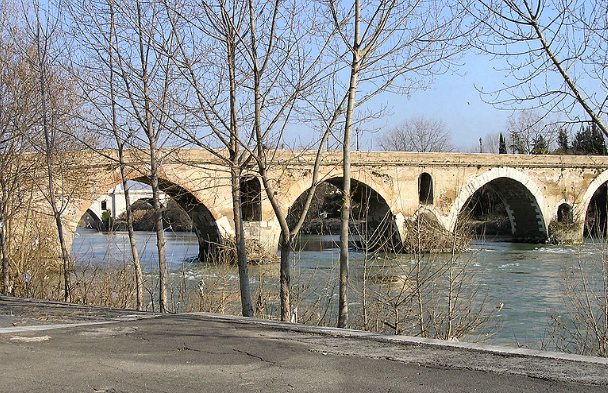
Despite having a defensible position in Rome, Roman Emperor Maxentius chose to engage Constantine near the Milvian Bridge, possibly due to omens or strategic miscalculations. This decision led to his downfall. Image: Milvian Bridge (Italian: Ponte Milvio or Ponte Molle) over the Tiber River in northern Rome, Italy.
Legacy and Damnatio Memoriae
Following his death, Maxentius was subjected to damnatio memoriae, a systematic erasure from official records and monuments. Constantine sought to depict him as a tyrant, justifying his own rule as a liberator of Rome. Many of Maxentius’s achievements were attributed to Constantine, including the completion of the Basilica of Maxentius.
Despite this, Maxentius’s contributions to Rome’s urban landscape remain evident. His major building projects, including the Circus and Basilica, showcase his vision for the city as a revitalized imperial center. Modern archaeological discoveries, including imperial regalia believed to have belonged to him, have helped re-evaluate his rule beyond the negative portrayal established by Constantine.
FAQs about Maxentius
How did Maxentius come to power?
He was proclaimed emperor by the Praetorian Guard in Rome in 306 after dissatisfaction with imperial taxation and military reforms. His rule was initially supported by his father, the former emperor Maximian.

Maxentius was a Roman emperor from 306 to 312, ruling over Italy and North Africa. Despite being recognized by the Roman Senate, he was not accepted as a legitimate emperor by his rivals. Image: Aureus of Maxentius.
Why was Maxentius not recognized as a legitimate ruler?
His rise to power was not part of the official Tetrarchic succession. Unlike Constantine, who was accepted by Galerius, Maxentius was seen as a usurper and never formally recognized by the ruling emperors.
What were Maxentius’ main conflicts?
He fought against multiple rivals, including Severus, Galerius, and Constantine. His final conflict was against Constantine, who invaded Italy in 312 and defeated him at the Battle of the Milvian Bridge.

An illustration portraying the Battle of the Milvian Bridge. Artwork by Giulio Romano.
How did Maxentius die?
He drowned in the Tiber River on October 28, 312, while retreating after his army was defeated by Constantine. His body was later recovered and displayed in Rome as proof of his death.
What was Maxentius’ policy towards Christianity?
Contrary to traditional narratives, new evidence suggests he ended Diocletian’s persecution of Christians in his territories and allowed the election of a new bishop of Rome. However, he remained unpopular among Christian factions.

What happened to Maxentius’ memory after his death?
Constantine issued a damnatio memoriae against him, erasing his name from public records and attributing his architectural achievements to himself. However, archaeological discoveries have provided insights into his reign.





