Senate of the Roman Empire
The Senate of the Roman Empire was a central political body that evolved significantly from its origins in the Roman Republic. Following the fall of the Republic, power shifted towards the Emperor, reducing the Senate’s influence to a primarily advisory and ceremonial role. Despite this decline, it remained a prestigious institution, symbolizing continuity and tradition within the Roman state. Below, World History Edu explores its evolution, procedures, powers, and eventual decline.

The vexillum of the Roman Empire was a prominent military standard that represented the power and identity of Roman legions.
The Transformation of the Senate: From Republic to Empire
During the Roman Republic, the Senate wielded considerable power, guiding military campaigns, overseeing finances, and influencing legislative matters. While it did not pass laws directly, its decrees (senatus consulta) heavily influenced magistrates and assemblies. The transition from Republic to Empire drastically altered its role.
The rise of Augustus marked the beginning of the Senate’s transformation. Augustus, the first emperor, sought to consolidate power while maintaining the illusion of shared governance. Although the Senate remained a legislative body, its authority was increasingly overshadowed by imperial decrees.
One of Augustus’ key reforms was reducing the Senate’s membership from 900 (as expanded under Julius Caesar) to 600, ensuring a more elite and controlled body. This restructuring also emphasized wealth and lineage, with stringent requirements for senatorial eligibility.
Though technically co-equal with the emperor in governance, in practice, the Senate became a vehicle for imperial policies. The emperor could bypass the Senate through direct decrees or use it as a formal means to validate decisions. This shift solidified the Senate’s subservience to the emperor.
Membership and Structure
Senatorial Qualifications and Entry
Becoming a senator under the Empire required meeting several criteria:
- Being of free birth and a Roman citizen.
- Holding at least 1,000,000 sesterces in property.
- No criminal convictions under lex Julia de vi private.
- Having served as a quaestor, an entry-level magistracy.
Sons of senators automatically held senatorial rank. Those outside the senatorial class could join either by imperial appointment (adlectio) or by receiving the emperor’s endorsement to stand for election.
The Album Senatorium: Annual Revision
Beginning in 9 BC, the Senate maintained an official list of its members, known as the album senatorium, updated annually. This list ranked senators by office:
- The Emperor always outranked all members.
- Consuls and former consuls followed.
- Praetors and their predecessors ranked next.
- The rest of the senatorial offices were listed in descending order.
Senatorial Dress and Status
Senators were easily recognizable by their attire. A broad reddish-purple stripe (latus clavus) adorned their togas, symbolizing their elevated status. Membership in the Senate, even as its power waned, remained a mark of immense prestige.

Functioning of the Senate
Meetings and Procedures
Senate meetings were held in the Curia Julia, typically on:
- The Kalends (1st of the month).
- The Ides (mid-month, usually the 15th).
- More frequently in September and October.
A quorum of 400 was required, but chronic absenteeism forced the relaxation of this rule. Occasionally, quorum rules were abandoned altogether, allowing a smaller number of senators to make decisions.
The emperor, consuls, or praetors presided over meetings. The emperor, sitting between the two consuls, could address the Senate at any time. Higher-ranking senators spoke before lower-ranking ones.
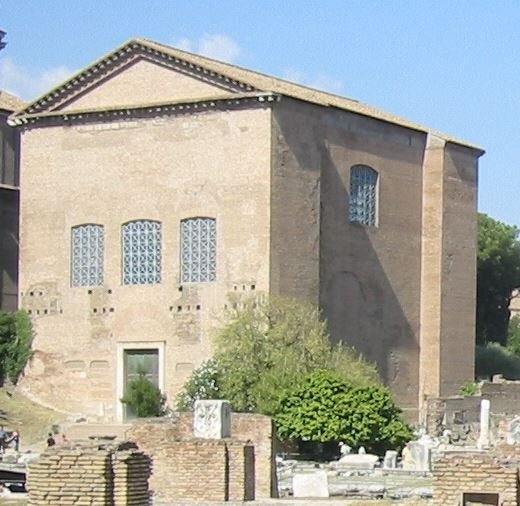
The Curia Julia, located in the heart of the Roman Forum, served as the official meeting place of the Roman Senate.
Legislation and Decision-Making
Although the Senate had legislative authority, most proposals originated from the emperor or his supporters. Emperors like Augustus and Tiberius initially concealed their influence, lobbying in private rather than openly directing proceedings. However, imperial control meant senators rarely opposed the emperor’s wishes.
Records and Publications
Each meeting’s minutes were compiled into the Acta Senatus, a confidential document detailing proposals, speeches, and decisions. Select information was published publicly in the Acta Diurna (Daily Record), disseminating key proceedings to the populace.
The Roman Senate’s Powers Under the Empire
Legislative Authority
With the decline of the assemblies, the Senate’s decrees (senatus consulta) gained legal weight. However, its legislative authority was largely administrative:
- Overseeing finances and taxation (subject to imperial approval).
- Managing public festivals, games, and religious institutions.
- Granting exemptions and privileges, often to the emperor.
- Handling governance in certain provinces.
While technically a legislative body, its role was increasingly ceremonial, with true decision-making power residing with the emperor.
Judicial Functions
Under the Republic, judicial authority was divided among various courts and assemblies. The early Empire transferred many of these powers to the Senate:
- It became responsible for criminal trials, with senators serving as jurors.
- The emperor could pardon convicts or overrule Senate verdicts.
- It managed judicial appeals from senatorial provinces.
Despite this, emperors frequently intervened in trials, rendering the Senate’s judicial authority ineffective.
Elections and Imperial Succession
In theory, the Senate elected new emperors and conferred imperium (command authority). In reality:
- Emperors were often chosen by military acclamation.
- Senate ratification was a formal gesture, not a true decision.
- Emperors influenced elections of magistrates, ensuring loyalists filled key offices.
Did you know…?
The Roman Senate could, however, deify deceased emperors or condemn unpopular ones through damnatio memoriae, erasing their legacy.
Decline and Marginalization
Diminishing Influence in the Late Empire
From the Severan dynasty (193-235 AD) onwards, the Senate’s significance further declined:
- Emperors relied on the equestrian class and military officials rather than senators.
- Administrative power shifted to imperial bureaucrats, reducing senatorial governance.
- By Diocletian’s reign (284-305 AD), the Senate lost its constitutional role.
Diocletian formally stripped the Senate of any remaining legislative or electoral authority. Although it continued as a consultative body, its role in governance was effectively over.
Attempts at Revival
- Under Vespasian (r. 69-79 AD), senators were appointed to govern key provinces.
- In 96 AD, the Senate managed to elect Emperor Nerva, a rare assertion of influence.
- Occasional emperors like Marcus Aurelius sought senatorial input, but this was the exception rather than the rule.
By the 4th century, the Senate primarily oversaw ceremonial functions, while true power resided with the emperor and military.
The Senate After the Fall of the Western Roman Empire
The Senate Under Barbarian Rule
After Rome fell in 476 AD, the Senate surprisingly continued to function:
- Odoacer and later Theoderic the Great preserved the Senate as an advisory body.
- Roman aristocrats from senatorial families remained influential in Ostrogothic Italy.
However, its power was severely limited, serving mainly as a symbolic institution.
Final Decline
- In 552 AD, following the Gothic War, several senators were executed by the Byzantines.
- Emperor Justinian I (r. 527-565) abolished senatorial offices, further weakening the institution.
- By the 7th century, the Senate was virtually nonexistent in Rome.
- Pope Gregory I (593 AD) lamented its disappearance.
The last known reference to the Senate in Rome dates to 603 AD, after which it fades from historical records. The Curia Julia was converted into a church by Pope Honorius I (c. 630 AD).
The Byzantine Senate
Although the Roman Senate vanished, the Byzantine Senate, founded by Constantine I, persisted in Constantinople until the 14th century. This body, however, was distinct from its Roman predecessor, serving as a council of advisors rather than a governing entity.
Frequently Asked Questions
How did Augustus reform the Senate?
Augustus reduced the Senate from 900 to 600 members, expelled senators of low birth, and implemented strict requirements, including wealth and legal status, for membership.

First Roman emperor Augustus
What was the significance of the lex Julia de senatu habendo?
Enacted in 9 BC, this law formalized the Senate’s membership list (album senatorium), ranking senators based on office and tenure, with the Emperor always at the top.
How did the Emperor control the Senate?
The Emperor presided over Senate meetings, influenced legislation, and controlled elections, ensuring that senators rarely opposed imperial policies.
What judicial powers did the Senate hold?
The Senate gained jurisdiction over criminal trials and provincial courts, but its verdicts could be overridden by the Emperor’s veto.
How did the Senate’s influence change under later emperors?
After Marcus Aurelius, emperors consulted the Senate less frequently, favoring equestrians and bureaucrats for government functions, further diminishing its role.
What happened to the Senate after the fall of the Western Roman Empire?
It continued under barbarian rulers like Odoacer and Theoderic but declined due to war and shifting power to Constantinople, disappearing by the early 7th century.
Did the Senate exist in the Eastern Roman Empire?
Yes, the Byzantine Senate, established in Constantinople by Constantine I, continued until at least the mid-14th century.
The last king of Rome before the establishment of the Roman Republic
FACT CHECK: At World History Edu, we strive for utmost accuracy and objectivity. But if you come across something that doesn’t look right, don’t hesitate to leave a comment below





