Roman Goddess Fama
In Roman mythology, Fama personified rumor, gossip, and fame, embodying the dual nature of communication. She was both revered and feared, as her influence could elevate reputations to greatness or ruin them through scandal and falsehood.
Comparable to the Greek goddess Pheme, Fama held a unique position in Roman thought and literature, serving as a symbol of the immense power of words and their ability to shape perceptions, both positively and negatively.
Origins and Nature
The Latin word fama translates to “rumor” or “fame,” reflecting the duality of its meanings. Derived from the verb fari (“to speak”), Fama embodies the spread of information, whether truthful or exaggerated. She does not originate as a deity in the traditional sense, like Jupiter or Venus, but rather as a symbolic and allegorical figure, personifying the concept of how news, both good and bad, propagates.
In Roman literature, Fama is depicted as an omnipresent and unstoppable force. She transcends physical boundaries, moving between the mortal and divine realms with ease, ensuring that no deed—whether virtuous or scandalous—goes unnoticed. Her presence underlines the Roman cultural understanding of reputation and public perception, both of which were critical in a society deeply tied to honor and legacy.
Descriptions of Fama in Literature
The most detailed account of Fama comes from Virgil’s Aeneid (Book IV), where she plays a significant role in spreading rumors about Dido and Aeneas. Virgil’s vivid portrayal of Fama presents her as a monstrous figure, highlighting her fearsome and exaggerated qualities:
Physical Attributes
Virgil describes Fama as having countless eyes, ears, tongues, and feathers, symbolizing her omniscience and ability to hear and repeat everything she encounters. Her many tongues amplify information, whether true or false, giving her a terrifying and almost grotesque form.
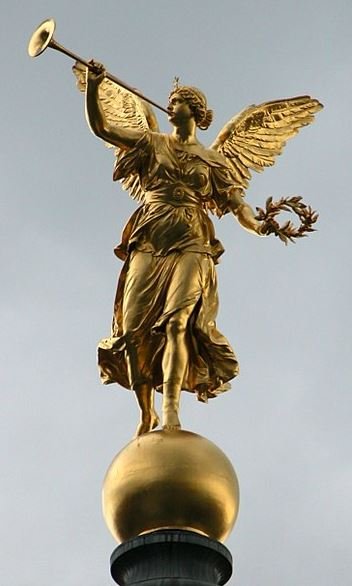
Image: Statue of Fama atop the Dresden University of Visual Arts in Germany. Artwork by Robert Henze.
Movement and Presence
Fama is said to move swiftly, with her feet on the ground and her head in the clouds, symbolizing her connection between the earthly realm and the heavens. This imagery conveys her ubiquity and her ability to transcend boundaries.
Exaggeration and Distortion
Virgil emphasizes that Fama thrives on distortion, making the small seem great and the great even greater. This highlights her propensity to amplify and sometimes twist information, feeding on human fascination with scandal.
In the Aeneid, Fama spreads the news of Dido and Aeneas’s romantic relationship throughout Carthage, inciting public scandal. Her actions set the stage for the eventual downfall of Dido, showcasing the destructive potential of unchecked rumor.
Symbolism of Fama
Fama’s role in Roman mythology and literature goes beyond a mere personification of rumor. She represents the social and cultural dynamics of communication in Roman society, where public reputation and legacy were paramount.
Dual Nature of Fame and Infamy
Fama embodies the paradoxical power of communication. On one hand, she can bring glory and renown, immortalizing individuals through stories of their deeds. On the other, she spreads gossip and lies, tarnishing reputations and causing ruin. This duality reflects the Roman understanding of the fragility of public perception.
Connection to Politics and Leadership
In a society like Rome, where political power relied heavily on public opinion, Fama symbolized the importance of reputation. Leaders, generals, and even emperors were acutely aware of the role that rumor played in shaping their legacies. Fama’s omnipresence served as a reminder that no action, whether private or public, could escape scrutiny.
Ubiquity of Information
The image of Fama, with her countless eyes and ears, underscores the idea that information spreads rapidly and universally. This allegory mirrors the speed at which news and gossip traveled in ancient Rome, often determining the course of political and personal fortunes.
Moral and Ethical Implications
Fama’s actions often carry a cautionary tone, warning against the dangers of spreading falsehoods and succumbing to the allure of scandal. She embodies the ethical challenges of communication: the tension between truth and distortion, and the consequences of gossip.
Fama’s Role in Roman Society
Fama’s influence was not limited to mythology; she also had a profound cultural significance in Roman society. The Romans placed immense value on reputation, and Fama symbolized both the rewards of virtuous behavior and the perils of moral failure.
In Roman culture, an individual’s legacy was often tied to their fama, or public reputation. Fama was not just about personal glory; it was also about how one’s deeds were perceived and remembered by society. This is evident in the Roman emphasis on honor, virtus (virtue), and gloria (glory), all of which were closely linked to Fama’s influence.
Fama also functioned as a mechanism of social control. The fear of public censure and the desire for recognition drove individuals to adhere to societal norms and expectations. Through Fama, the Romans acknowledged the power of communal judgment in regulating behavior.
Roman leaders often invoked Fama to bolster their image or discredit their opponents. By controlling the spread of information—or crafting their own narratives—they sought to manipulate public perception. Fama’s duality as both a force for renown and scandal made her an effective symbol in political rhetoric.
Depictions of Fama in Art and Renaissance Thought
While Fama was predominantly a literary and symbolic figure, she also appeared in Roman art and later in Renaissance allegories.
Artistic Representations
In Roman art, Fama was occasionally depicted as a winged figure, often carrying a trumpet. This imagery emphasized her swift and loud proclamations, as well as her connection to both glory and scandal. The trumpet symbolized her ability to amplify and broadcast information across vast distances.
Renaissance Allegory
During the Renaissance, Fama was revived as an allegorical figure representing the power of communication and reputation. She was frequently depicted in literature, theater, and visual art, often carrying elements like trumpets or scrolls to signify her role in spreading news. Renaissance thinkers, drawing from Virgil and other classical sources, used Fama to explore themes of truth, deceit, and the impact of public perception on individual and societal identity.
Legacy and Modern Relevance
Fama’s legacy extends beyond Roman mythology into contemporary thought. Her symbolic role as the personification of rumor and fame continues to resonate in discussions about the power of communication, the fragility of reputation, and the impact of misinformation.
In modern times, Fama’s attributes mirror the dynamics of media and social networks, where information—true or false—spreads rapidly and influences public opinion. The omnipresence of Fama in Roman mythology parallels the pervasive nature of today’s media.
Her dual nature serves as a reminder of the ethical responsibilities tied to communication. The spread of gossip and falsehoods can have devastating consequences, just as the sharing of truth can elevate and inspire.
She remains a powerful metaphor for the fleeting and often precarious nature of fame. Her depiction as a figure who amplifies both virtue and vice underscores the complexities of achieving and maintaining a positive legacy.
Conclusion
Fama, the Roman goddess of rumor and fame, embodies the profound influence of communication in shaping human experiences. Through her depictions in mythology, literature, and art, she serves as a timeless reminder of the power of words to create, elevate, distort, or destroy. Her dual role as a force for both glory and scandal reflects the complex dynamics of reputation and legacy, making her a relevant and enduring figure in the cultural imagination.
Frequently Asked Questions

What were Pheme’s origins according to mythology?
Pheme was considered a daughter of either Gaia (Earth) or Elpis (Hope). She was associated with the act of initiating and amplifying communication.
How was Pheme portrayed in art?
Pheme was often depicted with wings and a trumpet, symbolizing her ability to spread information swiftly and amplify her proclamations.
What was Pheme’s role in Greek mythology?
Pheme was known for her influence over communication and her meddling in the lives of mortals and gods. She spread information by starting with a faint whisper and growing louder with each retelling, ensuring everyone eventually heard the message.
Where was Pheme venerated in ancient Greece?
She was associated with an altar in Athens, signifying her cultural importance.
Who was Pheme’s Roman counterpart?
In Roman mythology, Pheme’s counterpart was Fama, who personified rumor.
How did Virgil describe Fama in the Aeneid?
Virgil depicted Fama as a creature with countless tongues, eyes, ears, and feathers, emphasizing her omnipresence. He also described her as having her “feet on the ground and her head in the clouds,” reflecting her connection to both the earthly and divine realms.
What role does Pheme play in Homer’s works?
In Homer’s writings, Pheme appears as a messenger of Zeus, often referred to as the “Rumor Goddess.” In The Odyssey (Book 1), Telemachus’ journey to Pylos is partly motivated by a desire to gain “pheme,” interpreted as renown or societal respect.
How did Pheme or Rumor appear in English Renaissance theater?
Pheme’s Roman equivalent, Rumor, was a recurring allegorical figure. For example, in Shakespeare’s Henry IV, Part 2, Rumor introduces the play by declaring her power to spread narratives, saying, “Open your ears; for which of you will stop the vent of hearing, when loud Rumour speaks?”
What are the linguistic origins of the word “fame”?
The Greek word pheme is derived from the verb phánai (“to speak”) and can mean “fame,” “report,” or “rumor.” Similarly, the Latin fama, from fari (“to speak”), shares the same meanings. The English word fame originates from fama through French influence.
What dual nature did Pheme and Fama represent?
Both Pheme and Fama symbolized the double-edged nature of communication: they could elevate individuals through recognition or tarnish reputations through damaging rumors.





