Roman jurist Ulpian
Gnaeus Domitius Annius Ulpianus, commonly known as Ulpian, was a distinguished Roman jurist whose influence on Roman law endures to this day.
Born around 170 AD in Tyre, located in what is now modern-day Lebanon, Ulpian rose through the ranks to become one of the most esteemed legal minds of his era. His contributions to the legal field were so profound that a significant portion of Justinian’s Digest, one of the most critical legal compilations in history, is derived from his writings.
Additionally, his work played a vital role in the Law of Citations enacted by Valentinian III, which recognized his legal authority alongside four other jurists.
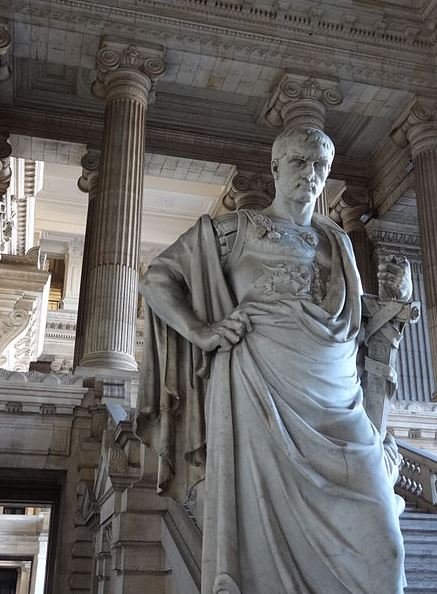
Statue of Ulpian at the Palais de Justice in Brussels, Belgium.
Ulpian’s influence on Roman law and governance was profound, shaping legal traditions that extended far beyond his lifetime.
Early Life and Career
The specifics of Ulpian’s early life, including his exact date of birth, remain unknown. However, it is believed that his intellectual pursuits and legal acumen became evident during his time in Rome. His legal career took shape under Emperor Septimius Severus, who appointed him as an assessor in the auditorium of Papinian, another prominent jurist. He also served as a member of the emperor’s council, gaining invaluable experience in legal and administrative matters.
Under Emperor Caracalla, Ulpian held the prestigious position of magister libellorum (master of requests), a role that involved handling petitions and legal inquiries addressed to the emperor. However, during the reign of Elagabalus, Ulpian faced political adversity and was exiled from Rome. Despite this setback, he made a triumphant return to the imperial court when Severus Alexander ascended the throne in 222 AD. His reinstatement marked the beginning of his tenure as the emperor’s chief legal advisor and his appointment as Praefectus Praetorio (Praetorian Prefect), one of the highest offices in the Roman administrative hierarchy.

Septimius Severus was Roman Emperor from 193 to 211 AD.
As one of the most significant jurists of antiquity, Ulpian exemplified the ideal of a legal scholar who sought to create a fair and equitable legal system for the Roman world.
Praetorian Prefect and Assassination
During the rule of the Severan dynasty, the role of the Praetorian Prefect evolved into a crucial administrative position. The office had traditionally been a military command, but under legal minds like Papinian and Ulpian, it took on broader administrative and judicial responsibilities. As Praetorian Prefect under Severus Alexander, Ulpian sought to restore discipline within the empire, particularly within the ranks of the Praetorian Guard, which had grown increasingly unruly under Elagabalus.
Ulpian’s reforms, which included curbing the privileges of the Praetorian Guard, were met with hostility. The guards, accustomed to unchecked power and influence, viewed him as a threat. Despite escaping several assassination attempts, Ulpian ultimately fell victim to their wrath. In a dramatic turn of events, he was murdered in the imperial palace, possibly amidst a riot involving both the soldiers and the Roman populace. Some accounts suggest that his assassination took place in the presence of Emperor Severus Alexander himself, highlighting the volatile nature of Roman politics.
Legal Contributions and Works
Ulpian’s legal scholarship was extensive, covering various aspects of Roman law. His most notable works include:
- Ad Sabinum – A commentary on the ius civile (civil law) spanning over fifty books. It provided interpretations and explanations of legal principles fundamental to Roman private law.
- Ad Edictum – An 83-book commentary on the Edictum Perpetuum, a proclamation that outlined the legal framework administered by Roman magistrates.
- De Officio Proconsulis – A detailed exposition on criminal law, which served as a guide for proconsuls in administering justice.
- Books on Rules and Institutions – These works codified legal principles and provided guidelines for legal interpretation.
- Legal Opinions and Disputations – Collections of case law, opinions, and responses to various legal issues.
- Monographs on Testamentary Trusts and Magistrates’ Duties – These works examined specific areas of law, such as inheritance and the responsibilities of Roman officials.
His writings accounted for approximately one-third of Justinian’s Digest, a foundational text in Roman law compiled in the 6th century AD. His ability to articulate complex legal concepts with clarity made his works indispensable to legal scholars and practitioners.
The Legacy of Ulpian
Ulpian’s legal philosophy revolved around justice, fairness, and the equitable application of law. He is best remembered for his succinct articulation of the fundamental principles of law: “Juris praecepta sunt haec: honeste vivere, alterum non laedere, suum cuique tribuere” (The basic principles of law are: to live honorably, not to harm any other person, and to render each his own). This statement encapsulated his belief in a just legal system and became a guiding principle in the study of law.
Beyond legal theory, Ulpian’s contributions extended into other intellectual fields. He is credited with creating the first recorded life table, an early attempt at demographic analysis that would later influence actuarial science and statistical studies. His meticulous approach to law and governance reflected a broader intellectual curiosity that set him apart from many of his contemporaries.

Ulpian and The Deipnosophists
There has been speculation regarding Ulpian’s depiction in The Deipnosophists, a work by Athenaeus. This text, which presents a series of learned banquets featuring discussions on literature, philosophy, and linguistics, includes a character named Ulpian. This character is portrayed as a grammarian and philologist, frequently interjecting with questions about word usage. However, modern scholars largely agree that this portrayal is not based on the historical Ulpian, but rather, is a separate literary figure—perhaps even modeled after his father.
Despite Roman jurist Ulpian’s tragic demise at the hands of the Praetorian Guard, Ulpian’s legacy remains intact.
A related historical debate concerns the precise date of Ulpian’s death. Some sources, including Robert Lee Cleve, argue that he was assassinated in 223 AD based on a papyrus discovered in 1966. However, other historical accounts place his death in 228 AD. The uncertainty surrounding this date has led to incorrect assumptions about the completion date of The Deipnosophists.
Frequently Asked Questions
What was Ulpian’s role in Roman law?
He was one of the five jurists whose opinions were authoritative under the Law of Citations and provided about a third of the content for the Justinian Digest.
What positions did Ulpian hold?
He served as an assessor under Papinian, master of the requests under Caracalla, and Praetorian Prefect under Severus Alexander.
Why was Ulpian exiled and later reinstated?
Elagabalus banished him from Rome, but he was recalled when Severus Alexander became emperor, eventually rising to become his chief adviser.

How did Ulpian die?
He was assassinated by the Praetorian Guard in the emperor’s presence, likely due to his efforts to curb their privileges.
What were Ulpian’s major works?
His key writings included Ad Sabinum, a commentary on civil law, Ad edictum, a commentary on the Praetorian Edict, and De officio proconsulis, a treatise on criminal law.
What is Ulpian’s most famous legal principle?
He defined the core principles of law as: “Live honorably, do no harm to others, and give each his due.”
How is Ulpian linked to The Deipnosophists?
A grammarian named Ulpian appears in Athenaeus’ The Deipnosophists, but scholars agree he was not the same person as the jurist.





