Solonian Constitution
In the early 6th century BC, Athens faced a dire social and political crisis. Severe inequality, rampant debt slavery, and aristocratic dominance had brought the city-state to the brink of collapse. The harsh laws of Draco, known for their severity, had failed to address these issues. Solon, a respected statesman and poet, was appointed archon with extraordinary powers to reform the state. His constitution, implemented around 594 BC, aimed to address these challenges and create a more stable and equitable society. These reforms would later form the foundation for Athenian democracy.

While not perfect, Solon’s vision for a more equitable society had a profound and lasting impact, shaping the trajectory of Athenian democracy and influencing governance practices for generations to come. Solon’s legacy endures as a testament to the power of thoughtful and balanced reform. Image: Bust of Solon, a Roman copy of a Greek original, displayed in Naples Museum.
The Economic Reforms
One of Solon’s most revolutionary measures was the Seisachtheia, or “dis-burdening ordinance.” This reform canceled all existing debts, liberated those who had been enslaved due to unpaid debts, and outlawed the practice of securing loans on personal freedom. Additionally, Solon abolished the hectemoroi system, where farmers had to surrender a significant portion of their produce to landowners. These changes alleviated widespread economic hardship and ended the exploitation of the poor.
To promote trade and economic stability, Solon reformed Athens’ currency and measurements. He introduced the Euboic standard, ensuring consistency and fairness in economic transactions, which contributed to the growth of commerce and prosperity.
Political Reforms: A Timocratic Framework
Solon replaced aristocratic privilege with a political system based on wealth, known as timocracy. He divided Athenian citizens into four classes based on annual agricultural production:
- Pentacosiomedimnoi: The wealthiest class, producing at least 500 medimnoi. They were eligible for the highest offices and could serve as generals.
- Hippeis: The second wealthiest, producing at least 300 medimnoi. They served as cavalrymen and held key political and military roles.
- Zeugitae: Citizens producing at least 200 medimnoi, typically serving as hoplites. They could hold minor offices and gained influence over time.
- Thetes: The poorest class, producing less than 200 medimnoi. They could participate in the Ecclesia (assembly) and serve as jurors but were excluded from high office.
Redistribution of Political Power
The class system redistributed political power, reducing aristocratic dominance. Wealth, rather than birth, became the criterion for political participation, allowing greater inclusivity in governance. The lower classes, particularly the Thetes, gained some influence through their roles in the assembly and courts.
The Council of the Four Hundred
Solon established the Council of the Four Hundred, a consultative body representing the wealthier classes. This council worked alongside the Areopagus, the traditional aristocratic council, ensuring broader representation in administrative and legislative processes.
Legal Reforms: Justice and Accessibility
Solon repealed most of Draco’s harsh laws, except those concerning homicide, and introduced a new legal code that covered both public and private life. His laws were written in poetic form, making them easier for citizens to understand and memorize.
Solon expanded access to justice by granting citizens the right to appeal decisions made by magistrates. This measure gave ordinary Athenians a voice in legal matters and reduced the power of the aristocracy. He also established jury courts, allowing citizens from all classes to participate in the judicial process.
Social and Religious Impact
While Solon’s reforms focused on economic and political restructuring, he respected Athenian religious traditions. Religion continued to play a significant role in shaping political authority and societal values. Solon’s laws sought to unite Athens’ diverse social groups by balancing traditional customs with progressive policies.
Solon emphasized the interconnectedness of society, stating that harm to one member affected the entire community. This perspective fostered a sense of unity and mutual responsibility among Athenians, helping to stabilize the city during a period of strife.

Solon’s reforms helped end the dominance of aristocratic rule and monopoly of government in ancient Athens
Challenges and Limitations
Solon’s reforms did not fully satisfy all groups. The wealthy resented the loss of their financial advantages, while the poor were disappointed that land redistribution was not part of the reforms. Solon’s moderate approach aimed to strike a balance between these competing interests but left some dissatisfaction on both sides.
To avoid being accused of tyranny and to allow his reforms to take root independently, Solon went into self-imposed exile for ten years after implementing his constitution. This decision helped prevent political backlash and ensured that his changes could be tested without his direct influence.
READ MORE: The Tyrants Who Ruled Ancient Athens
Legacy and Long-Term Significance
The Solonian Constitution laid the groundwork for the development of Athenian democracy. By weakening aristocratic power and promoting economic fairness, Solon’s reforms created a more inclusive political system. His emphasis on legal equality and citizen participation inspired future leaders like Cleisthenes and Pericles, who expanded democratic practices.
Solon’s vision of governance, rooted in moderation and compromise, became a model for later political systems. His reforms demonstrated the importance of balancing tradition with innovation, making Athens a pioneer in governance and civic engagement.

Frequently Asked Questions
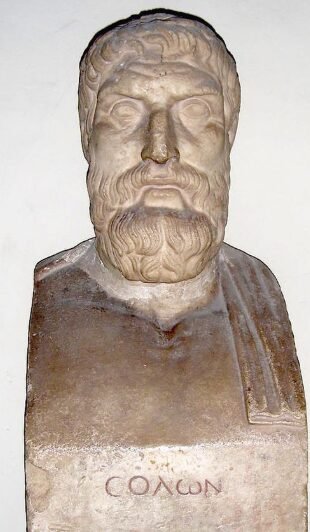
The purpose of the Solonian Constitution was to stabilize Athens during a period of severe social and political unrest by replacing Draco’s harsh laws with a more equitable legal framework. Image: Bust of Solon in Vatican Museums
What was the Seisachtheia, and why was it significant?
The Seisachtheia, or “dis-burdening ordinance,” abolished debt slavery, canceled existing debts, and prohibited securing loans on personal freedom, alleviating widespread poverty and inequality.
How did Solon classify citizens under his political reforms?
Solon introduced a timocracy, dividing citizens into four classes—Pentacosiomedimnoi, Hippeis, Zeugitae, and Thetes—based on their annual agricultural production.
What roles did the Pentacosiomedimnoi play in Athenian society?
As the wealthiest class, they held the highest political offices, including archonships, and played key roles in military leadership.
What political rights did the Thetes have under Solon’s reforms?
The Thetes could participate in the Ecclesia (assembly) and serve as jurors but were excluded from holding high political offices.
What was the Council of the Four Hundred, and who could participate?
The Council of the Four Hundred was a consultative body established by Solon, with membership limited to the top three wealth classes, excluding the Thetes.

Quotes by Solon of Athens
How did Solon address the issue of aristocratic dominance?
Solon reduced aristocratic power by making wealth, rather than birth, the basis for political eligibility, thereby broadening participation in governance.
Which Draconian laws did Solon retain, and why?
Solon retained Draco’s laws concerning homicide, as they were seen as fair and necessary for maintaining justice.
Why did Solon go into self-imposed exile after implementing his reforms?
Solon wanted to avoid the temptation of tyranny and to ensure the constitution could function independently of his personal influence.
What was the long-term impact of the Solonian Constitution?
It laid the foundation for Athenian democracy by weakening aristocratic control, promoting economic fairness, and encouraging broader political participation.

Solon of Athens





