Temple of Vesta in Rome
The Temple of Vesta, commonly associated with the Temple of Hercules in Rome, is an ancient structure steeped in history, architecture, and cultural significance. However, it’s crucial to clarify that these are actually two distinct temples, often confused due to their similarities and proximity within Rome. The former, with its eternal flame and sacred rituals, represents the spiritual heart of Rome, while the latter, a tribute to the heroic Hercules, celebrates Rome’s commercial success and cultural assimilation.
This explanation provides an in-depth look at the origins, architectural features, and cultural impact of each temple.
The Temple of Vesta Origins and Significance
The Temple of Vesta, unlike most temples dedicated to a single deity, held Rome’s sacred flame. The goddess Vesta (equivalent of Hestia in Greek mythology), symbolizing hearth and home, was worshiped here. The Vestal Virgins, priestesses serving Vesta, maintained an eternal flame within the temple. If extinguished, it was seen as an omen for Rome’s future. Dating back to at least the 7th century BCE, this structure represented Rome’s heart, literally and symbolically.
Situated in the Roman Forum, the temple was central to religious and political life. The round design of the Temple of Vesta was unique compared to the rectangular form of most Roman temples, reflecting the shape of early Roman houses, which often had a circular design around a central hearth. By mirroring the hearth within the home, this temple represented the “hearth” of the state. The interior housed the sacred flame and a hearth, further accentuating the symbolic importance of Vesta in Roman life.
Architecture
The Temple of Vesta was small and round, with a diameter of about 15 meters. Built of marble and concrete, it was an architectural marvel in its time, standing out for its unique circular plan, which broke away from the rectangular layout standard for Roman temples. Its design was likely inspired by the Tholos temples of Greece, which were typically circular. The exterior featured Corinthian columns around the perimeter, creating an elegant colonnade. A frieze decorated with relief carvings added to its grandeur.
Inside, the temple had a vestibule leading to the inner sanctum, which was rarely accessible to the public. Only the Vestal Virgins and select priests could enter, as it housed sacred objects and the eternal flame, emphasizing its religious sanctity.
The dome covering the temple also stood out, as domes were rare in Roman architecture at the time. The domed roof was not just practical but symbolic of the heavens, suggesting the divine nature of the flame within. Its design served as an architectural precedent for later religious buildings that would adopt the domed style as an emblem of celestial connection.

Ruins of the Temple of Vesta.
Vestal Virgins
The Temple of Vesta was famously served by the Vestal Virgins, a select group of priestesses who took a vow of chastity to maintain the purity of the temple and its eternal flame. These young women were chosen from noble families and served for 30 years, divided into three ten-year phases: learning, practicing, and teaching.
The Vestals held a unique position in Roman society; they were granted rights and privileges unavailable to other women, such as owning property and being free from the control of male guardians. However, the consequences of breaking their vows were severe, with violators often subjected to death by being buried alive, reflecting the gravity of their role in Roman society.
The Vestal Virgins’ role underscored the importance of Vesta’s flame, which symbolized Rome’s survival. The state’s welfare was believed to hinge on the flame’s preservation, making these priestesses crucial to Rome’s spiritual and political stability.
Temple of Hercules Victor (Temple of Hercules Olivarius) Origins and Significance
The Temple of Hercules Victor, also known as the Temple of Hercules Olivarius, stands in the Forum Boarium, Rome’s ancient cattle market near the Tiber River. This temple dates back to the 2nd century BCE and is considered one of the oldest surviving structures made of marble in Rome. It’s often mistakenly referred to as the Temple of Vesta due to its similar circular shape, though it honors Hercules, the hero-god associated with strength and commerce.
Built by a wealthy olive oil merchant, the Temple of Hercules was likely intended to honor Hercules as a protector of traders and travelers. The Forum Boarium, being a bustling hub of commerce, made it a fitting location for a temple to Hercules, who was considered a patron of merchants. Unlike the Temple of Vesta, which symbolized Rome’s sacred flame and domestic hearth, the Temple of Hercules reflected the prosperity and wealth of Rome’s commercial ventures.

Ruins of the Temple of Hercules Victor.
Architecture
This temple is remarkable for its Greek-inspired design. Constructed entirely of Greek Pentelic marble, it represents one of Rome’s earliest examples of Greek architectural influence. The structure is round, about 14.8 meters in diameter, and consists of 20 Corinthian columns that create a colonnade around the central chamber (cella). These columns, with their decorative acanthus leaf capitals, demonstrate the artistic prowess and cultural blending of Greek and Roman styles.
The inner sanctum, like most Roman temples, was the primary place of worship, containing a statue of Hercules that likely served as a focal point for worshipers. Although the temple’s roof has not survived, it’s believed to have been conical, giving it an elegant silhouette in the Forum Boarium.
The use of marble, along with the architectural style, indicates that this was a prestigious structure intended to showcase the wealth and artistic influence Rome had garnered from Greece. The Temple of Hercules is one of the best-preserved ancient buildings in Rome, offering insight into the evolving architectural styles and cultural exchanges during this period.
Differences from the Temple of Vesta
While both temples share a round design, their purposes and cultural significance diverge. The Temple of Vesta was closely guarded, embodying Rome’s sacred flame, while the Temple of Hercules was publicly accessible, reflecting a more secular and commercial focus. The materials and architectural details also vary, with the Temple of Vesta utilizing concrete and marble, whereas the Temple of Hercules was made entirely of imported Greek marble, underscoring its luxurious status.
Cultural and Historical Impact Symbolism and Religion
Both temples reflect different aspects of Roman life and values. The Temple of Vesta embodied the sanctity of the home and the state’s well-being, symbolized by the eternal flame, while the Temple of Hercules honored the spirit of commerce, strength, and the prosperity of Rome’s trade network. Together, they illustrate the dual nature of Roman religion, which was both deeply spiritual and integrally connected to practical, everyday aspects like trade and domestic life.
Architectural Influence
The circular design of both temples set a precedent in Roman architecture. While rectangular temples remained the norm, the round temples of Vesta and Hercules introduced the idea of a centralized, symmetrical form that would later influence the design of Christian baptisteries, mausoleums, and eventually Renaissance architecture. Their use of columns, marble, and domed or conical roofs would be echoed in structures built throughout the Roman Empire and beyond, highlighting their architectural importance.
Legacy
The Temple of Vesta and the Temple of Hercules Victor remain as enduring symbols of Rome’s history, from its religious rituals to its commercial power. They stand as reminders of the spiritual and economic foundations of Rome, embodying the resilience and adaptability that allowed the city to thrive for centuries.
Today, these temples are significant archaeological sites, attracting scholars and tourists interested in Rome’s ancient civilization. Their preservation offers invaluable insight into early Roman religion, social structure, and architectural innovation. The Temple of Vesta is largely in ruins, with only fragments remaining in the Roman Forum. The Temple of Hercules, however, is remarkably well-preserved, offering a clear view of ancient Roman engineering and design that continues to inspire admiration.
Questions and Answers

Reconstructed remains of the Temple.
Why is the temple near Rome’s Tiber River popularly known as the Temple of Vesta?
The temple is popularly known as the Temple of Vesta because of its round shape, which is similar to the original Temple of Vesta. However, its actual dedication remains uncertain.
To which deity might this temple have been dedicated, if not Vesta?
It may have been dedicated to Hercules Olivarius, the patron god of oil merchants at Portus Tiberinus.
Where is this temple located, and what was significant about its location in ancient Rome?
The temple is located in Piazza Bocca della Verità, near the Tiber River. In ancient Rome, it was situated in the Forum Boarium, an area that had several temples dedicated to Hercules and a prominent altar honoring him.
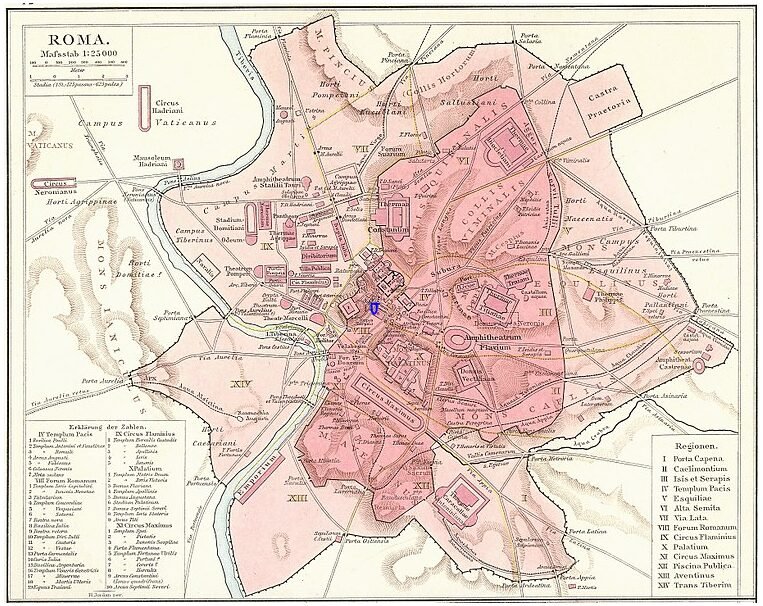
The location of the Temple of Vesta (marked blue) within ancient Rome.
What stylistic influence does the temple’s design reflect, and who likely designed it?
The temple is Greek in style and was likely designed by an architect from eastern Greece.
What is the primary material used in the temple’s construction, and why is it notable?
The temple was constructed with Pentelic marble, a valuable material from near Athens, typically reserved for smaller, prestigious projects due to its cost.
What are the temple’s dimensions and architectural features?
The temple measures almost 15 meters in diameter and has 20 Corinthian columns around a circular, five-step tufa podium. Each column is about 10.65 meters tall, topped with composite capitals that combine Ionic volutes with Corinthian acanthus leaves.
What happened to the temple in the 1st century CE, and how was it repaired?
A disaster damaged the temple, resulting in the replacement of ten columns on the north side with Luna marble. One capital on the south side was replaced with a near-replica of the originals.
How was the temple preserved through the centuries, and when was it converted into a church?
The temple was preserved by being converted into a church, first recorded in 1132 CE as the Church of S. Stefano alle Carozze.
What modifications were made to the temple over the years during its use as a church?
Modifications included removing the original roof and entablature, reconstructing the upper cella wall with brick-faced concrete, and adding windows in the 12th century. In 1475, a fresco was painted above the altar.
In the 17th century, the church was rededicated as S. Maria del Sole but was later deconsecrated. Between 1809 and 1810, excavations lowered the ground level around the podium, and further restoration efforts were made to preserve the structure.





