The Teocalli of Sacred War
The Teocalli of Sacred War, also known as the Throne of Montezuma II or the Temple Stone, is a significant stone monument adorned with intricate carvings of major Aztec deities and symbols. Scholars generally suggest that the Teocalli of Sacred War may have once served as a throne for the Aztec ruler Montezuma II (also known as Motecuhzoma II) himself.
The throne is crafted in the shape of a pyramid temple and commemorates the 1507 CE New Fire Ceremony. The throne symbolizes the connection between fire, water, rulers, and the cosmos, showcasing Aztec artistic and religious beliefs.
As a result, the throne has become a symbol of Aztec power, artistry, and cultural achievements. Also, much of its legend is rooted in the wider context of Aztec society and its confrontation with European colonization.
In the article below, World History Edu takes an in-depth look at the origin story and significance of the Throne of Montezuma.
Teocalli of Sacred War
Historical Background of the Aztec Empire
The Aztec Empire, dominant in Mesoamerica from the 14th to the 16th centuries, was a powerful political and military force with its capital at Tenochtitlan (modern-day Mexico City). The Aztecs, or Mexica, had a highly organized society with a centralized monarchy, and their civilization thrived on sophisticated agriculture, trade, and an intricate belief system centered around their gods.
Montezuma II, known as the ninth and last sovereign Aztec emperor, ruled during a particularly turbulent time in Aztec history. His reign, beginning in 1502, saw the empire at its zenith but also exposed it to threats from within and without. The Spanish arrival in 1519 marked the beginning of the end for the Aztec Empire, leading to Montezuma’s capture and, ultimately, the empire’s collapse.
Montezuma II’s Role and the Symbolic Significance of the Throne
Montezuma II (often spelled Moctezuma or Motecuhzoma) is remembered for his significant contributions to the Aztec Empire but also for his fateful interaction with Spanish conquistadors. The throne attributed to Montezuma is steeped in symbolic importance as it represents the height of Aztec power and the complexity of their rule.
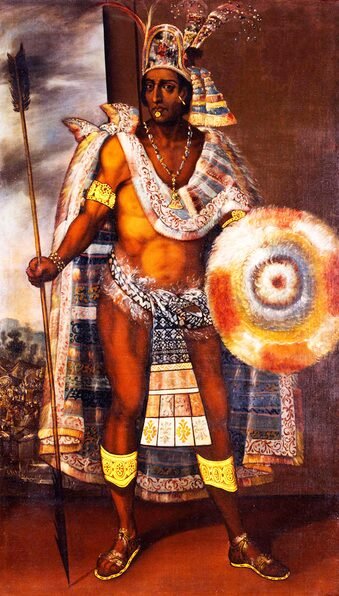
Thrones in the Aztec culture could represent specific gods or symbolize the ruler’s role as a conduit for divine will. Image: Portrait of Montezuma II by Antonio Rodríguez.
Thrones in Aztec culture were not merely seats of physical rest but also symbols of divine right and power, often crafted with intricate designs that signified status, divinity, and authority over the land and its people.
Montezuma’s throne itself might have been a ceremonial or ritualistic artifact, possibly adorned with precious materials and motifs sacred to the Aztec people. The throne would have reflected Montezuma’s position as both a military leader and a spiritual intermediary between the gods and the people.
Where did the name of throne come from?
The name ‘Teocalli of the Sacred War’ stems from the Nahuatl word for “temple”. Mexican archaeologist Alfonso Caso y Andrade (1896 – 1970) identified the artifact as a diminutive version of a Late Post-classic temple.
Unearthed initially in 1831 beneath the National Palace of Mexico, it remained buried until its removal in the 1920s, when it was transferred to the Museo Nacional de Antropología in Mexico City.
Construction and Artistic Qualities
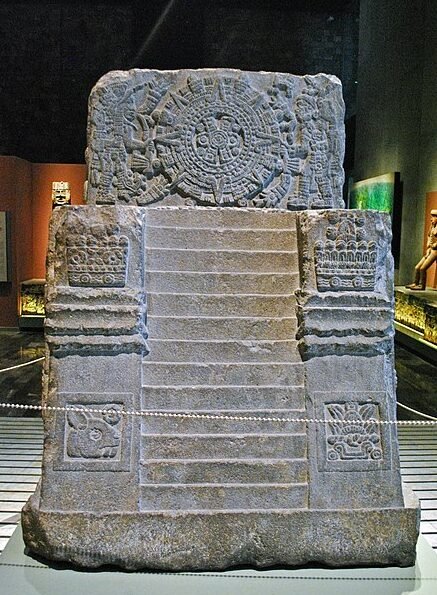
Structurally, the throne consists of two principal sections. The upper area resembles a flat-roofed sanctuary, while the lower portion takes the shape of a truncated pyramid outfitted with front-facing stairs. These combined elements mirror the hallmarks of late Mexica temple architecture.
Prominently, a solar disk labeled with the date Four Movement appears on the upper section of the façade. It is flanked by the deity Huītzilōpōchtli on one side and Tepēyōllōtl, a manifestation of Tezcatlipoca, on the other.

In 2006, archaeologists in Mexico City uncovered the Monolith of Tlaltecuhtli.
Directly below, a depiction of the earth god Tlaltecuhtli faces upward, situated next to weapons and implements of battle, underscoring the sculpture’s association with warfare. Beneath that, two glyphs––One Rabbit and Two Reed––mark the façade’s lower register. The latter includes a rope symbolizing the New Fire ceremony of Two Reed, thereby reflecting cyclical renewal in the Mexica belief system.
Throne structures were often fashioned to face the four cardinal directions, reflecting Aztec cosmology and the four quadrants of the world central to their beliefs.
Along the sides of the truncated pyramid, four figures appear in pairs. Each pair carries ceremonial items such as bags of copal incense, maguey leaves, or tobacco containers. Caso identifies these four as Tláloc, Tlahuiscalpantecuhtli, Xochipilli, and Xiuhtecuhtli––major deities in the Aztec pantheon.
Inscribed on the upper surface of the sculpture is another date, Two House, reinforcing the dense array of symbols.
Meanwhile, on the monument’s reverse side, one finds the image of an eagle perched on a prickly pear cactus, reminiscent of the modern Mexican coat of arms. The eagle, typically associated with Huītzilōpōchtli, clutches the war glyph, atl-tlachinolli, in its beak. Traces of the water deity Chalchiuhtlicue lie below the cactus, though part of the carving has been worn away by time.
Lastly, a stylized “earth monster” motif graces the platform, highlighting the enduring importance of terrestrial elements within Mexica cosmology.
Crucially, near the image of Tezcatlipoca, one observes a distinctive hieroglyph identified as the “Headdress Glyph.” This icon features a ruler’s hair, ear plug, nose plug, and diadem. Comparative studies of artifacts, such as the Hackmack Box in Hamburg, indicate that these components together formed the name glyph for Motecuhzoma. However, some scholars have sometimes interpreted this motif as a symbol of fire, which in turn is has been strongly associated with the name of the famous Mexica sovereign.

A militaristic justification for human sacrifice
In 1927, Alfonso Caso proposed that the figures and designs on the Teocalli advanced a religio-military rationale for human sacrifice in Tenochtitlan’s temples. He argued that these depictions underlined the belief in a divine mandate to fight and capture prisoners for sacrificial rites. This concept of a “mystical-military” ideology casts the Mexica as the sun’s chosen people.
However, other specialists, such as Enrique Juan Palacios, took a different perspective. Palacios treated these symbols as cosmograms that transcend mythological narratives, focusing instead on the sacred essence of Mexica society as a whole. His reading found wide support among scholars, shaping subsequent examinations of how Aztec religious practice integrated cosmic, historical, and civic dimensions into single ritual monuments.
Meaning of the earth monster on the platform
The Teocalli’s detailed iconography offers crucial insights into Aztec theology, governance, and cyclical rituals.
According to some scholars, the earth monster depicted on the platform may represent Mexica territorial holdings maintained by military might.
With celestial symbols overlaying terrestrial motifs, the Teocalli of the Sacred War underscores how warfare, rulership, and religious renewal converged in the Mexica worldview, highlighting Motecuhzoma II’s essential role in sustaining cosmic balance.
Montezuma’s Throne in Modern Interpretation
In modern times, Montezuma’s throne stands as a cultural icon, symbolizing indigenous heritage and historical complexity. Museums around the world, including the National Museum of Anthropology in Mexico City, display artifacts reminiscent of the Aztec throne, allowing modern audiences to connect with the artistic and symbolic heritage of the Aztec civilization.

An illustration depicting the back of the Teocalli of Sacred War.
Did you know…?
As emperor, Montezuma played a central role in ritual sacrifices, seasonal ceremonies, and public displays that reinforced his status. His throne would have been central to various rites and ceremonies that promoted social cohesion, validated the emperor’s divine mandate, and honored the gods. During festivals, he would sit on the throne to address his people, surrounded by symbols of authority and protected by his loyal warriors.
The Teocalli of Sacred War combines artistry and religious reverence, illustrating Montezuma’s divine role and the Aztec belief in the ruler’s connection to cosmic and natural forces.
In Aztec society, the ruler was not only the king but also the “tlatoani,” or speaker. This term implied a leader who held authority but also served as the communicator of divine messages. Sitting upon the throne, Montezuma was more than just a ruler; he was a mediator with the gods, and his decisions were perceived as guided by divine will. Thrones were important in ceremonies that included ritual sacrifice, where the ruler’s presence was required to ensure the gods’ continued favor and the city’s prosperity.
Conclusion
Today, the Teocalli of the Sacred War stands as both artifact and historical statement, exemplifying the deep synergy of Aztec religious practice and political authority.
Whether serving as a physical seat for a ruler or functioning as a symbolic microcosm of Tenochtitlan’s central temple, this singular piece of art speaks to the sophisticated conceptual universe that shaped Aztec religious ceremonies.
Through its representations of deities, calendrical dates, and martial imagery, the Teocalli of the Sacred War remains a vital document of Mexica cosmology, state power, and devotional traditions.
Frequently Asked Questions about the Teocalli of Sacred War
Where can the throne be viewed today?
The Teocalli of Sacred War is displayed in the National Museum of Anthropology in Mexico City, where it stands as a key example of Aztec art and cultural heritage.
When and where was the throne discovered?
The throne was discovered in 1831 near the site of Montezuma’s palace, beneath what is now Mexico City. Its discovery added significantly to the understanding of Aztec ceremonial art and religious practices.
What does the throne represent in Aztec culture?
The throne represents both the triumph of the sun and the foundation of Aztec cosmology, as well as Montezuma’s role as a divine ruler. Its design symbolizes the Aztec calendar cycle, sacred warfare, and the critical New Fire Ceremony, which marked the renewal of the sun every 52 years.
What is the significance of the New Fire Ceremony commemorated by the throne?
The New Fire Ceremony, overseen by Xiuhtecuhtli, the god of fire, was a crucial ritual held every 52 years to ensure the sun’s renewal. It involved a sacrificial ritual on Mt. Uixachtecatl to ignite a new flame, symbolizing cosmic harmony. If the flame failed to light, the Aztecs feared it would signal the end of the world, as monstrous beings known as the Tzitzimime would descend upon the earth.
The 1507 New Fire Ceremony was particularly significant because it followed a series of calamities, including famine and severe snowstorms. These misfortunes intensified the need for a successful ceremony, which would bring about a fresh start and cosmic harmony. Although the ceremony was successful, the empire would encounter its own end only 14 years later with the Spanish conquest.
What symbols are found on the throne’s steps, and what do they represent?
The twelve steps leading to the throne feature a rabbit symbol on one side (representing the calendar date 1) and reeds on the other side (symbolizing the date 2). These symbols may represent the start and end of the 52-year cycle or the specific years associated with this New Fire Ceremony. Above them, vessels used to hold sacrificial hearts, decorated with jaguar and eagle motifs, highlight the Aztec’s reverence for these animals.
How does the throne depict Montezuma’s role as a ruler?
The throne’s back panel features a large sun disk with cardinal directions, common in Aztec art. On one side of the disk stands Huitzilopochtli, the god of war and the sun, and on the other side, Montezuma performs a sacrificial ritual.
The throne seat also includes a relief of Tlaltecuhtli, the earth monster, symbolizing that when Montezuma sat on the throne, he embodied the connection between earth and sun, serving as a divine guardian of both.

What other Aztec deities are depicted on the throne, and what do they signify?
In addition to Huitzilopochtli, the throne features carvings of other deities like Tlaloc (god of rain), Tlahuizcalpantecuhtli (Dawn), Xiuhtecuhtli (fire), and Xochipilli (god of flowers, summer, and music). Each god performs self-sacrifice, emphasizing the importance of sacrifice in maintaining cosmic order and reinforcing Montezuma’s divine mandate.
How does the throne reflect Aztec beliefs about cosmic order and divine favor?
The throne’s carvings illustrate the Aztec belief that their ruler had a divine connection to cosmic forces. Dates such as 1 Flint and 1 Death, alongside symbols like Tezcatlipoca’s smoking mirror, reinforce the divine favor over Montezuma’s reign and emphasize his role as a sacred guardian tasked with maintaining balance between earth, sun, and the Aztec cosmos.
How does the eagle motif relate to the founding of Tenochtitlan?
The eagle carving on the back of the throne recalls the Aztec founding legend of Tenochtitlan. According to this legend, the god Huitzilopochtli guided the Aztecs to settle at the site where they saw an eagle perched on a cactus, symbolizing the establishment of their capital. The eagle on the throne underscores Montezuma’s connection to this divine foundation and his role as the protector of Tenochtitlan.