The Templo Mayor, or Main Temple, was the central religious and ceremonial structure of the Mexica people in Tenochtitlan, their capital city, which is now Mexico City.
This grand temple belonged to the late Postclassic period of Mesoamerica and was known in the Nahuatl language as Huēyi Teōcalli. It was dedicated to two principal deities: Huitzilopochtli, the god of war, and Tlaloc, the god of rain and agriculture. Each deity had a shrine at the top of the pyramid, accessible via separate staircases.
Additionally, the central spire was dedicated to Quetzalcoatl in his form as Ehecatl, the wind god. Measuring approximately 100 by 80 meters (328 by 262 feet) at its base, the temple was the dominant feature of the Sacred Precinct of Tenochtitlan.
Construction began shortly after 1325, and the temple was rebuilt six times before being almost entirely destroyed by the Spanish in 1521. The Mexico City Metropolitan Cathedral was later built on its site.
The Templo Mayor remains a significant archaeological and historical landmark, with its ruins forming part of the Historic Center of Mexico City, a UNESCO World Heritage Site since 1987.
Discovery and Excavation
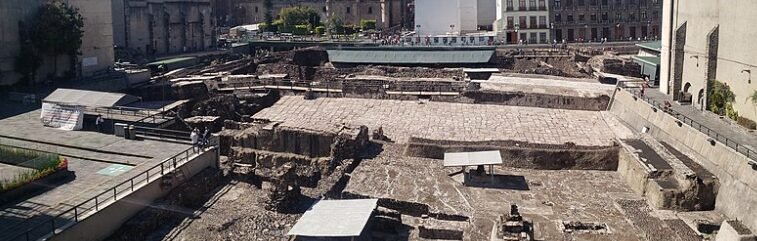
The Templo Mayor was the heart of the Mexica civilization, representing their religious beliefs, cosmology, and political power. Its destruction marked the end of an era, yet its rediscovery has provided invaluable insights into Mesoamerican history.
After the fall of Tenochtitlan, the Spanish dismantled the Templo Mayor, repurposing its materials for colonial constructions. Over time, the exact location of the temple was forgotten. Archaeologists speculated about its location, and by the 20th century, preliminary excavations provided clues. Scholars like Leopoldo Batres, Manuel Gamio, and others uncovered portions of the temple, but large-scale excavation efforts did not begin until the late 20th century.

Huitzilopochtli as depicted in the Codex Borbonicus
A breakthrough came in 1978 when workers from the city’s electricity provider, Comisión Federal de Electricidad, accidentally unearthed a massive stone disk depicting the dismembered body of Coyolxauhqui, the sister of Huitzilopochtli.
This discovery prompted full-scale archaeological efforts led by Eduardo Matos Moctezuma from 1978 to 1982. The excavation revealed numerous artifacts, including effigies, ceramic urns, obsidian knives, skull masks, and Mixtec figurines.
To preserve and display these findings, the Templo Mayor Museum was established, housing over 6,800 objects from the site.
Architectural Evolution
Like many Aztec structures, the Templo Mayor was expanded and rebuilt in successive layers. Each reconstruction preserved elements of previous versions, creating a stratified archaeological site. The temple underwent seven major phases:
First Temple
The first version was built of earth and wood, but no physical remains have been found due to the high water table in the former lakebed. Historical records indicate its existence shortly after Tenochtitlan’s founding in 1325.
Second Temple
Constructed between 1375 and 1427, this phase saw the inclusion of stone shrines. A chacmool, a sacrificial stone, and sculpted faces were discovered from this period.
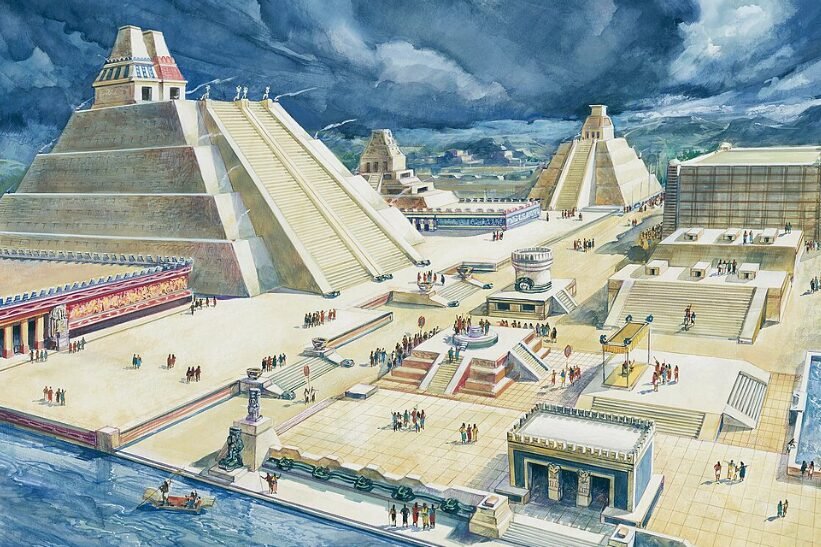
Depiction of Templo Mayor
Third Temple
Built between 1427 and 1440, this version featured a staircase flanked by eight stone standard-bearers with glyphs dated to 1431. These figures represented divine warriors.
Fourth Temple
Constructed between 1440 and 1481, this phase included elaborate serpent and monkey sculptures, braziers, and the famous Coyolxauhqui monolith. Architectural decorations and iconography became more complex.
Fifth Temple
Built between 1481 and 1486 under Tizoc’s reign, this phase saw stucco refinements and the paving of the ceremonial plaza.
Sixth Temple
Ahuizotl’s reign (1486–1502) introduced more modifications, including a walled Sacred Precinct adorned with serpent heads. He also constructed three shrines and the House of the Eagle Warriors.
Seventh Temple
Little remains of this final phase due to the Spanish demolition. However, it was described as the largest and most important ceremonial center of the time, with two towering shrines dedicated to Huitzilopochtli and Tlaloc, standing approximately 60 meters (200 feet) tall.
Templo Mayor was the main temple of the Mexica (Aztec) capital, Tenochtitlán, located in present-day Mexico City.
Religious and Symbolic Importance
The Templo Mayor was a vital religious center, aligning with the Mexica worldview. It symbolized the sacred mountain of Coatepec, where Huitzilopochtli triumphed over Coyolxauhqui. The temple’s twin pyramids represented the duality of life: war and sustenance. Huitzilopochtli’s shrine, marked by red and white paint, symbolized blood and sacrifice, while Tlaloc’s shrine, in blue, represented water and fertility.

Tláloc effigy vessel (1440–1469), painted earthenware, 35 cm, Museo del Templo Mayor: blue-stuccoed jar featuring Tláloc’s visage with ringed eyes, jaguar teeth, symbolizing thunder.
Ritual human sacrifices were conducted at the temple to appease the gods. Captives were led up the steep stairs and sacrificed on the temple’s sacrificial stone. Their hearts were extracted and offered to Huitzilopochtli, while their bodies were thrown down the steps to mimic the myth of Coyolxauhqui’s defeat.
Templo Mayo was a massive stepped pyramid dedicated to two major deities: Huitzilopochtli – The god of war and the sun; and Tlaloc – The god of rain and fertility.
Sacred Precinct and Surrounding Structures
The temple was part of a larger ceremonial complex enclosed by a serpent wall. Important structures within the precinct included:
- House of the Eagle Warriors: An elite warrior society’s residence with murals and sculptures.
- Temple of Quetzalcoatl: A circular temple honoring the feathered serpent god.
- Ball Court (Tlachtli): A ritual ball game site associated with warfare and sacrifice.
- Tzompantli (Skull Rack): Displayed the skulls of sacrificed individuals.
- Calmecac: A priestly school for religious and administrative education.
Offerings and Artifacts
Archaeological excavations uncovered a vast array of offerings at the site. These included sculptures, flint knives, ceramic vessels, gold ornaments, and even animal and human remains. The most notable offering was the Coyolxauhqui monolith, found at the foot of Huitzilopochtli’s shrine, reinforcing the temple’s mythological symbolism.
The Mexica also practiced autosacrifice, using obsidian blades and maguey thorns to draw blood as offerings. Remains of these ritual items, including decorated skull masks and face-painted flint knives, were among the many artifacts discovered.

Huitzilopochtli, as depicted in the Codex Telleriano-Remensis
Modern Museum and Preservation
The Templo Mayor Museum, established in 1987, houses the site’s most significant artifacts and provides insight into Mexica religion, culture, and daily life. The museum features eight primary exhibition halls, each dedicated to different aspects of Aztec civilization, including deities, ritual practices, and economic systems.
Significant artifacts on display include the massive Coyolxauhqui monolith, Mictlantecuhtli statues, and ceremonial urns. The museum also continues archaeological investigations through the Urban Archaeology Program, which explores the historic center of Mexico City.
Frequently Asked Questions
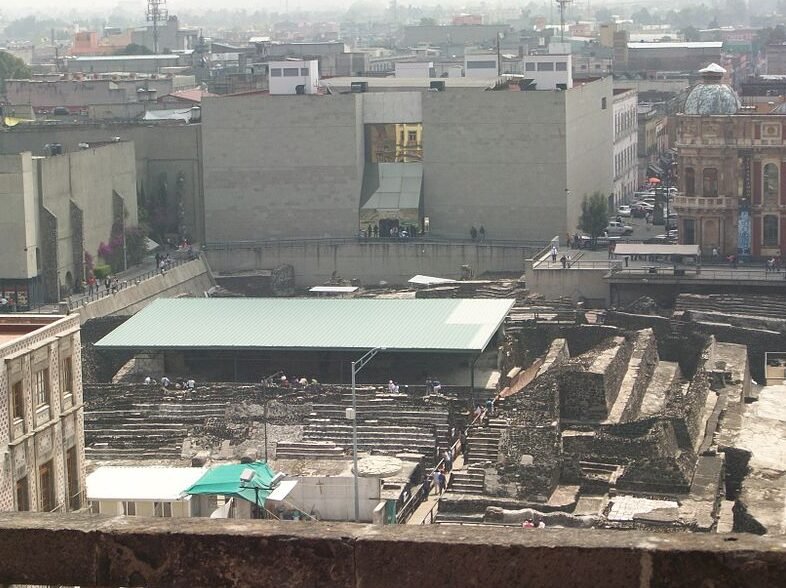
The Templo Mayor was the main temple of the Mexica people in Tenochtitlan, dedicated to Huitzilopochtli, the god of war, and Tlaloc, the god of rain and agriculture. Image: Aerial view of the Templo Mayor
When was the Templo Mayor built and how many times was it rebuilt?
The first temple was constructed after 1325, and it was rebuilt six times before its destruction by the Spanish in 1521.
Where is the Templo Mayor located today?
It is located in modern-day Mexico City, near the Zócalo, in the Historic Center, a UNESCO World Heritage Site.
How was the Templo Mayor rediscovered?
In 1978, workers from the Comisión Federal de Electricidad found a massive stone disk depicting the dismembered goddess Coyolxauhqui, prompting full-scale excavations.
What was found during excavations of the Templo Mayor?
More than 6,800 artifacts, including sculptures, ceremonial offerings, Mixtec figurines, decorated skulls, and obsidian knives, were uncovered and are now housed in the Templo Mayor Museum.
What was the significance of the twin temples atop the pyramid?
The twin temples symbolized the Mexica cosmos: Huitzilopochtli’s shrine represented Coatepec, the mythical hill of his birth, while Tlaloc’s shrine represented Tonacatepetl, the mountain of sustenance.
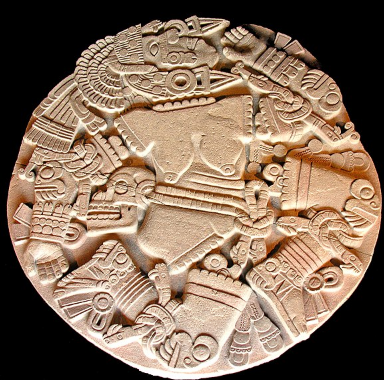
Considered one of the most famous Aztec monuments, the Coyolxauhqui stone was found at the base of the pyramidal stairway leading to the Templo Mayor, a major temple of the gods Huitzilopochtli and Tlaloc.
What role did the Templo Mayor play in human sacrifice?
It was a major site for ritual sacrifices, including the flaying of victims and the display of skulls on tzompantli (skull racks), often to honor Huitzilopochtli and Tlaloc.
What happened to the Templo Mayor after the Spanish conquest?
The temple was demolished, and its stones were repurposed for colonial buildings, including the Mexico City Metropolitan Cathedral, which was built on its remains.
Key Facts About Templo Mayor
- Construction: Built in phases from the 14th century until the Spanish conquest in 1521.
- Structure: A twin-temple pyramid with two shrines at the top, one for each deity.
- Religious Significance: It was the site of human sacrifices, particularly during major festivals like the Panquetzaliztli in honor of Huitzilopochtli.
- Destruction: The Spanish, led by Hernán Cortés, demolished the temple in 1521 and used its stones to build the Metropolitan Cathedral.
- Rediscovery: In 1978, the remains of the temple were rediscovered when workers found the monolith of Coyolxauhqui, the moon goddess.
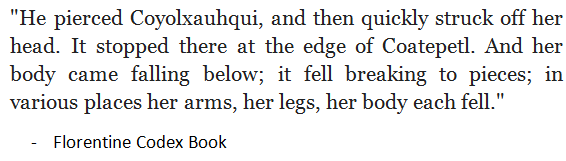
Huitzilopochtli was born on the sacred mountain of Coatepec. The same mountain were Coyolxauhqui died. | Quote from the Huitzilopochtli codex
Templo Mayor Today
- Museo del Templo Mayor: Houses artifacts from the temple, including sacrificial knives, masks, and offerings.
- Archaeological Site: Located in the heart of Mexico City’s historic center, near the Zócalo.





