The Ancient City of Nimrud: History and Major Facts

Location of Nimrud in Iraq
Nimrud, one of the most important cities of the ancient Assyrian Empire, holds a significant place in the history of Mesopotamia. Known as Kalḫu in ancient Assyrian and referred to as Calah in the Bible, Nimrud was a major political, religious, and cultural center of the Assyrian Empire from approximately 1350 BC to 610 BC.
Located in present-day Iraq, the city is situated 30 kilometers south of Mosul, near the confluence of the Tigris River and its tributary, the Great Zab. Nimrud was the royal capital for several prominent Assyrian kings, and its archaeological significance lies in the wealth of artifacts and structures uncovered over the centuries.
Nimrud’s history, from its rise as a major Assyrian city to its destruction and subsequent rediscovery by archaeologists, provides insight into the development of the Assyrian Empire and ancient Mesopotamian civilization.
Below, ancient Mesopotamian historians at World History Edu explore the history of Nimrud, its key archaeological discoveries, and the cultural and historical importance of the city.
Historical Overview

Nimrud’s palaces, temples, and art shaped the culture and politics of the Assyrian Empire, and its rediscovery has provided invaluable insight into one of history’s most powerful ancient states. Image: Lamassu deity at the Metropolitan Museum in New York City
Founding and Early History

Relief of City under siege (British Museum)
The ancient city of Nimrud, originally named Kalḫu, was first established around 1350 BC during the Middle Assyrian period. Its rise to prominence occurred during the reign of Ashurnasirpal II (883–859 BC), the king of the Neo-Assyrian Empire. Ashurnasirpal II moved the capital of the empire from the city of Aššur to Kalḫu, marking the beginning of a new era of urban development, military expansion, and cultural flourishing for the Assyrians. The city covered an area of about 360 hectares (890 acres), making it one of the largest and most strategically significant cities in the empire.
Nimrud’s location was particularly advantageous for the Assyrians due to its proximity to the Tigris River and the Great Zab, which provided access to water resources, trade routes, and fertile agricultural land. The city served as a key hub for trade and communication across the empire, connecting Assyria with the wider Mesopotamian region, as well as with neighboring regions like Anatolia and Syria.
Ashurnasirpal II and the Rise of Nimrud

Ashurnasirpal II
The most notable phase of Nimrud’s development came during the reign of Ashurnasirpal II, who transformed the city into a symbol of Assyrian power and grandeur. Ashurnasirpal II is remembered for his extensive building projects, which included the construction of his grand palace and several temples. His reign also marked the height of Assyrian military expansion, as he led campaigns into surrounding regions to expand the empire’s influence.
Ashurnasirpal II’s palace, known as the North-West Palace, was a massive complex that served as the administrative and ceremonial heart of the city. The palace was adorned with intricately carved reliefs depicting the king’s military conquests, religious rituals, and scenes of court life. These reliefs, which remain some of the most famous artifacts from ancient Assyria, exemplify the artistic achievements of the period and provide a vivid depiction of the power and majesty of the Assyrian king.
Ashurnasirpal II also commissioned the construction of several temples in Nimrud, dedicated to Assyrian gods such as Ninurta, the god of war and agriculture, and Ishtar (equivalent of Inanna in Sumerian pantheon), the goddess of love and war. The temples played a central role in the religious life of the city, serving as places of worship and centers for the performance of rituals and offerings to the gods.
READ MORE: 10 Most Famous Ancient Mesopotamian Kings
Nimrud as the Capital of the Neo-Assyrian Empire

Ashurnasirpal II
Following Ashurnasirpal II’s reign, Nimrud continued to serve as the capital of the Neo-Assyrian Empire for over a century. The city reached its zenith under the rule of Shalmaneser III (858–824 BC), the son of Ashurnasirpal II. Shalmaneser III expanded the city further and added to its architectural grandeur by constructing the Great Ziggurat, a towering structure that symbolized the connection between the earthly realm and the divine. The ziggurat, along with the city’s palaces and temples, cemented Nimrud’s reputation as one of the most impressive cities of the ancient world.
During the Neo-Assyrian period, Nimrud became the center of an empire that stretched from the Persian Gulf in the south to the Mediterranean Sea in the west. The city’s wealth and power were derived from the tributes and resources collected from conquered territories, as well as from its control over trade routes that linked Mesopotamia to Egypt, Anatolia, and the Levant.
The Assyrian Empire’s military might and territorial expansion under kings like Tiglath-Pileser III (744–727 BC) and Sargon II (722–705 BC) contributed to Nimrud’s prosperity. However, the city’s fortunes began to decline toward the end of the 7th century BC, as internal strife and external pressures weakened the empire. The final blow to Nimrud came in 612 BC, when the city was sacked by a coalition of Babylonians, Medes, and Scythians during the fall of the Assyrian Empire.
READ MORE: How did Cyrus the Great conquer the Neo-Babylonian Empire?
Archaeological Discoveries
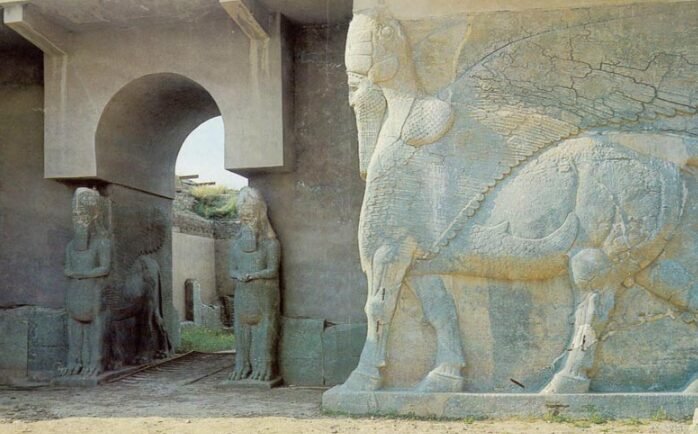
Image: Nimrud Lamassu’s at the North West Palace of Ashurnasirpal. Lamassu (Lama or Lamma) is an Assyrian protective deity, often depicted as a human-headed winged bull or lion.
Early Excavations (1840s–1879)
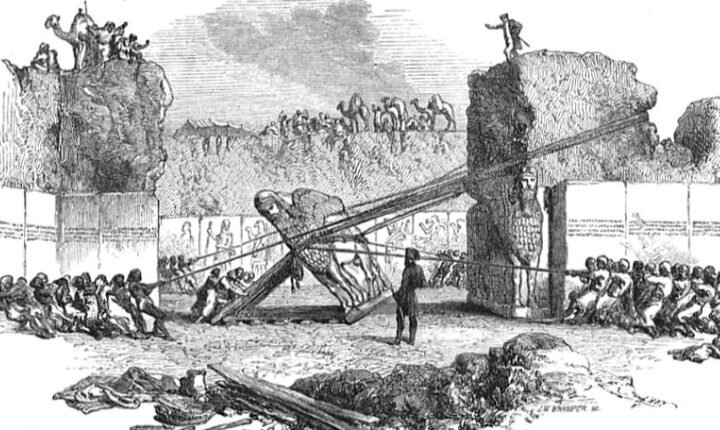
Nimrud remained lost to history for centuries until it was rediscovered by European explorers and archaeologists in the 19th century. The first modern excavations at the site were conducted by English Assyriologist and historian Austen Henry Layard in 1845, marking the beginning of a new era of archaeological exploration in Mesopotamia. Layard’s work at Nimrud uncovered some of the most important artifacts and architectural features of the Assyrian period, including the remains of the North-West Palace, the lamassu statues, and the famous Nimrud Ivories.

Austen Henry Layard
The lamassu, which were large protective deities with human heads, wings, and the bodies of lions or bulls, were found at the entrances to the royal palaces. These statues symbolized the power and authority of the Assyrian kings and were intended to ward off evil spirits. The lamassu, along with the palace reliefs and inscriptions, became iconic representations of Assyrian art and architecture.
Layard also discovered thousands of cuneiform tablets in the ruins of Nimrud, which provided valuable insights into the administration, religion, and daily life of the Assyrian Empire. These tablets, written in the Akkadian language, recorded everything from royal decrees and legal contracts to religious hymns and prayers. The discovery of these tablets was a major breakthrough in the understanding of ancient Mesopotamian civilization.
Later Excavations (1949–Present)
After Layard’s initial excavations, archaeological work at Nimrud continued intermittently throughout the late 19th and early 20th centuries. In 1949, a new phase of excavations was initiated by Max Mallowan, the British archaeologist and husband of the famous author Agatha Christie. Mallowan’s team uncovered additional royal buildings, temples, and artifacts, further enhancing the understanding of Nimrud’s historical and cultural significance.

Cavalry battle in Nimrud
One of the most significant discoveries made during Mallowan’s excavations was the Nimrud Treasure, a collection of gold jewelry, precious stones, and other luxury items that had been buried in the royal tombs of Nimrud. The treasure, which dates to the reign of Ashurnasirpal II and his successors, is considered one of the most remarkable finds from the ancient Near East.
Archaeological work at Nimrud continued into the 21st century, with international teams conducting further excavations and conservation efforts. In 2013, the Nimrud Project, funded by the UK’s Arts and Humanities Research Council and led by Eleanor Robson, aimed to document the city’s history and track the dispersal of artifacts found at the site. Artifacts from Nimrud are now held in over 76 museums worldwide, including the British Museum, the Iraqi National Museum, and the Metropolitan Museum of Art.

Image: Esarhaddon cylinder from Fort Shalmaneser at Nimrud, originally housed in the Iraqi Museum, Baghdad, now in the Erbil Civilization Museum, Iraq.
The Destruction of Nimrud by ISIS
In recent history, Nimrud faced one of its most devastating chapters. In March 2015, the terrorist organization ISIS (Islamic State of Iraq and Syria) deliberately targeted the site, labeling it “un-Islamic” due to its Assyrian, pre-Islamic heritage. ISIS militants used bulldozers, explosives, and sledgehammers to destroy much of the city’s excavated remains, including the lamassu statues, palace reliefs, and the Great Ziggurat.
Videos released by ISIS showed militants smashing ancient statues and carvings, causing widespread outrage among the international archaeological community and governments around the world. The destruction of Nimrud was condemned as an act of cultural genocide, with many viewing it as an irreparable loss to the world’s shared heritage.
By the time ISIS was driven out of the area by Iraqi forces in November 2016, it was estimated that nearly 90% of the excavated portion of Nimrud had been completely destroyed. The lamassu statues, which had stood as silent guardians of the city for millennia, were reduced to rubble, and the North-West Palace was heavily damaged. The ziggurat, one of the city’s most iconic structures, was also leveled.
Retaking and Preservation
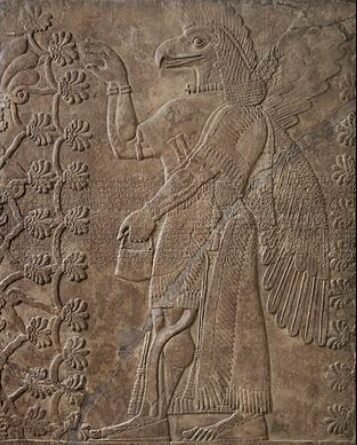
Eagle-headed deity in ancient Mesopotamia
Following the defeat of ISIS in the region, Iraqi forces regained control of Nimrud, and efforts to protect and preserve the site began. Initial assessments of the damage confirmed the widespread destruction, but some portions of the city’s ruins were still intact. Since 2016, Nimrud has been guarded by Iraqi forces to prevent further damage or looting.
The process of reconstruction at Nimrud has been slow and complex, given the scale of destruction and the challenges of restoring ancient structures. International organizations such as UNESCO have pledged support for the recovery and preservation of the site, and efforts are underway to stabilize the remaining structures and prevent further degradation.
While much of Nimrud’s architectural and artistic heritage has been lost, ongoing archaeological and conservation efforts aim to preserve what remains and ensure that the city’s legacy continues to inform future generations.
Cultural and Historical Significance
Nimrud holds a special place in the history of ancient Mesopotamia and the Assyrian Empire. As the royal capital during the reign of some of Assyria’s most powerful kings, Nimrud was a center of political, religious, and cultural activity. The city’s palaces, temples, and monumental sculptures were not only symbols of Assyrian power but also testaments to the artistic and architectural achievements of the ancient Near East.
The Nimrud Ivories, intricately carved plaques and furniture decorations, are among the finest examples of Assyrian craftsmanship. These ivories, which were often inlaid with precious stones and metals, demonstrate the high level of artistic skill that flourished in Nimrud during its heyday.
The city’s strategic location and role as a hub for trade and communication also contributed to its historical importance. Nimrud was a key player in the network of cities that connected Mesopotamia with the broader ancient world, facilitating the exchange of goods, ideas, and cultural influences.

Stela of Shamshi-Adad V
READ MORE: Greatest Cities from Ancient Mesopotamia
Frequently asked questions

Image: Glazed terracotta tile from Nimrud, Iraq, depicting an Assyrian king under a parasol, surrounded by guards and attendants. 875–850 BC, British Museum.
From its founding as Kalḫu to its rise as the capital of the Neo-Assyrian Empire, Nimrud played a central role in the political, religious, and cultural life of ancient Mesopotamia. Its monumental architecture, intricate artworks, and cuneiform records provide a window into the world of the Assyrian kings and the empire they built.
Where is Nimrud located, and why was it significant in ancient times?
Nimrud, also known as Kalḫu (biblical Calah), is located in modern-day Iraq, 30 kilometers south of Mosul. It was a major city in the Assyrian Empire between 1350 BC and 610 BC, strategically positioned near the confluence of the Tigris River and the Great Zab, serving as a key political, religious, and cultural center during the empire’s peak.
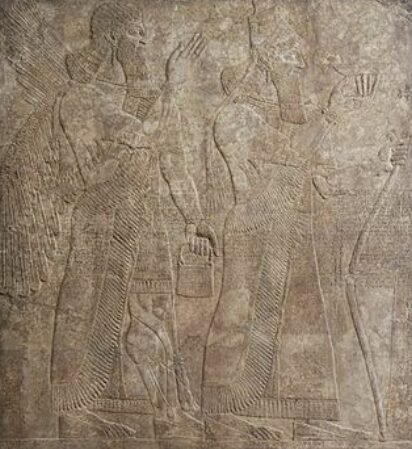
Ashurnasirpal II
How did Nimrud get its name?
The name Nimrud was recorded by Carsten Niebuhr in the mid-18th century as the local name for the ruins. In the 19th century, biblical archaeologists linked the site to Kalḫu (Calah), mentioned in the Book of Genesis and associated with the biblical figure Nimrod, though this connection is more cultural than historically verified.
What were some of the key discoveries made during the excavations at Nimrud?
Early excavations, led by English Assyriologist and historian Austen Henry Layard in 1845, uncovered major finds such as the grand palaces, temples, fortifications, and the lamassu statues. The Nimrud Ivories, intricate carvings used for furniture, and cuneiform tablets were also found, shedding light on Assyrian daily life and administration.
What was the significance of the lamassu statues at Nimrud?
The lamassu statues were protective deities with human heads, wings, and the bodies of lions or bulls. They stood at the entrances of Assyrian palaces, symbolizing the power and authority of the kings. These statues were a significant part of Assyrian architecture and religious symbolism.

What was the Nimrud Project, and what were its objectives?
The Nimrud Project, funded by the UK’s Arts and Humanities Research Council in 2013, aimed to document the history of Nimrud from ancient times to the modern era. It also tracked the dispersal of artifacts from Nimrud, which are now held in at least 76 museums worldwide, including 36 in the United States and 13 in the United Kingdom.
What happened to Nimrud in 2015?
In March 2015, the terrorist organization ISIS destroyed much of Nimrud, using bulldozers and explosives to obliterate around 90% of the excavated structures, including the lamassu statues, palaces, and the ziggurat. ISIS targeted the site for its pre-Islamic Assyrian heritage, releasing videos that documented the destruction.
What has been done to preserve Nimrud after its destruction?
After Iraqi forces retook Nimrud in November 2016, preservation efforts began. Although much of the site was reduced to rubble, ongoing reconstruction work, supported by international organizations like UNESCO, aims to stabilize the remaining structures and safeguard Nimrud’s legacy for future generations.
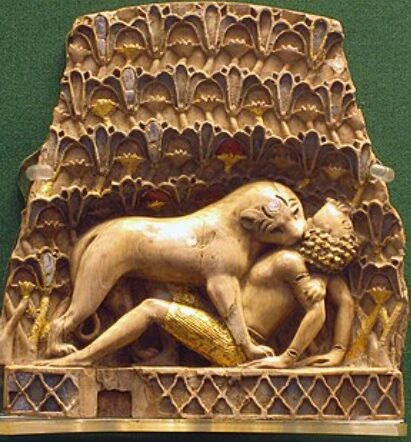
Nimrud ivory plaque with gold leaf and paint, showing a lion attacking a human. (British Museum)
What is the current status of Nimrud?
Nimrud remains under the protection of Iraqi forces, with reconstruction efforts underway to preserve what remains of the city. Despite the significant destruction, international collaboration is focused on documenting and conserving Nimrud’s surviving artifacts and ruins, ensuring its historical legacy endures.
Why is Nimrud considered an important archaeological site today?
Nimrud is a crucial site for understanding the Assyrian Empire, one of the most powerful civilizations of ancient Mesopotamia. Its monumental architecture, extensive reliefs, and cuneiform records provide insights into Assyrian culture, politics, and religion. Despite the destruction by ISIS, Nimrud’s historical significance continues to inform our knowledge of ancient Mesopotamia.

Location of the ancient city of Nimrud
READ MORE: Most Famous Myths from Ancient Mesopotamia





