The Berthouville Treasure
The Berthouville Treasure is a significant hoard of Roman silver discovered in 1830 near the hamlet of Villeret, in the commune of Berthouville, Normandy, France. This remarkable collection of silver artifacts, weighing approximately 25 kg, was buried in antiquity and later unearthed purely by chance. The treasure is now preserved in the Cabinet des Médailles at the Bibliothèque nationale de France in Paris. Notable for its intricate craftsmanship and cultural significance, the Berthouville Treasure provides valuable insight into Gallo-Roman religious practices and artistic influences.
Discovery of the Berthouville Treasure
The treasure was discovered in March 1830 by a local farmer named Prosper Taurin while he was plowing his field. His plow struck a Roman tile buried just 20 cm beneath the surface, revealing a hidden cache of silver objects. These items were quickly identified as belonging to a sanctuary dedicated to Mercury Canetonensis, a deity who played a central role in Gallo-Roman religion.
Mercury was one of the principal gods of the Roman pantheon and was widely venerated in Gaul. The Roman general Julius Caesar had noted that Mercury was one of the most important deities among the Gauls, often worshipped with native Gallic epithets. The discovery at Berthouville reinforced this observation, as the objects bore inscriptions and symbols associated with the god.
The Berthouville Treasure consists of 93 silver and metal items, including bowls, cups, jugs, a phiale for libations, and silver statuettes of Mercury and a goddess, likely Maia.
The Berthouville Treasure is particularly significant because it is one of only three known collections of valuable objects explicitly connected to local religious cults in Gaul or Britannia. This rarity, along with the quality of the artifacts, makes the hoard an important archaeological and historical find.
Julius Caesar’s Conquest of Gaul: History, Significance & Other Important Facts
Contents and Significance of the Treasure
The treasure consists of 93 silver and metal objects, including bowls, jugs, cups, and ceremonial items. These artifacts range in date from the 1st to the late 2nd century CE, though some pieces were already heirlooms by the time they were hidden in the late 2nd or early 3rd century CE.
Among the most significant items in the hoard are:
- A repoussé silver jug from 1st century CE Italy, featuring an inscription dedicated to Mercury.
- Two silver statuettes of Mercury, the larger standing at 60 cm tall.
- A silver bust of a goddess, likely Maia, Mercury’s mother, representing the Romanization of a native Gallic deity.
- Four inscribed silver bowls with Mercury’s symbolic imagery and the Latin votive phrase VSLM (Votum Solvit Libens Merito, meaning “He fulfills his vow freely, as is deserved”).
- A phiale, a shallow vessel used for libations in religious ceremonies.

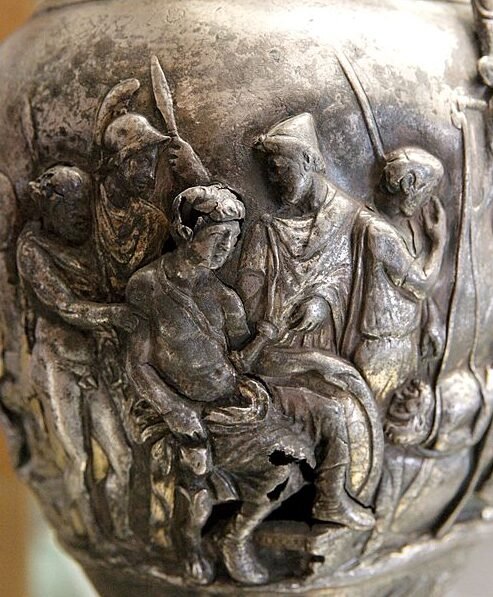
Detail of a cup dedicated to Mercury by Quintus Domitius Tutus, featuring Seated Poseidon and other Isthmian gods alongside a goddess.
Interestingly, not all the objects in the hoard are directly linked to Mercury. Nine pieces form a group of luxury domestic silverware from the 1st century CE, dedicated by Q. Domitius Tutus. These include a pair of silver drinking cups (scyphi) decorated with centaurs and two silver wine jugs. Their iconography is associated with Dionysus, the god of wine, rather than Mercury, suggesting that votive offerings could include items originally meant for personal use.
Cultural and Religious Context
The Berthouville Treasure highlights the interplay between Roman and Gallic religious traditions. The shrine of Mercury Canetonensis was a site of devotion where Roman and local Gallic deities were worshipped together. This phenomenon, known as interpretatio Romana, was common in Gallo-Roman religion, where native gods were identified with Roman counterparts.
Mercury, as a god of commerce, communication, and travel, was particularly popular in Gaul, a region rich in trade routes. The pairing of a Roman god with a Gallic goddess, such as Maia, reflects a cultural fusion that was characteristic of the Gallo-Roman religious landscape.
Archaeological excavations near the discovery site in 1861-1862 and again in 1986 uncovered remnants of a Gallo-Roman theater and a shrine, likely the sanctuary to which the silver objects were originally dedicated. These structures indicate that the site was an important religious center.
Preservation and Conservation
Upon discovery, the treasure was sold for 15,000 francs, a modest sum considering its historical significance. It has since been housed in the Cabinet des Médailles in Paris, where it remains a focal point of Roman-era studies.
In a landmark conservation effort, the treasure left France for the first time to undergo restoration and study at the J. Paul Getty Museum in Malibu, California. This multi-year collaboration between the Getty and the Bibliothèque nationale de France allowed experts to analyze the hoard using modern technology, revealing fine details previously obscured by centuries of corrosion and wear.
The project led to several important discoveries about the techniques used to craft these objects and the cultural interactions between Roman and Gallic societies. The conservation work not only preserved the treasure but also provided scholars with a deeper understanding of Roman silver craftsmanship and votive practices.
Exhibitions and Public Display
After its restoration, the Berthouville Treasure was exhibited at the Getty Villa in California from November 2014 to August 2015. The exhibition, titled “Ancient Luxury and the Roman Silver Treasure from Berthouville,” showcased the hoard’s artistry and religious significance. Following this display, the treasure went on an international tour, making stops in the United States and Europe before returning to France.
Today, the treasure remains an important subject of study and admiration, attracting scholars and visitors alike. Its discovery and subsequent conservation have enriched our understanding of Roman art, religious practices, and the cultural blending between the Roman Empire and the indigenous peoples of Gaul.
Frequently Asked Questions
How was the treasure discovered?
Farmer Prosper Taurin uncovered it while plowing his field, striking a Roman tile that revealed the buried hoard just 20 cm below the surface.
What was the treasure’s religious significance?
It was dedicated to Mercury Canetonensis, a Gallo-Roman deity, and is one of the few known collections linked to a local religious cult in Gaul or Britannia.

A silver statue depicting the god Mercury.
Who was Q. Domitius Tutus, and what did he contribute?
Tutus was a donor whose votive offerings included luxury silverware with Dionysiac imagery, such as drinking cups and wine jugs.
When and why was the hoard buried?
It was likely hidden in the late 2nd or early 3rd century CE, possibly to protect it from looting or conflict.
What later excavations were conducted?
Excavations in 1861–1862 and 1986 uncovered a Gallo-Roman theatre and a shrine, possibly the original site of the silver offerings.
How was the treasure conserved?
It underwent restoration at the Getty Museum, where new details were revealed, enhancing understanding of Roman-Gallic cultural interactions.





