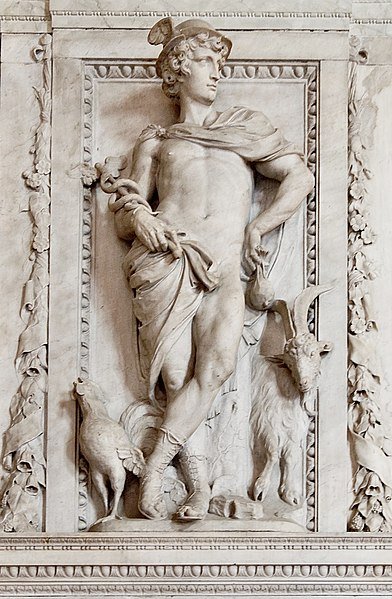
“Mercurius” by Artus Quellinus the Elder, a Flemish sculptor.
Mercury, known in Latin as Mercurius, is one of the most significant deities in Roman mythology. As a member of the Dii Consentes, the twelve principal gods of the Roman pantheon, he played a crucial role in various aspects of Roman religion and culture. Recognized as the god of commerce, communication, eloquence, financial gain, and travelers, he also held dominion over trickery, thievery, and the guidance of souls to the underworld. His multifaceted nature made him one of the most revered and widely worshipped deities in the Roman world.
Origins and Mythological Background
Mercury was the son of Jupiter, the king of the gods, and Maia, one of the Pleiades and the daughter of the Titan Atlas. His origins closely align with those of Hermes, his Greek counterpart, with whom he shares many attributes. Some historians argue that Mercury’s earliest form was influenced by the Etruscan god Turms, who exhibited similar characteristics. The assimilation of Mercury into Roman mythology was a result of cultural syncretism, merging Roman, Greek, and Etruscan religious traditions.

Marcus Aurelius, with his head covered, performing a sacrifice at the Temple of Jupiter.
Attributes and Symbols
Mercury is typically depicted as a youthful and agile figure, often wearing winged sandals (talaria) and a winged hat (petasos), symbolizing his speed and mobility. One of his most recognizable attributes is the caduceus, a staff entwined with two serpents, which Apollo originally bestowed upon Hermes. The caduceus later became associated with medicine and diplomacy. Mercury is also frequently accompanied by animals such as the rooster, a herald of the new day, the ram or goat, representing fertility, and the tortoise, linked to his legendary invention of the lyre.
Role in Commerce and Trade
Mercury was widely worshipped as the god of merchants and trade. His association with financial gain and commerce made him a key figure among Roman businessmen. Many Roman traders and shopkeepers invoked his name for prosperity and success. The connection between Mercury and commerce is evident in the etymology of his name, which is believed to derive from the Latin words merx (merchandise), mercari (to trade), and merces (wages). His temple in Rome, built in 495 BC, was strategically located in the Circus Maximus, a central hub for commercial activity.
Mercury as a Psychopomp
One of Mercury’s most critical roles was as a psychopomp, or guide of souls to the underworld. This function aligns with Hermes’ role in Greek mythology. Mercury’s responsibility was to ensure the smooth transition of souls from the realm of the living to the afterlife. This aspect of his identity underscores his role as a mediator, bridging the worlds of gods, humans, and the dead.
Mercury and Divine Communication
As the messenger of the gods, Mercury played a crucial role in conveying divine messages. His exceptional eloquence and cunning made him the ideal intermediary between deities and mortals. This role also extended to prophecy and divination, reinforcing his influence over communication and knowledge transmission.
Worship and Festivals
Unlike many early Roman deities, Mercury was not assigned a flamen (a specific priest dedicated to his worship). However, he was honored through festivals, particularly the Mercuralia, which was celebrated annually on May 15. During this festival, merchants and traders would sprinkle water from Mercury’s sacred well near the Porta Capena on their heads and wares, seeking his blessing for prosperity and successful transactions.
Syncretism with Other Deities
Mercury’s popularity extended beyond Rome, as he was frequently identified with local deities through interpretatio romana, a cultural practice of equating foreign gods with Roman counterparts. In Gaul, he was associated with the Celtic god Lugus, who shared similar traits as a god of commerce, skill, and trade. In Germanic regions, Mercury was linked to Wotan (Odin), a connection reflected in the modern-day names for Wednesday, Mercredi in French and Wednesday in English, which derives from Woden’s Day.
Epithets and Regional Variations
Mercury was worshipped under various epithets, each emphasizing different aspects of his divinity:
- Mercurius Artaios – A fusion of Mercury with the Celtic hunting god Artaios.
- Mercurius Arvernus – Associated with the Arverni tribe in the Rhineland.
- Mercurius Cimbrianus – Linked to a deity worshipped by the Cimbri, possibly Odin.
- Mercurius Cissonius – Revered in Gaul and Germany, blending with the Celtic god Cissonius.
- Mercurius Visucius – Worshipped in Gaul and Germany, sometimes linked to Mars.
READ MORE: Top 10 Most Powerful Celtic Gods and Goddesses
Mercury in Roman Literature
Mercury appears in various Roman literary works, playing vital roles in myths and stories. In Virgil’s Aeneid, he serves as a divine messenger, reminding Aeneas of his destiny to found Rome. Ovid’s Fasti narrates an episode where Mercury, while escorting the nymph Larunda to the underworld, falls in love with her, leading to the birth of the Lares, the invisible household deities of Rome.
The Temple of Mercury in Rome
The most significant temple dedicated to Mercury in Rome was constructed in 495 BC at the Circus Maximus. This location was ideal due to its prominence in commerce and trade. The temple’s dedication was notably awarded to Marcus Laetorius, a military tribune, rather than a patrician, reflecting the sociopolitical tensions between the patrician elite and the plebeians. The temple reinforced Mercury’s status as a divine mediator and protector of economic affairs.
Other interesting facts about Mercury
- Mercury’s legacy continues in modern culture, influencing various artistic, literary, and commercial representations. His name has been immortalized in astronomy, with the planet Mercury being named after him due to its rapid orbit around the Sun.
- The god has appeared in comic books, notably in Jack Kirby’s Mercury in the 20th Century (1940), and in video games such as Smite, where he is a playable character.
- The famous Mercury dime, a U.S. coin minted from 1916 to 1945, features a depiction of Liberty with a winged cap, leading to the mistaken association with the god.





