Byzantine Emperor Heraclius
Heraclius was a Byzantine emperor whose reign profoundly impacted the course of history. Ascending the throne in 610 after overthrowing Emperor Phocas, Heraclius inherited an empire under severe external threats. His leadership saw significant military confrontations, particularly against the Sasanian Empire and later the Rashidun Caliphate, leading to the realignment of power in the Mediterranean and the Near East. Heraclius also played a crucial role in religious affairs, attempting to unify Christian factions, and restructured Byzantine governance to address the empire’s vulnerabilities.

A golden coin of Heraclius
Origins and Early Life
Heraclius was the son of Heraclius the Elder, the Exarch of Africa, and his wife Epiphania. His Armenian heritage is debated among scholars, though some sources claim his lineage traced back to the Arsacid dynasty of Armenia. Raised in a military and administrative environment, Heraclius acquired strategic acumen and political experience that prepared him for leadership. His father’s role as a general under Emperor Maurice exposed Heraclius to the complexities of Byzantine-Sasanian conflicts.
Revolt Against Phocas and Accession
In 608, Heraclius the Elder led a revolt against the despised Emperor Phocas. The rebellion began in Africa and was supported by an invasion of Egypt led by Heraclius’s cousin, Nicetas. Meanwhile, Heraclius embarked on a naval expedition to Constantinople, coordinating with internal dissenters. Upon arrival in 610, his forces swiftly overthrew Phocas, leading to the latter’s execution. Heraclius was crowned emperor on October 5, 610, beginning a reign that would be marked by profound challenges and dramatic reversals of fortune.
The Byzantine-Sasanian War (602-628)
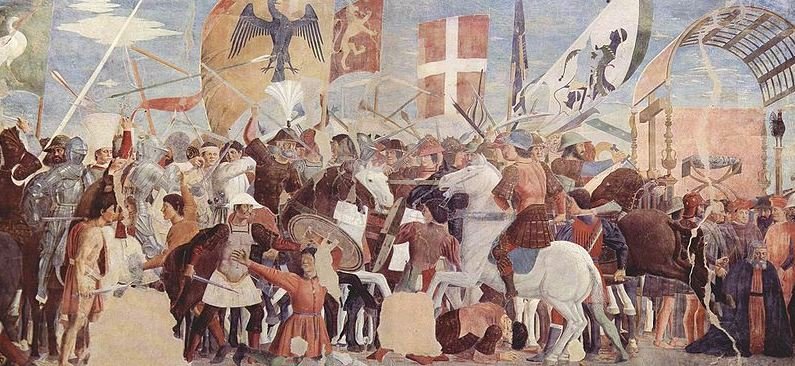
A fresco by Italian painter, Piero della Francesca, created around 1452, depicting the Battle of Nineveh (627) between the forces of Heraclius and the Persian army led by Khosrow II.
Heraclius ascended to the throne during the Byzantine-Sasanian War (602-628), an exhausting conflict initiated by Emperor Phocas’s disastrous policies. The Sasanian Empire, under Khosrow II, had captured significant Byzantine territories, including Mesopotamia, Syria, Palestine, and Egypt.
Initially, Heraclius’s counterattacks failed, and the Persians reached as far as Chalcedon, threatening Constantinople. Facing internal dissent and financial instability, Heraclius considered relocating the capital to Carthage. However, Patriarch Sergius convinced him to remain and resist. Heraclius then implemented crucial military and fiscal reforms, such as reducing non-military expenditures, devaluing currency, and utilizing church wealth to fund the army.
In 622, he launched a counteroffensive, utilizing innovative tactics and alliances. He formed an alliance with the Western Turkic Khaganate, weakening Persian forces in the Caucasus. The tide turned in favor of the Byzantines, and Heraclius won decisive battles in Armenia and Mesopotamia. In 627, his forces achieved a historic victory at the Battle of Nineveh, leading to Khosrow II’s overthrow and execution. The new Persian ruler, Kavad II, sought peace, returning all occupied Byzantine territories. This treaty marked the end of a war that had devastated both empires.
Who were the greatest military generals of the Byzantine Empire?
The Rise of Islam and the Byzantine-Arab Wars
Just as Heraclius secured peace with Persia, a new threat emerged from Arabia. The Rashidun Caliphate, under the leadership of Caliph Abu Bakr and later Caliph Umar, launched an expansionist campaign. In 636, the Muslim army decisively defeated the Byzantines at the Battle of Yarmouk, marking the beginning of Byzantine territorial losses in the Levant. Within a few years, Syria, Mesopotamia, and Egypt fell to the Rashidun forces, permanently altering the empire’s territorial extent.
Heraclius attempted to reorganize defenses, strengthening Anatolia as the core of Byzantine resistance. His reforms, including the thematic system, laid the groundwork for Byzantine military resilience in later centuries. However, his health declined, and he could not mount a successful counteroffensive against the Arabs.
Religious Policies and Monothelitism
Heraclius was deeply involved in religious matters, attempting to reconcile theological disputes between Chalcedonian Christians and Monophysites. He introduced Monothelitism, a doctrine proposing that Christ had a single divine will, hoping it would bridge the gap between the conflicting factions. However, the compromise was rejected by both sides and ultimately condemned as heretical. While his efforts did not resolve religious discord, they underscored his commitment to unity within the empire.
Diplomatic Relations in the Balkans
Beyond military and religious affairs, Heraclius played a key role in the Balkans. He negotiated with Slavic and Avar groups, seeking to stabilize the region. He also initiated diplomatic relations with the Croats and Serbs, influencing their Christianization. His policies helped integrate these groups into the Byzantine sphere, shaping the region’s medieval political landscape.
Legacy and Death
Heraclius died on February 11, 641, after a reign of three decades. His later years were marked by declining health and internal power struggles, particularly involving his second wife and niece, Martina. He attempted to secure succession by appointing both his son Constantine III and his stepson Heraclonas as co-emperors, leading to a period of instability after his death.
His reign transformed the Byzantine Empire. Though he successfully repelled the Persian threat, the subsequent loss of the Levant and Egypt to the Muslims reshaped the empire’s trajectory. His military and administrative reforms influenced Byzantine resilience in the coming centuries, particularly in Anatolia. Moreover, his decision to adopt Greek as the empire’s official language marked a significant cultural shift, further distancing Byzantium from its Roman roots.
Heraclius’s legacy remains a subject of historical debate. While some historians emphasize his military genius and diplomatic acumen, others criticize his later failures and religious policies. Nevertheless, he remains one of Byzantium’s most consequential rulers, guiding the empire through one of its most tumultuous periods.
Frequently Asked Questions
How did Heraclius come to power?
Heraclius and his father launched a rebellion against Phocas in 608, and in 610, Heraclius sailed to Constantinople, overthrew Phocas, and became emperor.

A gold coin depicting Heraclius (left) and Heraclius Constantine, his son.
What was Heraclius’s role in the Byzantine-Sasanian War?
Heraclius led a counteroffensive against the Persian Empire after early Byzantine defeats. He reorganized the military, formed alliances, and achieved a decisive victory at the Battle of Nineveh in 627, leading to Persian withdrawal.
What were the consequences of the Byzantine-Sasanian War?
Although Heraclius successfully restored lost Byzantine territories, both empires were severely weakened, which left them vulnerable to the rapid expansion of the Rashidun Caliphate.
How did the rise of Islam impact Heraclius’s reign?
The Rashidun Caliphate quickly conquered Persia and then advanced into Byzantine territories, defeating Heraclius’s forces at the Battle of Yarmouk in 636 and subsequently taking Syria, Mesopotamia, Armenia, and Egypt.
What military reforms did Heraclius implement?
He reorganized the Byzantine army by strengthening the themes (military districts), improving recruitment, and utilizing religious imagery to boost morale.
What was Heraclius’s religious policy?
He attempted to reconcile Christian theological divisions through Monothelitism, a doctrine proposing Christ had a single divine will, but it was ultimately rejected.
What diplomatic relations did Heraclius establish in the Balkans?
He negotiated with the Croats and Serbs, facilitating their Christianization and integrating them into the Byzantine sphere of influence.
What is Heraclius’s legacy?
Heraclius’s reign was pivotal in shaping the Byzantine Empire’s future. His victories against Persia were undermined by Arab conquests, but his military and administrative reforms helped the empire endure for centuries.
How did Heraclius die?
Heraclius died on February 11, 641, after suffering from prolonged illness. His death led to a power struggle between his wife Martina and his son Constantine III.





