The Dominate, also known as the late Roman Empire, was a despotic form of imperial government that emerged after the earlier Principate. This transition was marked by significant administrative, military, and economic transformations.
The period is often considered to have begun with the reign of Diocletian in AD 284 following the Crisis of the Third Century and is generally regarded as ending in the West with the fall of the Western Roman Empire in AD 476. In the East, its conclusion is debated, with some historians placing it around the transition from the Justinian to the Heraclian dynasties (AD 565–641).
The Dominate represented a shift towards a more authoritarian, bureaucratic, and militarized state structure.
“Lord” or “Master”
The term “Dominate” derives from the Latin dominus, meaning “lord” or “master.” While emperors of the Principate era occasionally used this term, it was generally discouraged as it was associated with servitude.
However, under the rule of Aurelian (AD 270–275), the phrase deus et dominus natus (“born god and master”) began appearing on coinage. This shift became official under Diocletian, who incorporated “dominus” into the imperial titulature as part of his broader governmental reforms.
Transition from the Principate
The Dominate emerged as a response to the instability of the Third Century Crisis (AD 235–284), characterized by military insurrections, frequent usurpations, and external invasions. To address these issues, the new system saw a centralization of power, the exclusion of the senatorial elite from military commands, the establishment of mobile field armies, extensive monetary and taxation reforms, and a restructuring of the empire’s bureaucracy.

Sculpture work depicting the head of Diocletian.
Though Diocletian is often credited with founding the Dominate, many of its foundations were laid by earlier emperors such as Aurelian, Gallienus, and even Trajan. The shift was not immediate; rather, it was a gradual process that continued into the reign of Constantine I (reign: AD 306–337), who refined and solidified the system.
Ultimately, the Dominate was both a response to crisis and a bridge to the post-Roman world.
Characteristics of the Dominate
Multiple Emperors: The Tetrarchy
A key feature of the Dominate was the sharing of imperial authority among multiple rulers. Diocletian established the Tetrarchy, a system with two senior emperors (Augusti) and two junior emperors (Caesares). This division aimed to ensure more effective governance and rapid military response to threats. Though the Tetrarchy collapsed due to internal conflicts, the precedent for shared rule persisted, with later emperors frequently dividing power among co-rulers.
Devaluation of the Consulate
Under the Dominate, the role of consul, once the pinnacle of political office, was significantly reduced. While still an honorific title, the consulate lost its former political significance as the emperor’s authority became more centralized. Senators increasingly found their role confined to ceremonial functions, and the equestrian order (equites) took over many administrative and military responsibilities.

Sculpture work portraying the four Tetrarchs
Transformation of the Senatorial Order
Senators were gradually excluded from key administrative and military roles. By Diocletian’s reign, they were primarily limited to Italy and a few provinces. Constantine I reintroduced a limited senatorial career, but the real power shifted to the imperial bureaucracy. The Senate persisted as an institution, but its influence was overshadowed by the emperor’s direct rule and his appointed officials.
READ MORE: Senate of the Roman Empire
Expansion of Bureaucracy
The Dominate saw an expansion of the imperial bureaucracy, with new administrative offices created to manage the growing complexities of governance. Key officials included:
- Quaestor sacri palatii: Drafted laws and handled imperial petitions.
- Magister officiorum: Oversaw secretarial departments, court ceremonies, and imperial audiences.
- Praepositus sacri cubiculi: Served as the emperor’s chamberlain, wielding significant influence at court.
The bureaucratic class expanded significantly, with thousands of officials managing different aspects of the empire, from tax collection to legal administration.
Military Reforms
The late Roman army was reorganized into two main groups:
- Limitanei: Frontier troops stationed along the empire’s borders.
- Comitatenses: Mobile field armies that could respond rapidly to crises.
Additionally, new high-ranking military commanders (Magistri Militum) were introduced, replacing the previous system where governors commanded legions. These reforms strengthened the military’s ability to defend the empire but also increased its political influence.
The restructuring of the army included:
- A shift from large legions to smaller, more flexible units.
- Increased reliance on cavalry.
- The fortification of key strategic points along the empire’s frontiers.
These changes allowed for a more adaptive defense strategy but also placed a heavier financial burden on the state.
The Dominate represented a critical phase in Roman history, characterized by increased centralization, militarization, and bureaucratization.
Religious Reforms and the Rise of Christianity
The religious landscape of the Roman Empire underwent profound changes under the Dominate. The transition from polytheism to Christianity as the dominant faith was facilitated by emperors such as Constantine I (also known as Constantine the Great) and Theodosius I.
READ MORE: How did Constantine’s vision at Milvian Bridge facilitate the spread of Christianity?
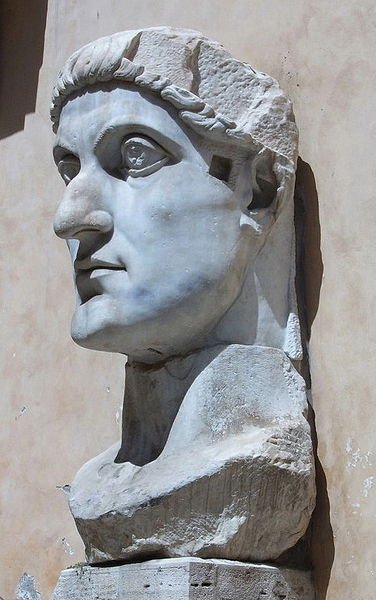
Head of the Colossus of Constantine, Capitoline Museums
Constantine’s Religious Policies
Constantine initially promoted Sol Invictus but gradually aligned with Christianity. His policies included:
- The Edict of Milan (AD 313), which granted religious tolerance to Christians.
- State patronage of Christian churches.
- The integration of Christian symbols into imperial iconography.
Theodosius I and the Christianization of the Empire
Under Theodosius I (AD 379–395), Christianity became the empire’s official religion. Pagan practices were increasingly suppressed, and the imperial bureaucracy became intertwined with the Christian Church. By the late 4th century, the bishoprics and patriarchates mirrored the administrative divisions of the empire.
Why did Roman Emperor Constantine the Great convert to Christianity?
The Decline of Rome as the Imperial Capital
As the empire’s focus shifted to defensive and administrative concerns, Rome itself was no longer a practical capital. Emperors relocated their courts to more strategic cities:
- Diocletian established his capital at Nicomedia.
- Constantine founded Constantinople as the new eastern capital.
- In the West, Mediolanum (Milan) and later Ravenna became the preferred imperial residences.
This shift reflected the changing priorities of the empire, emphasizing military and administrative efficiency over Rome’s traditional prestige.
The Rise of the Coloni and the Origins of Serfdom
One of the most significant socio-economic shifts under the Dominate was the increasing reliance on coloni, tenant farmers bound to the land. Laws issued under Constantine and later emperors restricted their mobility, laying the groundwork for medieval serfdom. This system emerged as landowners sought stability in agricultural production and as tax policies made it beneficial to tie laborers to estates.
Fiscal Reforms and Increased Taxation
Diocletian’s reforms included:
- A new land and population-based tax system.
- The standardization of currency to curb inflation.
- Increased state control over economic production.
While these measures temporarily stabilized the economy, they also placed heavy burdens on the lower classes, leading to social unrest and migration away from overtaxed regions.
Cultural and Stylistic Shifts
The Dominate introduced elaborate court ceremonies that emphasized the emperor’s divine status. Emperors adopted Eastern-style regalia, including jewel-encrusted robes and elaborate crowns. Rituals such as proskynesis (bowing or kneeling before the emperor) became standard, reinforcing the ruler’s elevated status.
As the empire transitioned into the medieval period, many classical institutions declined:
- The Senate lost its practical power.
- Traditional Roman civic life diminished.
- Latin remained the official language, but Greek became increasingly dominant in the East.
These changes marked the gradual transformation of the Roman world into the Byzantine Empire in the East and fragmented successor states in the West.
Timeline of the Dominate (Late Roman Empire)
- AD 284 – Diocletian becomes emperor, initiating the Dominate with increased centralization and bureaucracy.
- AD 293 – Establishment of the Tetrarchy, dividing rule among two Augusti and two Caesars.
- AD 305 – Diocletian and Maximian abdicate; instability follows.
- AD 312 – Constantine defeats Maxentius at the Battle of Milvian Bridge, later promoting Christianity.
- AD 324 – Constantine reunites the empire under one ruler.
- AD 330 – Constantinople becomes the new imperial capital.
- AD 337 – Constantine dies; empire divided among his sons.
- AD 395 – Theodosius I permanently splits the empire between East and West.
- AD 476 – Western Roman Empire falls; Eastern Empire continues.
- AD 565–641 – The Dominate transitions into Byzantine absolutism during the Justinian and Heraclian dynasties.
Frequently Asked Questions
How did the Dominate differ from the Principate?
The Dominate was more openly autocratic, reducing senatorial influence, expanding the imperial bureaucracy, and enforcing a rigid hierarchical structure, whereas the Principate maintained a facade of republican traditions.
What role did Diocletian play in shaping the Dominate?
Diocletian introduced the Tetrarchy, centralized administration, expanded military reforms, and formally adopted the title “dominus,” marking a shift toward absolute rule.
How did the Tetrarchy function?
Diocletian’s Tetrarchy divided the empire among two senior emperors (augusti) and two junior emperors (caesars), each governing a distinct region to improve administration and defense.
What were the key military reforms of the Dominate?
The army was divided into mobile field units (comitatenses) and border troops (limitanei), with separate civil and military leadership to prevent governors from seizing power.
How did the role of the Senate change?
The Senate lost most of its political influence, as imperial administration became dominated by equestrian and bureaucratic officials rather than aristocratic senators.

How did religion change under the Dominate?
Imperial cult practices expanded under Diocletian, but Constantine’s reign saw the gradual Christianization of the empire, culminating in Christianity becoming the state religion under Theodosius I.

A sculpture work depicting the bust of Theodosius I, also known as Theodosius the Great
Why was Rome no longer the imperial capital?
Emperors increasingly resided in strategic cities like Milan, Ravenna, and Constantinople due to military and administrative needs, reducing Rome’s political importance.
Western Historians’ Somewhat Biased Labeling of the Eastern Roman Empire





