Amenemhat I: First Pharaoh of the Twelfth Dynasty of the Middle Kingdom
Amenemhat I, also spelled Amenemhet I, was the inaugural ruler of the Twelfth Dynasty in ancient Egypt’s Middle Kingdom. Rising from non-royal lineage, he established a fresh political order, relocated the capital, and began an era of cultural revival that emulated earlier dynasties.

Relief of Middle Kingdom Pharaoh Amenemhat I from his pyramid complex at El-Lisht
In the article below, World History Edu explores the life and rise to power of ancient Egyptian pharaoh Amenemhat I.
Background and Accession
Prior to claiming the throne, Amenemhat I may have served as vizier under Mentuhotep IV, the last king of the Eleventh Dynasty. Inscriptions from Wadi Hammamat mention a vizier named Amenemhat leading an expedition, which most scholars link to the future king. Although it is sometimes speculated that he toppled Mentuhotep IV or even orchestrated his demise, evidence remains inconclusive.

Amenemhat I was the first pharaoh of the Twelfth Dynasty of Egypt’s Middle Kingdom, likely the same Amenemhat who served as vizier under Mentuhotep IV. Image: Depiction of Mentuhotep IV (right) with the god Min.
There are also suggestions of a possible co-regency where Amenemhat might have governed alongside Mentuhotep IV for a brief time. Regardless of the precise circumstances, Amenemhat ultimately emerged as sole ruler, inaugurating the Twelfth Dynasty around the turn of the second millennium BC.
READ MORE: 10 Most Famous Egyptian Goddesses
Origins and Legitimacy
Amenemhat I was born to parents named Senusret and Nefert, neither of whom belonged to a royal family. His mother’s heritage, mentioned in documents from this period, is often tied to Ta-Seti—an Upper Egyptian nome bordering Nubia.
Many modern scholars argue that Nefert was likely of Nubian origin, indicating a broader cultural background for Amenemhat. To reinforce his legitimacy, he invoked traditions from the Old Kingdom, particularly by reviving the pyramid burial complex and associating himself with literary works such as the Prophecy of Neferti and The Instructions of Amenemhat. These measures aimed to cement his new authority.
Sources and King Lists
Numerous surviving texts and inscriptions attest to Amenemhat I’s reign. He appears in the Karnak King List, occupying the initial entry of its third row. His throne name, Sehetep-ib-Re, is recorded in the Abydos King List as entry fifty-nine.
The Saqqara Tablet also includes him, assigning him a place among the Middle Kingdom monarchs. Meanwhile, the Turin Canon notes a 29-year reign, though partial lacunae obscure complete details.
Outside of Egyptian sources, the later historian Manetho attributes either 16 or 26 years to Amenemhat’s rule, with variations arising in different versions preserved by Josephus, Africanus, Eusebius, and George Syncellus.
Relationship with Mentuhotep IV
Whether Amenemhat I was directly responsible for Mentuhotep IV’s fall remains debated. Some scholars think he may have supplanted his predecessor after serving as vizier; others suggest they shared a short co-regency.
Inscriptions mentioning miraculous events—like a gazelle’s birth on the stone used for Mentuhotep IV’s sarcophagus lid—were interpreted as divine signals favoring the future king. Archaeological clues, including a bowl inscription at El-Lisht bearing both kings’ names, hint at a link between them.
Additionally, texts from Deir el-Bersha point to possible unrest during this transitional period, with at least two other contenders vying for the throne.
Relocation of the Capital and Building Projects
A critical move in Amenemhat I’s program of consolidating power was transferring the capital from Thebes to a new city, Itjtawy. This shift allowed him to centralize administration closer to the Faiyum region, an area with strong agricultural potential.
In architecture, Amenemhat sought to reassert royal authority by reinstating pyramid complexes resembling those of the Old Kingdom. At El-Lisht, he built his own pyramid using a limestone core filled with rubble, an approach that unfortunately led to significant structural deterioration over time.
By relocating the capital to Itjtawy, Amenemhat I created a political and economic hub that anchored the Twelfth Dynasty’s power.
Surviving blocks indicate that stone was repurposed from earlier monuments, aligning with Amenemhat’s vision of linking past and present.
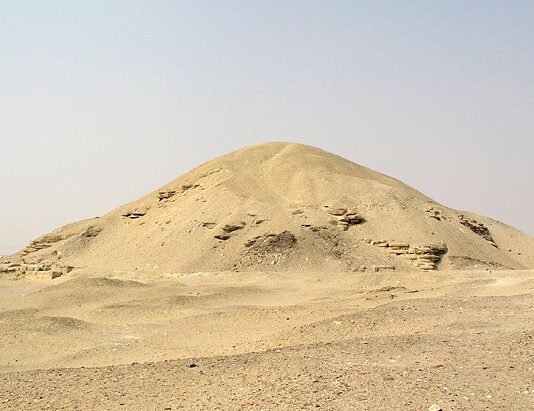
The ruined pyramid of Amenemhat I at Lisht, south of Cairo
The Founding of Cairo and its significance during the medieval era
Family Ties and Royal Offspring
Amenemhat I’s family included his presumed wife, potentially named Neferitatjenen, though the accuracy of this name remains uncertain due to the disappearance of a crucial artifact.
More definitively, his most famous child was his successor, Senusret I, who would become a major force in shaping the Twelfth Dynasty. Textual references also mention three daughters: Neferu III, who married Senusret I; Neferusherit; and Kayet, whose names survive on objects from Amenemhat’s pyramid complex.
The status of his mother Nefert as “king’s mother” was likewise highlighted at his pyramid in El-Lisht, reflecting her elevated position under his reign.

Statue of Senusret I in the Cairo Museum, Egypt
Political Climate and Military Initiatives
Early in Amenemhat I’s rule, tensions appear to have persisted both inside Egypt and along its frontiers. Governors like Nehri and Khnumhotep I recorded episodes of domestic and foreign strife. Naval skirmishes and campaigns were waged against peoples from the eastern deserts and Nubia, as documented by those local authorities.
After proving his loyalty and skill, Khnumhotep I was granted a governorship at Beni Hasan, where his lineage thrived into subsequent generations. By subduing regional powers and organizing administrative roles effectively, Amenemhat I worked to restore centralized control, a hallmark endeavor that shaped the Middle Kingdom’s broader stability.
Assassination and Literary Reflections
Two notable texts depict Amenemhat I’s final moments. In the Instructions of Amenemhat, supposedly delivered posthumously to Senusret I, the king recounts being set upon by his own guards at night.
This treachery took place when Senusret was away leading a campaign in Libya, emphasizing the vulnerability of a monarch without immediate support. The Story of Sinuhe corroborates this event: it describes the palace in mourning after the king’s sudden death and portrays Senusret’s swift, solitary return to stabilize the throne. Both works highlight the precariousness of power during periods of transition, as well as the loyalty demanded of royal protectors.
Co-Regency, Succession, and Legacy
A double-dated stela from Abydos records Year 30 of Amenemhat I and Year 10 of Senusret I concurrently, indicating that Senusret was likely named co-regent in his father’s twentieth regnal year. This arrangement helped ensure a smooth transfer of authority once Amenemhat was assassinated. Officials such as the viziers Ipi and Intefiqer, as well as treasurers Rehuerdjersen and another Ipi, served under his government.
In modern literature, Amenemhat I has been reimagined in works by Egyptian novelist Naguib Mahfouz, particularly “The Return of Sinuhe” and Facing the Throne, which creatively expand on the intrigue surrounding his reign and demise.
READ MORE: 9 Famous Middle Kingdom Pharaohs
Frequently Asked Questions about Pharaoh Amenemhat I
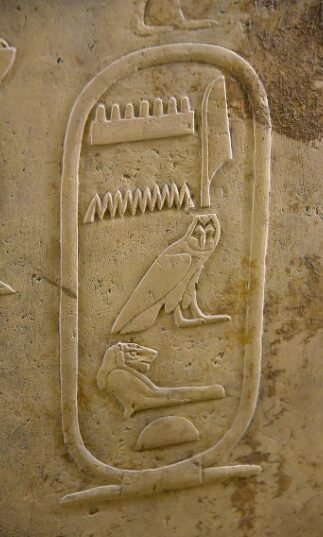
Amenemhat I’s ascent signaled a transformative moment in Egyptian history. Despite his non-royal background, he adopted earlier dynastic customs—returning to pyramid complexes and venerating the Old Kingdom as an idealized past—while simultaneously initiating vital reforms in governance and administrative organization. Image: Cartouche of the birth name, or nomen, of Amenemhat I, detail of a wall-block from Koptos
What is known about his origins?
He did not come from a royal family; his parents, Senusret and Nefert, were possibly linked to the nomarchial family of Elephantine, and his mother is said to have been from Nubia.
Did he overthrow Mentuhotep IV?
It remains uncertain. Some scholars believe Amenemhat I may have seized power, but there’s also evidence of a possible co-regency rather than a forcible overthrow.
Why was the move of the capital significant?
Amenemhat I relocated the capital from Thebes to Itjtawy, reflecting his intention to centralize authority and establish a new royal seat.
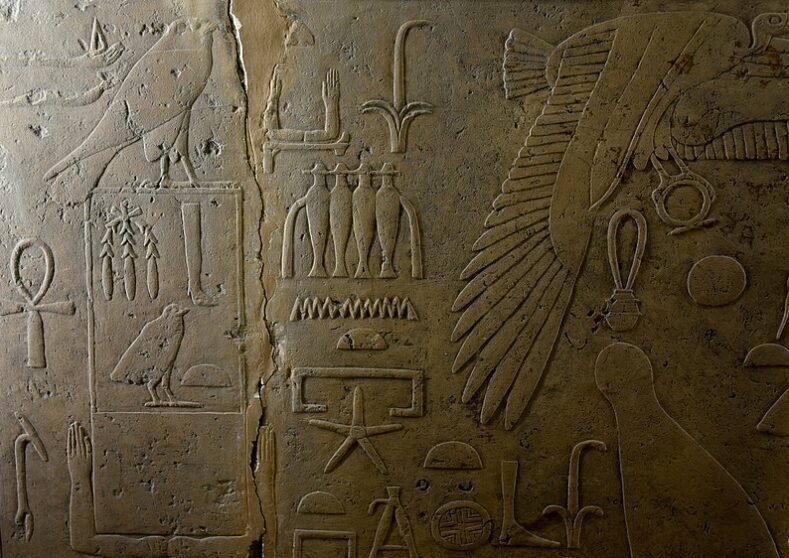
Although he ultimately fell victim to assassination, his strategic choice of co-regency with Senusret I ensured the continuity of his line. These achievements and the literary depictions that followed solidify Amenemhat I’s reputation as the architect of a new Middle Kingdom era. Image: Serekh or Horus name of Amenemhat I, detail of a limestone wall-block from Koptos
What do the “Instructions of Amenemhat” and the “Story of Sinuhe” say about his end?
Both texts suggest he was assassinated, possibly by his own guards, while his son Senusret I was away campaigning.
Where was Amenemhat I buried?
He was buried in a pyramid at el-Lisht, constructed with a core of lower-quality materials and encased in fine limestone blocks.
Who succeeded Amenemhat I?
He was succeeded to the throne by his son Senusret I.
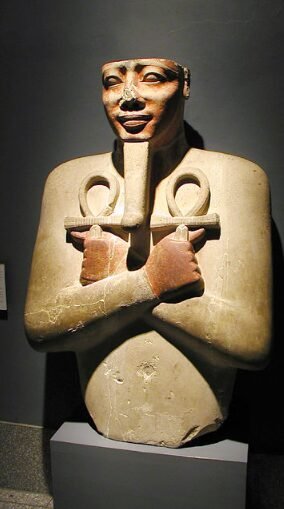
A double-dated stela shows that Senusret I was co-regent starting in Amenemhat I’s twentieth regnal year. Image: Osiride statue of Pharoah Senusret I
How have modern writers adapted his story?
Naguib Mahfouz retold elements of the “Story of Sinuhe” in works such as “The Return of Sinuhe,” adding fictional details like a love-triangle plot involving Amenemhat I.
READ MORE: 10 Major Events in Ancient Egyptian History
FACT CHECK: At World History Edu, we strive for utmost accuracy and objectivity. But if you come across something that doesn’t look right, don’t hesitate to leave a comment below.





