Most Famous Stoic Philosophers of the Ancient World
Stoicism, one of the most enduring schools of philosophy, originated in ancient Greece around the 3rd century BCE. Founded by Zeno of Citium, Stoicism emphasized virtue, wisdom, and the importance of living in harmony with nature’s rational order. It taught that the key to a fulfilling life lay in cultivating self-control, accepting the natural course of events, and focusing on what can be controlled while remaining indifferent to external circumstances.
Stoic philosophy gained prominence through the works of its most famous philosophers, who shaped its development and legacy.
In this detailed discussion, historians at WHE cover the key figures in ancient Stoicism, their contributions, and their influence on later philosophical thought.
Zeno of Citium (c. 334–262 BCE)
Zeno of Citium, the founder of Stoicism, was originally from the city of Citium on the island of Cyprus. After surviving a shipwreck, Zeno arrived in Athens and was introduced to Socratic philosophy. Inspired by the teachings of Socrates and the Cynic philosopher Crates of Thebes, Zeno eventually founded his own philosophical school around 300 BCE.
Zeno’s teachings formed the foundation of Stoicism. His philosophy revolved around the idea that living in accordance with nature and reason was the path to happiness. He argued that the universe was governed by a rational order (logos), and that human beings, as part of this order, should align their will with it. He promoted the virtues of wisdom, courage, justice, and temperance as the highest goods, and claimed that emotional disturbances, like fear or anger, stemmed from false judgments about what is truly valuable.
Zeno’s teachings attracted a significant following, and he taught his students in a public space called the Stoa Poikile (Painted Porch) in Athens, from which the term “Stoicism” is derived. Though most of his original works are lost, his influence is preserved through the writings of later Stoic philosophers.
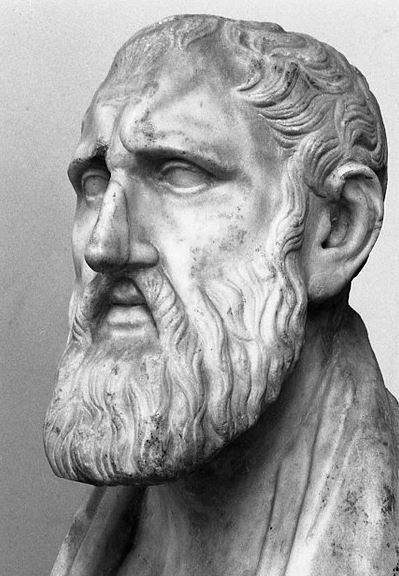
Image: Zeno of Citium
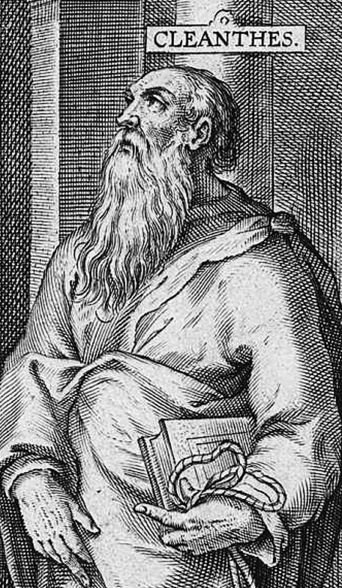
Cleanthes (c. 330–230 BCE)
Cleanthes, a student of Zeno, succeeded him as the second head of the Stoic school. Cleanthes is known for his unwavering dedication to Stoicism, often studying and working in extreme poverty to continue his philosophical pursuits. His most famous work is the Hymn to Zeus, which expresses his belief in the divine rationality governing the universe and reflects the Stoic view that everything is part of a divine plan.
Cleanthes made significant contributions to the metaphysical and theological aspects of Stoicism. He emphasized the role of Zeus as a manifestation of the Stoic concept of the logos, the rational principle that pervades the cosmos. He argued that the universe was a living, divine being, and that humans, as parts of this whole, must accept their place in the grand scheme of things.
Although Cleanthes’ philosophical views were more conservative compared to his successors, he was instrumental in preserving and transmitting Zeno’s ideas. His dedication and leadership solidified the foundation of Stoicism and helped it grow into a major philosophical movement.
Chrysippus (c. 279–206 BCE)
Chrysippus, often considered the second founder of Stoicism, played a critical role in shaping the development of the school. Born in Soli, Cilicia, Chrysippus was initially a student of Cleanthes but quickly surpassed his teacher in terms of intellectual influence. He was a prolific writer, credited with authoring over 700 works, although only fragments of his writings survive today.
Chrysippus systematized and expanded Stoic philosophy, particularly in the areas of logic, ethics, and physics. His contributions to logic were groundbreaking, as he developed a form of propositional logic that influenced later developments in the field. Chrysippus believed that logic was essential for understanding the natural world and for cultivating virtue, as clear thinking led to right action.
In ethics, Chrysippus emphasized the Stoic belief that only virtue is good and that external circumstances, such as wealth or health, are indifferent. He argued that true happiness comes from living in accordance with nature and reason, regardless of external conditions. Chrysippus also advanced Stoic physics, proposing that the universe was cyclical and that all events were determined by fate, though individuals still had moral responsibility for their actions.
Chrysippus’ influence on Stoicism was so profound that it was said, “If there had been no Chrysippus, there would have been no Stoic school.” His efforts to refine and defend Stoicism against critics ensured the survival and continued growth of the philosophy.
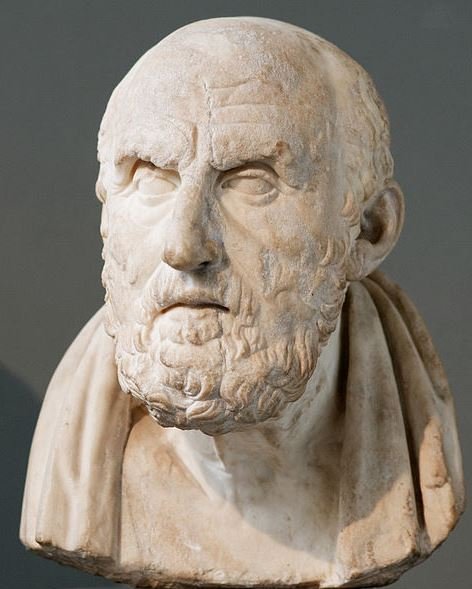
Image: Statue of Chrysippus
Diogenes of Babylon (c. 230–150 BCE)
Diogenes of Babylon, a student of Chrysippus, was one of the most prominent Stoic philosophers of the 2nd century BCE. He is best known for his role in spreading Stoic ideas beyond Greece, particularly through his visit to Rome in 155 BCE as part of an Athenian delegation. This visit had a lasting impact on Roman intellectual circles and contributed to the later adoption of Stoicism by Roman thinkers.
Diogenes’ teachings focused on Stoic logic and ethics, though his specific contributions are less well-documented than those of his predecessors. He was known for his eloquent style and ability to defend Stoic doctrines in public debates. His efforts to popularize Stoicism helped ensure that the philosophy would continue to grow and evolve.
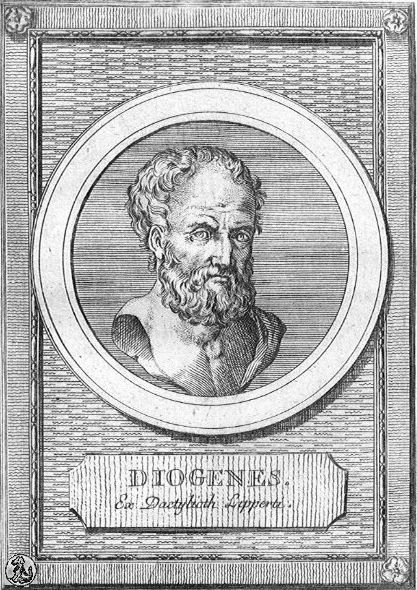
Image: Diogenes of Babylon
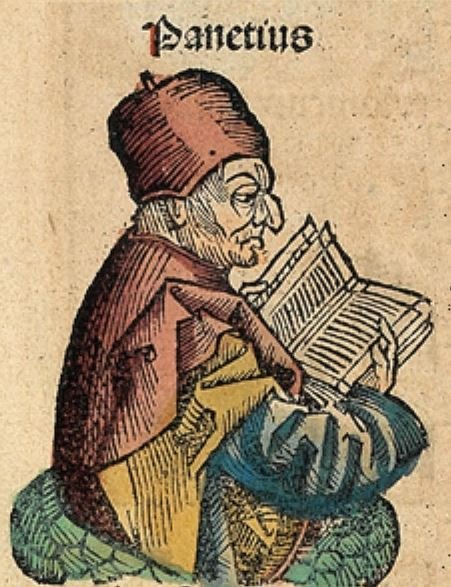
Panaetius of Rhodes (c. 185–109 BCE)
Panaetius was a significant figure in the history of Stoicism, as he was responsible for adapting Stoic ideas to the Roman world. Born in Rhodes, he studied in Athens under Diogenes of Babylon and later moved to Rome, where he became friends with influential Roman leaders such as Scipio Aemilianus. Through his connections with the Roman elite, Panaetius introduced Stoicism to Roman culture and made it more accessible to Roman sensibilities.
Panaetius modified some aspects of traditional Stoicism, particularly its harsh views on emotions and indifference to external goods. He emphasized the importance of practical ethics and the need to balance Stoic ideals with everyday life. His version of Stoicism was more flexible and less rigid than that of earlier Stoics, which made it more appealing to Roman thinkers.
One of Panaetius’ most famous contributions was his influence on Cicero, the Roman statesman and philosopher. Although Panaetius’ works have not survived, his ideas are reflected in Cicero’s writings, particularly in De Officiis, a work that had a profound impact on Western ethical thought. Panaetius’ adaptation of Stoicism laid the groundwork for its flourishing in Roman intellectual circles.
Posidonius (c. 135–51 BCE)
Posidonius was a student of Panaetius and is regarded as one of the most important Stoic philosophers of the late Hellenistic period. Born in Apamea (modern-day Syria), he traveled widely and became known for his vast knowledge of various subjects, including philosophy, astronomy, geography, and history.
Posidonius sought to integrate Stoicism with other schools of thought, such as Platonism and Aristotelianism. He argued that the Stoic concept of the universe as a rational, interconnected whole could be harmonized with the scientific discoveries of his time. Posidonius was also interested in the role of emotions in human behavior, suggesting that emotions were not entirely irrational but could be understood and controlled through philosophy.
His works, though mostly lost, were highly influential in both the Greek and Roman worlds. He had a significant impact on Roman intellectuals, including Cicero and the historian Polybius, and his integration of Stoic philosophy with scientific inquiry helped ensure that Stoicism remained relevant in the changing intellectual landscape of the Roman Empire.

Image: Posidonius
Seneca (c. 4 BCE–65 CE)
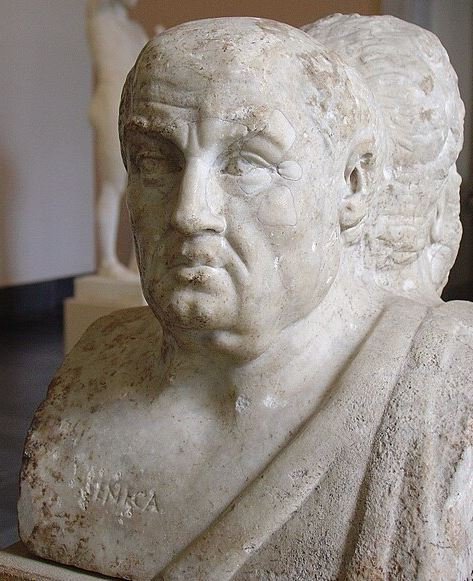
Image: Seneca
Seneca, a Roman Stoic philosopher, statesman, and playwright, is one of the most famous and influential Stoics of antiquity. Born in Spain, Seneca spent much of his life in Rome, where he served as an advisor to the emperor Nero. Despite his political career, Seneca is best known for his philosophical writings, which explore Stoic ethics and the nature of human life.
Seneca’s works, including Letters to Lucilius, On the Shortness of Life, and On Anger, emphasize the importance of self-control, resilience, and rationality. He believed that philosophy should be practical and that Stoic teachings could help individuals navigate the challenges of life. Seneca’s Stoicism was deeply personal, focusing on how to achieve inner peace and moral integrity in a world full of uncertainty and suffering.
Although Seneca’s involvement in Nero’s court led to accusations of hypocrisy—he was extremely wealthy, despite Stoic teachings on material indifference—his writings had a profound influence on later generations. His ideas on the transience of life and the importance of virtuous living have resonated with readers for centuries.

Epictetus (c. 55–135 CE)
Epictetus was born a slave in the Roman Empire and later gained his freedom, becoming one of the most influential Stoic philosophers. Unlike other Stoics who came from wealthy or privileged backgrounds, Epictetus’ experiences as a slave shaped his views on the importance of inner freedom and the need to focus on what is within one’s control.
Epictetus taught that while external circumstances—such as wealth, health, or social status—are beyond our control, our reactions to them are not. He emphasized the Stoic principle of accepting fate and maintaining equanimity in the face of adversity. His teachings were recorded by his student Arrian in the Discourses and Enchiridion, which became highly influential texts in the later Stoic tradition.
Epictetus’ practical approach to Stoicism made his teachings accessible to a broad audience, and his focus on personal responsibility and self-discipline continues to inspire modern readers. His philosophy had a profound impact on later thinkers, including the Roman emperor Marcus Aurelius.
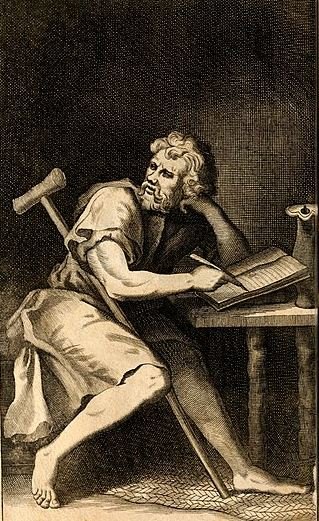
Image: Epictetus
Marcus Aurelius (121–180 CE)
Marcus Aurelius, the Roman emperor from 161 to 180 CE, is perhaps the most famous Stoic philosopher. His work, Meditations, is a series of personal reflections written during his military campaigns and rule as emperor. Despite his position of power, Marcus Aurelius remained deeply committed to Stoic principles, and his writings offer a glimpse into how he applied Stoic teachings to his life and leadership.
In Meditations, Marcus Aurelius reflects on the impermanence of life, the importance of accepting fate, and the need to cultivate inner virtue. He often reminds himself to focus on what is within his control and to remain indifferent to external events. His Stoicism is characterized by a sense of duty, responsibility, and compassion for others.
As both a philosopher and a ruler, Marcus Aurelius embodied the Stoic ideal of the wise and virtuous leader. His writings have been celebrated for their wisdom and humility, and Meditations remains one of the most widely read and revered works of Stoic philosophy.

Image: Marcus Aurelius





