The Green Dome: History and Major Facts
The Green Dome, situated atop the Prophet’s Mosque (Al-Masjid an-Nabawi) in Medina, Saudi Arabia, is a structure of profound historical depth and spiritual significance to Muslims worldwide. Its importance extends well beyond mere aesthetics; the dome directly marks the resting place of the Prophet Muhammad and two of his closest companions, the Rashidun Caliphs Abu Bakr and Umar.
Over centuries, the Green Dome has undergone multiple renovations, color changes, and architectural enhancements. At the same time, it has withstood periods of political upheaval, theological debate, and cultural shifts.
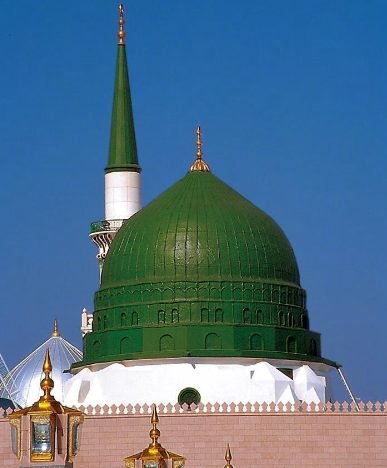
Image: A closer view of the famous Green Dome.
Origins of the Dome
The story of the Green Dome’s existence begins not with a grand monument but with a simple and humble structure. In 1279 C.E. (late 13th century), well over six centuries after the Prophet’s passing, an unadorned wooden canopy was placed above his tomb.
At that time, the mosque complex itself had been expanded several times by various Islamic rulers, incorporating what was once the home of the Prophet’s wife, Aisha. This small wooden cupola was meant primarily to protect and mark the sacred graves beneath it. Initially, it bore no particular color or decorative flourish. Instead, it served as a practical solution, a physical indicator of a site already infused with immense reverence.
The earliest canopy, while modest, laid the foundational concept of a dedicated architectural marker that would eventually evolve into the structure we know today.
Architectural Transformations Over the Centuries
From its simplest beginnings, the structure above the Prophet’s tomb continued to transform as the region’s rulers sponsored renovations and expansions.
Over time, the materials used to construct and maintain this covering shifted from basic wood to more durable substances, such as brick and lead plating.
One of the most defining moments in its architectural evolution came in 1481 when a catastrophic fire ravaged parts of the mosque. This disaster necessitated a comprehensive rebuilding effort.
Under the patronage of Mamluk Sultan Qaitbay, workers replaced much of the original wooden dome with sturdier masonry and introduced lead sheets as protective cladding. These modifications were pragmatic, aimed at preventing future collapses and preserving the integrity of the structure in an environment prone to natural wear, mishaps, and fire hazards.
The Role of Patronage and Different Dynasties
The transformations of the dome did not occur in a cultural vacuum; each ruling dynasty or patron brought their distinct vision, resources, and sensibilities.
Under the Mamluks, the structure underwent significant restorations that reinforced its durability. Later, the Ottomans assumed custodianship of the region, which included the holy cities of Mecca and Medina. The Ottoman era, known for its remarkable architectural patronage, saw the dome refined even further.
In 1818, during the reign of Ottoman Sultan Mahmud II, another major reconstruction led to the creation of the dome as we largely know it today. The cumulative efforts of these various patrons reflect a deep-seated desire to honor the sanctity of the site while also asserting a certain cultural and political identity.
Coloring the Dome and the Emergence of the Iconic Green Shade
While the dome initially bore no distinct hue, its color palette evolved over time, mirroring the cultural tastes and artistic trends of successive periods. Before adopting its current green shade, the dome was reportedly painted in various colors, including white, blue, and even silver. These changes were often part of broader restoration projects that addressed structural concerns as well as aesthetic preferences.
In 1837, the dome received the green paint that would forever define its image in the collective Muslim imagination. This particular color choice quickly became synonymous with the Prophet’s Mosque and resonated with visitors, many of whom found the green dome a comforting, recognizable landmark.
Over the ensuing decades, the vibrant green hue became an enduring symbol—an instantly identifiable beacon that draws millions of faithful each year.
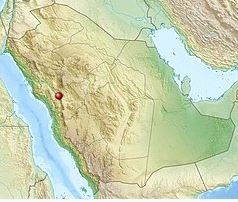
Image: A map showing the exact location (in red) of the Green Dome in Saudi Arabia.
Spiritual and Religious Significance
The Green Dome’s importance is not limited to history or architecture; it also resonates deeply on a spiritual level. The Prophet Muhammad is considered the final messenger of Islam, and the two Rashidun Caliphs buried beside him are among the most revered figures in Islamic history. Their leadership, wisdom, and service to the early Muslim community are legendary.
For pilgrims visiting Medina, seeing the Green Dome often evokes feelings of gratitude, reverence, and a tangible sense of connection to these pivotal personalities. Many Muslims make it a point to visit Medina either before or after their pilgrimage to Mecca, recognizing that standing within sight of the dome provides a unique spiritual encounter.
Although the actual graves are not visible—shielded behind barriers, screens, and curtains—just being near the resting place of these figures can be a profoundly moving experience. The dome, therefore, serves as both a physical and symbolic gateway to sacred memory, a reminder of Islam’s foundational era and the human beings who helped shape its trajectory.
Wahhabi Influence and the Preservation of the Dome
The Green Dome’s endurance through shifting religious interpretations and political changes is notable. In the early 19th century, when Wahhabi forces took control of Medina, a wave of strict reformist ideology discouraged veneration of any structure deemed conducive to grave worship.
Many domes and tombs were demolished, as they were interpreted as potentially leading believers astray from the fundamental oneness of God. The Green Dome, however, survived this period of iconoclasm. Various explanations have been offered—some suggest the dome’s fortified construction made it difficult to demolish, while others believe that the authorities deliberately chose to preserve it out of respect or strategic considerations.
Regardless of the precise reason, the dome remained standing, a rare survivor in an era that saw many such monuments reduced to rubble. Later, when Saudi authorities consolidated their control in the early 20th century, they maintained policies restricting grave worship yet did not remove the dome.
Access Restrictions, Enclosures, and Symbolism
From the earliest expansions of the Prophet’s Mosque, the immediate area of the graves was carefully protected and enclosed. Over time, various physical barriers were introduced to prevent direct access to the tombs.
By employing decorative screens, protective curtains, and limited viewing angles, the mosque’s caretakers ensured that the site remained a place of reverent reflection rather than an object of inappropriate veneration.
At one point, a pentagonal enclosure was constructed around the grave area. This unusual geometric choice was deliberate: it prevented anyone from mistaking the gravesite for a structure akin to the Kaaba or attempting any form of circumambulation that might mimic rituals reserved exclusively for Mecca’s holiest sanctuary.
Today, the Green Dome can be viewed from various parts of the mosque and its courtyards, serving as a reminder of the sacred history embedded within the building’s fabric. Although visitors cannot see the actual resting places of Muhammad, Abu Bakr, and Umar, the very presence of the dome signals their proximity. Millions of worshippers pass beneath its shade each year, offering prayers of peace and blessings upon the Prophet and his companions. The dome’s function as both a symbol of continuity and a witness to centuries of change underscores the multifaceted role it plays in the Islamic world.
Rashidun Caliphate and the First Four Muslim Caliphs of the Islamic World
Frequently Asked Questions
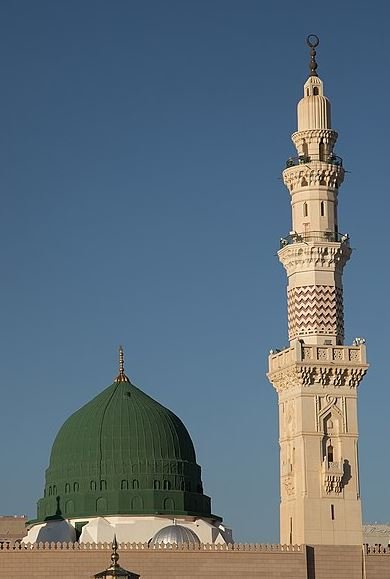
What does the Green Dome mark?
It marks the resting place of the Prophet Muhammad and the first two Rashidun Caliphs, Abu Bakr and Umar.
Where is the Green Dome located?
It is situated at the southeastern corner of the Prophet’s Mosque (Al-Masjid an-Nabawi) in Medina, Saudi Arabia.
What was the original form of the dome’s structure?
Initially, it was a simple, unpainted wooden canopy placed over the graves in 1279 C.E.
How did the color of the dome evolve over time?
It changed from unpainted to various colors including white, blue, and silver before finally being painted green in 1837.
When did the dome acquire its well-known green shade?
The dome was first painted green in 1837, giving it the iconic appearance it has today.
What significant restoration took place after a fire in 1481?
Following the fire, the structure was rebuilt with more durable materials, including brick and lead plating, to prevent future collapse.
What happened under Wahhabi control in the early 19th century?
Many tombs and domes were demolished to prevent grave veneration, but the Green Dome survived—either due to its sturdy construction or a conscious decision not to destroy it.
What measures ensure that the actual graves are not directly visible?
The graves are shielded by protective barriers, screens, and curtains, keeping them respectfully out of public view.
Who are buried beneath the Green Dome?
The Prophet Muhammad, along with Abu Bakr and Umar, is buried beneath the dome.
Why was the tomb enclosure designed as an irregular pentagon?
The five-sided shape was chosen to discourage any ritual circling (tawaf) around it, a practice reserved for the Kaaba.





