The Individuals behind Greek Vase Painting and Pottery
Greek vase painters and potters were crucial to the development of ancient Greek art and culture, blending artistry and craftsmanship in ways that would influence future generations of artists. Their works, particularly from the Geometric, Archaic, and Classical periods, were not only utilitarian but also deeply symbolic, reflecting the myths, religious practices, social customs, and daily life of the ancient Greeks.
Historical Overview of Greek Pottery
Greek pottery dates back to around 1000 BCE and spans several distinct periods. Each period saw different styles and techniques emerge, corresponding to broader cultural and artistic trends. Greek vase painters and potters developed their craft over centuries, culminating in works that were widely admired across the Mediterranean and later emulated by Roman artists.
The Geometric Period (900–700 BCE)
This era marks the beginning of Greek pottery as a major art form. Early pottery was characterized by its simplicity and decorative patterns. These vases often had geometric motifs, such as spirals, meanders, and zigzags, hence the name of the period. Figures were rare in the early Geometric period, but by the late Geometric period, human and animal figures became more common, albeit still stylized.
One of the significant features of this period was the use of large funerary vases, often used as grave markers. These vases were decorated with scenes of funerary processions, battles, and other life events, rendered in the geometric style. One of the most famous examples is the Dipylon Vase, a large funerary amphora with intricate geometric patterns and figural depictions of mourning and burial scenes.
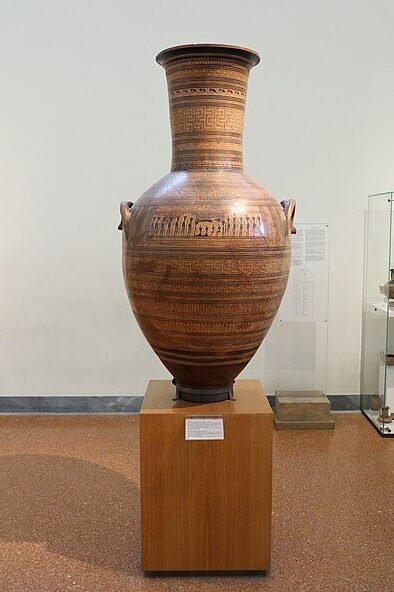
Image: Dipylon Vase
The Orientalizing Period (700–600 BCE)
During the Orientalizing period, Greek vase painters began incorporating influences from the Near East and Egypt. This period was marked by the use of more curvilinear designs, including lotus flowers, palmettes, and mythological creatures such as griffins and sphinxes. The addition of animal and floral motifs into vase decoration was a direct result of increased contact between Greece and its Eastern neighbors through trade.
This period also saw the rise of black-figure pottery, which would dominate the Greek ceramic industry in the centuries to come. In black-figure technique, artists painted figures in a slip that turned black during firing, while the background of the vase remained the natural color of the clay.
The Archaic Period (600–480 BCE)
The Archaic period witnessed the flourishing of black-figure pottery. This technique involved painting figures and scenes on the vase using a black slip. Once the vase was fired, the figures appeared in stark contrast to the red clay background. Painters like Exekias and the Amasis Painter became known for their detailed depictions of mythological scenes, athletic competitions, and daily life. These vases often depicted gods, heroes, and warriors in great detail, with their postures and expressions reflecting the drama of the moment.
Exekias, one of the most famous vase painters and potters from this period, was known for his portrayal of scenes from Greek mythology. His most famous work is the Dionysus in a Boat kylix, which shows the god Dionysus reclining in a boat surrounded by dolphins, executed with remarkable finesse.
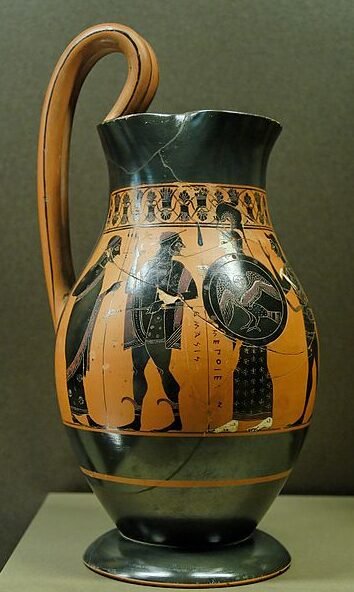
Heracles entering Mount Olympus by Amasis Painter
The Classical Period (480–323 BCE)
The Classical period marked a shift in Greek pottery towards the red-figure technique, where the background was painted black, and the figures were left in the natural red color of the clay. This technique allowed for greater detail and more realistic depictions of the human form. Red-figure pottery dominated from the late Archaic into the Classical period, offering painters more flexibility and subtlety in their designs.
One of the masters of red-figure pottery was the Berlin Painter, who was known for his elegant, elongated figures and simple compositions. Unlike the crowded scenes of earlier periods, his vases often depicted a single figure, or a few figures, against a black background, which emphasized the grace and poise of the human body.
Another significant artist from this period was the Niobid Painter, whose work is distinguished by its complexity and experimentation with spatial depth. His famous Niobid Krater shows the massacre of the children of Niobe by Apollo and Artemis, with figures arranged on different levels, giving the scene a sense of three-dimensional space.
The Hellenistic Period (323–31 BCE)
In the Hellenistic period, the focus of Greek art shifted from pottery to other forms of art, like sculpture and mosaics, as Greek society evolved under the influence of Alexander the Great’s conquests. Although vase painting declined in importance, some fine examples continued to be produced, often with more elaborate and theatrical scenes reflecting the changing tastes of the time. Pottery from Southern Italy, for example, became more colorful and elaborate, often featuring mythological scenes with heightened emotion.
Techniques and Styles
Greek vase painting evolved through several distinct styles, each with its own methods and decorative motifs. Two of the most famous techniques were black-figure and red-figure painting, though other techniques, such as white-ground and polychrome, also played important roles in the development of Greek pottery.
Black-Figure Technique
Developed in Corinth in the 7th century BCE, black-figure pottery involved applying a slip to the surface of the vase, which would turn black during the firing process. Artists would scratch into the slip to create details, and after firing, the figures remained black against the red clay background. This technique was especially suited to depicting strong, bold figures and scenes from mythology.
Black-figure pottery was often used for large vessels, such as amphorae, kraters, and hydriai. Artists like Exekias and the Amasis Painter were masters of this technique, excelling in the portrayal of dynamic mythological narratives.

Death of Penthesileia by Exekias
Red-Figure Technique
Introduced around 530 BCE, the red-figure technique gradually replaced black-figure pottery. In red-figure pottery, the roles were reversed: the background was painted black, while the figures were left in the natural red color of the clay. This technique allowed for more detailed and realistic depictions of the human body, as painters could use fine brushes to add details, rather than relying on incised lines.
Red-figure pottery gave artists more flexibility to create intricate scenes with greater movement and anatomical accuracy. The technique was particularly well-suited to portraying human emotion and naturalism, as seen in the work of artists like the Berlin Painter and the Kleophrades Painter.
White-Ground Technique
White-ground pottery was a less common but highly prized technique that involved covering the entire vase in a light-colored slip, usually white or cream, and then painting figures in a variety of colors. The technique was used primarily for funerary vases, as the delicate surface was not well-suited to everyday use. The Achilles Painter was one of the most famous practitioners of this technique.
Polychrome and Other Techniques
Later in the Hellenistic period, potters began experimenting with the use of color. Polychrome pottery, which employed a range of colors beyond the traditional black and red, became more popular. The use of added color on white-ground vases also allowed for greater experimentation in shading and realism.
Vase Shapes and Functions
Greek pottery came in a variety of shapes and sizes, each designed for specific purposes. Some of the most common types of Greek vases include:
- Amphora: A two-handled jar used for storing wine, oil, or grain. Amphorae were also used as grave markers and for prize vessels in athletic competitions.
- Krater: A large bowl used for mixing water and wine during symposia (drinking parties). Kraters often had wide mouths and were richly decorated with scenes of mythology or daily life.
- Kylix: A shallow drinking cup with a wide mouth and a pair of horizontal handles. The inside of the kylix was often painted with humorous or mythological scenes, designed to be revealed as the drinker finished their wine.
- Hydria: A three-handled water jar, used primarily for carrying and storing water. Hydriae were often decorated with scenes of women at the fountain or other domestic activities.
- Lekythos: A tall, narrow vase used to hold oil, particularly for funerary purposes. Lekythoi were often painted in the white-ground technique and depicted scenes of mourning or offerings to the dead.
Cultural Significance and Legacy
Greek vases played a significant role in ancient Greek culture, both as utilitarian objects and as vehicles for storytelling. They were used in daily life for storing and serving food and drink, but they were also highly prized as grave goods and offerings to the gods. The scenes painted on these vases give us a window into ancient Greek life, showing everything from religious rituals and athletic contests to domestic scenes and mythological battles.
Vase painters often signed their works, either as the potter or the painter, indicating a sense of pride and artistry in their craft. Some of the most famous names associated with Greek pottery include:
- Exekias: A master of black-figure pottery, known for his detailed and dramatic scenes from Greek mythology.
- The Berlin Painter: A prominent red-figure painter, celebrated for his elegant and minimalistic compositions.
- The Achilles Painter: Known for his work in both the red-figure and white-ground techniques, particularly his delicate and expressive funerary vases.
Frequently asked questions
Today, Greek vases are valued both for their beauty and as historical documents, offering insights into the daily lives, beliefs, and artistic achievements of the ancient Greeks. Many of these works are housed in museums around the world, where they continue to inspire and educate.
How do we know the names of some ancient Greek potters and painters?
Some ancient Greek potters and painters signed their work. Painters typically signed their name followed by a form of the verb “painted,” while potters (or possibly the painter writing for them) used the word “made.”
Some individuals, like Exekias and Epiktetos, both created the pottery and painted it, signing their names for both roles.
Were potters and painters always the same person?
No, potters and painters were sometimes different individuals, and one or both might sign the vase.
Also, not all craftsmen signed their work. Some artists never signed their vases, or perhaps the signed pieces did not survive.
Even for unsigned vases, experts can often identify the artist by closely examining the style and details. This method was pioneered in the 20th century by Sir John Davidson Beazley for Athenian black- and red-figure vases.
Similarly, scholars like Professor A.D. Trendall developed similar methods for identifying painters of South Italian red-figure pottery.

Sir John Davidson Beazley is credited with pioneering a system for identifying both named and anonymous painters of Athenian black- and red-figure vases through careful examination of their styles. Image John Beazley in 1956.
How were anonymous painters given names?
Modern scholars tend to assign nicknames to anonymous painters. These names are often based on various factors, such as the potter they worked with, the location where a key vase was found, the subject of a vase, or specific characteristics in the painter’s style.
For example, the Brygos Painter and the Sotades Painter were named after the potters they likely collaborated with.
Also, painters like the Lipari Painter and the Berlin Painter were named after the location where a key vase was found or where it is now located.
In some cases, painters were named after former or current owners of key vases, such as the Burgon Painter.
There are also some painters who were named after the subjects depicted on significant vases, such as the Siren and Cyclops Painters.





